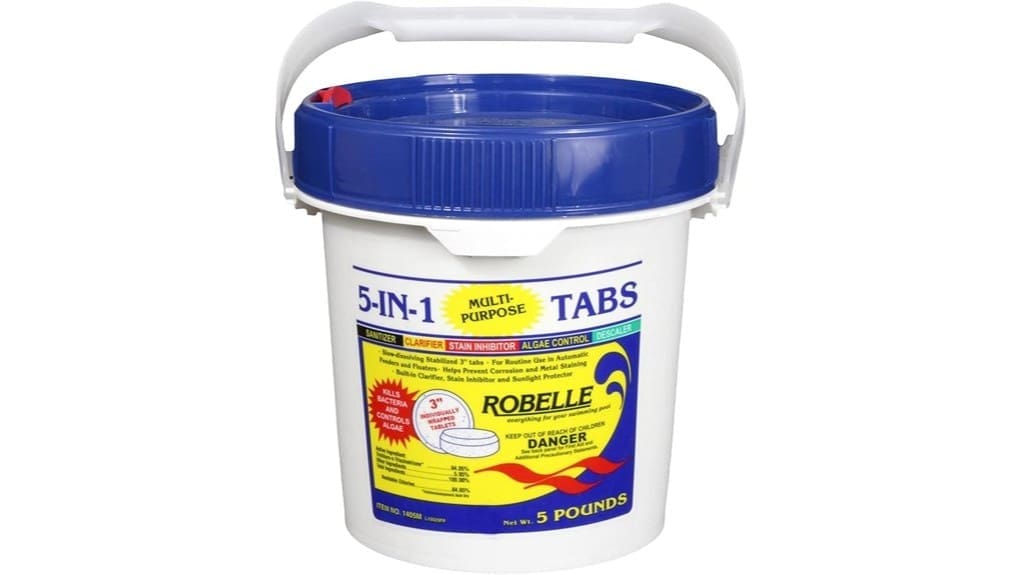
You’ll find Robelle’s 5‑Pound Premium 5‑In‑1 tabs give you steady, low‑maintenance chlorination with three slow‑dissolving 8‑oz tablets per pack. Each tablet’s high trichloro content delivers continuous sanitizer, clarifier, and anti‑algae action while individual wraps limit moisture and handling risk. They’re great for travelers or budget‑minded owners but can raise cyanuric acid and don’t control pH. Use a proper floater/feeder and monitor residuals; keep going for practical dosing and maintenance tips.
Some Key Takeaways
- Ten individually wrapped 8‑oz slow‑dissolving tablets deliver steady chlorine for up to about 5 pounds total.
- Tablets contain ~94.05% trichloro‑s‑triazinetrione (~84.65% available chlorine) for continuous sanitization.
- Suggested start dose: roughly 2 tablets per 10,000 gallons in a compatible floater or automatic feeder.
- Pros: low‑maintenance steady chlorination and compact, contamination‑reducing individual wraps; watch CYA buildup.
- Monitor free chlorine, pH 7.4–7.6, and alkalinity 80–130 ppm; adjust dosing for temperature and bather load.
Robelle 5-Pounds Premium 5-In-1 Tabs at a Glance: What’s in the Container
Inside the 5-pound container you’ll find ten individually wrapped 8-ounce slow-dissolving tablets of Robelle’s Premium 5-in-1 formula, each made with 94.05% Trichloro-S-Triazinetrione (about 84.65% available chlorine). You’ll note compact packaging design that groups tablets securely, reducing moisture exposure and simplifying storage. The individual wraps improve handling safety by limiting direct contact and contamination; they also let you load feeders or floaters without touching tablets. Labeling is straightforward, listing active content and basic dosing. Overall, the container balances protection and convenience, supplying a predictable, user-friendly package for routine pool maintenance. These tablets are designed for homeowners who want to keep their pool sparkling and maintain safe chlorine levels for outdoor enjoyment.
How the 3 Slow-Dissolving Chlorine Tablets Work in Your Pool
When you place a 3-inch Robelle slow-dissolving tablet in a floater or feeder, it releases stabilized chlorine steadily into the circulation so you get continuous sanitization without large daily swings in chlorine levels. You’ll observe predictable slow release chemistry: the trichloro-s-triazinetrione core maintains available chlorine while secondary ingredients provide clarifying, anti-algae, stain-inhibiting, and descaling actions. Tablet dissolution rate responds to flow, temperature, and surface area, so performance is steady but not instantaneous. This design reduces dosing frequency and chemical stacking, yet you should monitor residuals. Overall, the tablets deliver reliable, extended sanitization with multipurpose benefits in routine pool maintenance. Proper shocking and periodic monitoring help keep pools safe and clear, particularly when managing shock treatment after heavy use or storms.
Dosing, Feeders, and Water Targets: Using Robelle Tabs Safely
Because maintaining consistent sanitizer levels matters, you should place Robelle 3-inch tablets in a compatible floater or automatic feeder and follow the dosing guideline of about 2 tablets per 10,000 gallons as a starting point. You’ll check feeder placement to guarantee steady dissolution and avoid tablets sitting in low-flow pockets. Monitor free chlorine and adjust dosage toward target ranges while keeping pH 7.4–7.6 and alkalinity 80–130 ppm. Stagger additions after heavy use to reduce chlorine burnout and short spikes. Use test strips or a meter weekly; recalibrate dosing when levels drift or when temperature and bather load change. For convenient monitoring, consider using digital testers to track sanitizer and pH levels more accurately.
Real-World Performance: Sanitizing, Algae Control, and Stain Prevention
After you’ve set up feeders and dialed in dosing, you’ll judge Robelle’s real-world effectiveness by how consistently it keeps free chlorine in range, prevents algae blooms, and limits metal stains. You’ll find sanitizing reliable for routine maintenance: tablets sustain residual chlorine without frequent shock treatment unless heavy bather load or rain dilutes levels. Algae control is strong when feeders are properly sized; occasional manual brushing may still be needed for shady areas. Stain prevention works against common metals, though in high-iron or copper cases you’ll monitor for residue buildup and supplement with a targeted sequestering product if stains appear. For long-term pool health, don’t forget to keep calcium hardness balanced with calcium boosters to protect plaster and equipment.
Pros, Cons, and Who Should Buy Robelle 5-Pounds Premium Tabs
While no single tablet suits every pool, Robelle’s 5-in-1 tabs deliver a clear set of advantages you’ll appreciate: they maintain steady chlorination, cut down on extra chemicals, and simplify handling with individually wrapped slow-dissolving tablets that fit feeders and floaters. You’ll like consistent sanitizing, reduced dosing steps, and easy storage. Downsides include high chlorine concentration that can raise cyanuric acid and limited pH control, so you’ll still monitor chemistry. Buy if you’re a budget buyer wanting low-maintenance treatment or a frequent traveler needing reliable, slow-release protection. Don’t buy if you need precise, multi-chemical conditioning. These tablets are especially useful for homeowners who want to enjoy their outdoor spaces without daily maintenance.
Some Questions Answered
Are These Tablets Safe for Vinyl or Fiberglass Pool Liners?
Yes — you can use them, but you should monitor conditions closely. Their slow‑dissolving chlorine suits vinyl and fiberglass when you keep pH (7.4–7.6) and alkalinity stable. If you neglect balance or overfeed, you risk vinyl discoloration and liner degradation from high chlorine or acidic drift. Use an automatic feeder or floater as directed, test weekly, and adjust dosing to prevent damage and prolong liner life.
Can I Use Robelle Tabs With a Saltwater Chlorine Generator?
You shouldn’t use Robelle tabs as your primary sanitizer with a saltwater chlorine generator; they’ll add stabilized chlorine that can raise combined chlorine and cyanuric acid. You can use them sparingly for shock or algae control, but monitor saltwater compatibility and adjust generator settings. Maintain regular generator maintenance, test free chlorine and CYA frequently, and avoid routine overlap to prevent scale, reduced efficiency, and sensor fouling.
Do the Tablets Contain Stabilizer (Cyanuric Acid)?
Yes — the tablets include stabilizer (cyanuric acid). You’ll see cyanuric effects over time as the slow-dissolving tablets release CYA, which helps stabilization needs by protecting chlorine from UV degradation. That means you’ll get sustained sanitizer persistence, but you’ll need to monitor CYA to avoid buildup. Test regularly and adjust dosing or dilution if CYA climbs above recommended levels for your pool or saltwater chlorinator.
How Should I Store Partially Used Wrapped Tablets?
Store partially used wrapped tablets in a resealable container placed in cool storage away from heat, flames, moisture, and direct sunlight. Keep them in their individual wrappers, upright if possible, and separate from incompatible chemicals (acids, metals, organics). Label the container with contents and date. Check wrappers for damage before use; discard any compromised tablets. You’ll reduce degradation, moisture exposure, and safety risks by following these precautions.
Are These Tablets Safe to Handle Without Gloves or Goggles?
You shouldn’t handle them bare-handed or without eye protection. They can cause skin irritation and eye damage if dust or dissolved residue contacts you, so use protective measures: wear chemical-resistant gloves and goggles, avoid inhaling dust, and wash any exposed skin promptly. If a tablet crumbles, clean up with a dry scoop and rinse tools; store wrapped tablets sealed. Follow label directions and keep children and pets away.