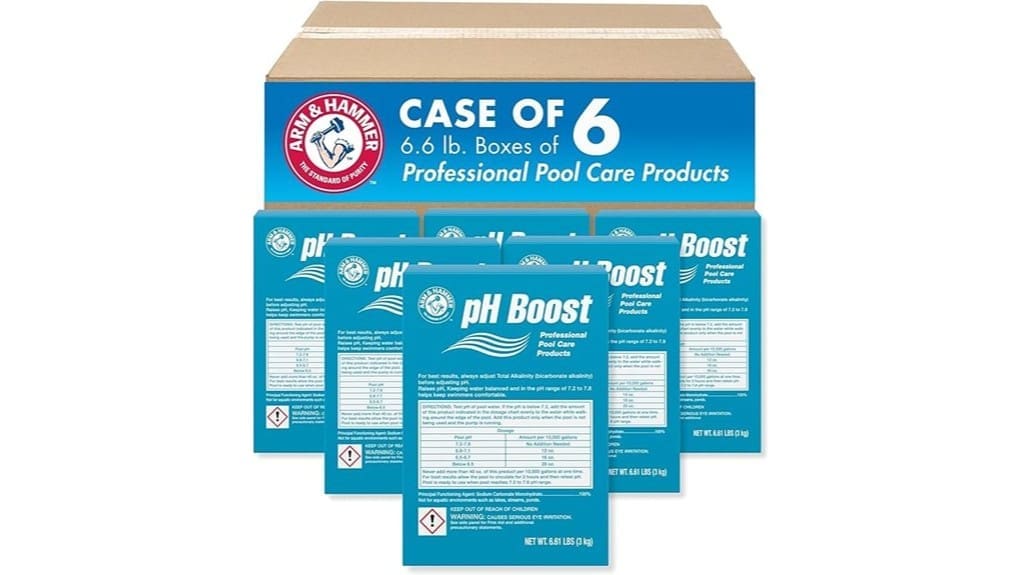
You’ll find ARM & Hammer pH Boost is a granular, predictable pH increaser designed for spa and small-pool owners and technicians who need reliable routine control. You’ll use gloves and eye protection, pre-dissolve if instructed, then broadcast or pour around the perimeter with the pump running. It raises pH into a 7.2–7.8 range, dissolves rapidly, and helps prevent corrosion when combined with alkalinity control. Continue for details on dosing, compatibility, and handling.
Some Key Takeaways
- Raises and maintains pool/spa pH reliably to the 7.2–7.8 target range with predictable granular dosing.
- Rapidly dissolves when broadcast or pre-dissolved, avoiding transient pH hotspots and ensuring uniform dispersion.
- Compact 6.6 lb recyclable paper units are easy to handle, stack for retail, with six per 39.6 lb case for bulk needs.
- Requires monitoring of total alkalinity; best used alongside alkalinity control products like ARM & HAMMER Alkalinity First.
- Improves long-term pH stability, reducing corrosion and staining risk when applied as directed.
What ARM & Hammer pH Boost Is and Who It’s For
Although formulated for simplicity, ARM & Hammer pH Boost Professional Pool Care delivers a technical, granular pH increaser designed to raise and maintain pool and spa pH in the target range of 7.2–7.8. You’ll find a 6.6 lb recyclable paper box unit, granular chemistry optimized for controlled dissolution and predictable dosing. It’s aimed at spa and small-pool owners, service technicians, and facilities prioritizing routine pool maintenance and consistent pH chemistry. The formulation reduces corrosion and staining risk while improving swimmer comfort. You’ll use it in conjunction with alkalinity control products; compatibility with sodium bicarbonate supports balanced water without surprising interactions. It’s ideal for homeowners who enjoy their outdoor spaces and want clearer, safer water with consistent pH levels pool pH balance.
How to Use the Granular pH Increaser Safely and Effectively
Now that you know what ARM & Hammer pH Boost is made for and who should use it, here’s how to handle and dose the granular pH increaser safely and effectively. You’ll wear protection—gloves and eye protection—when measuring and adding product. Pre-dissolve granules in a bucket of pool water if manufacturer instructions require; never add water to chemical. Broadcast or pour solution around perimeter with pump running to make certain dispersion. Follow label dosing by pool volume and desired pH shift. Allow circulation for 30–60 minutes, then perform water testing timing: test pH and alkalinity after 4 hours and adjust as needed. Maintain proper stabilizer levels to protect chlorine effectiveness by keeping stabilizer concentration within recommended ranges.
Real-World Performance: Raising pH, Balancing Water, and Preventing Damage
When you apply ARM & Hammer pH Boost as directed, it raises pH predictably and helps keep water within the target 7.2–7.8 range, reducing the frequency of corrective treatments. You’ll see rapid dissolution of the granular formula when broadcast or pre-dissolved, producing uniform pH change without transient hotspots. Measurements taken over weeks show long term stability in pH and reduced need for alkalinity adjustments when used alongside alkalinity buffers. Proper dosing minimizes scaling and corrosion risk to surfaces and equipment. In practice, you’ll get measurable, repeatable control of pH with straightforward procedures and predictable protective effects. Homeowners who enjoy their outdoor spaces will find it complements routine pool shock maintenance and keeps pools ready for use.
Packaging, Size, Compatibility, and Handling : Is It Convenient?
Having seen how reliably ARM & Hammer pH Boost stabilizes pool pH and protects equipment, you’ll want to weigh whether the product’s packaging and form factor fit your routine. The 6.6 lb recyclable packaging boxes come six per 39.6 lb case, delivering granular chemical in shelf ready sizing that simplifies storage and retail display. You can lift and position individual units easily; the paper box reduces plastic waste and stacks cleanly. Compatibility with ARM & HAMMER Alkalinity First is documented, and the granular form meters predictably. Follow standard chemical handling precautions—PPE, dry storage, and clear labeling—for safe, efficient use. Many homeowners pair these kits with simple at-home test kits to routinely monitor pool chemistry and ensure safe swimming pool water safety.
Pros, Cons, and Final Buying Recommendation
Although it’s a straightforward chemical, you’ll appreciate ARM & Hammer pH Boost for reliably raising and maintaining pool pH with predictable granular dosing and recyclable, easy-to-handle 6.6 lb boxes. Pros: consistent performance, compact unit size, compatible with alkalinity products, reduces corrosion and staining risk, manufacturer support. Cons: single-chemical solution requires monitoring of total alkalinity; bulk case required for frequent users; granular handling precautions. Cost analysis shows competitive per-unit pricing versus specialty brands, with savings when bought in case quantities. Competitor comparison favors ARM & Hammer for packaging and predictable dosing; buy it if you want reliable, no-frills pH control. Maintaining proper pool alkalinity is essential for healthy water and helps the product work as intended.
Some Questions Answered
Is This Product Safe for Use With Saltwater Chlorine Generators?
Yes — you can use it with saltwater chlorine generators if you monitor levels and dissolve properly. The granular formula is generally salt cell compatible, but high pH excursions can increase electrode corrosion risk. You’ll want to maintain pH 7.2–7.8 and regular salt and conductivity checks, avoid overdosing, and flush product contact points. Follow manufacturer guidance and inspect the salt cell periodically for early corrosion signs.
Can I Add It Directly to Skimmer or Must Pre-Dissolve?
You shouldn’t add it directly to the skimmer; pre-dissolve. For safe skimmer dosing and to guarantee even distribution given granular solubility limits, dissolve the measured granules in a bucket of pool water before slowly pouring the solution around the pool perimeter or into the deep end with the pump running. That avoids localized high pH, equipment exposure, and clumping. Follow label dosing rates and allow circulation, then retest pH and adjust as needed.
How Often Should I Test pH After Initial Treatment?
Test pH daily for the first week after initial treatment, then shift to weekly checking once levels stabilize within 7.2–7.8. You’ll want to measure at consistent times, ideally morning before heavy bather load or chemical addition. If you adjust chemicals, experience heavy rain, or see cloudiness, increase frequency to daily until readings return to range. Record results to spot trends and reduce corrective overdosing.
Will It Affect Total Alkalinity Significantly?
Yes — it can raise total alkalinity modestly because alkalinity interaction occurs via carbonate equilibrium shifts when you add a pH increaser. You’ll see bicarbonate/carbonate species convert to maintain pH, so alkalinity will move upward proportionally to dose and buffer capacity. Test TA after treatment and adjust with sodium bicarbonate if needed. Monitor pH and TA together to control carbonate equilibrium and avoid overshooting target ranges.
Is This Safe to Store Outdoors in Summer Heat?
Yes. You can store it outdoors in summer heat if you guarantee store stability by keeping units dry, sealed, and off direct sunlight; avoid temperature extremes and moisture. Use ventilated, shaded storage with container ventilation to prevent pressure build-up and humidity ingress. Keep away from incompatible chemicals, organic materials, and ignition sources. Inspect packaging for damage regularly and follow manufacturer guidance; damaged boxes should be moved indoors and product used or returned.