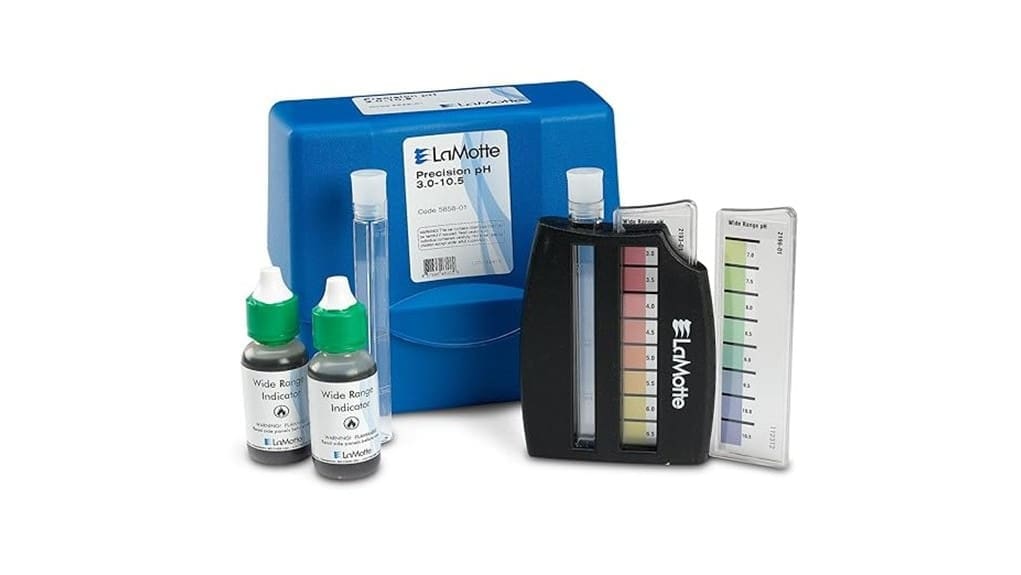
You’ll find the LaMotte wide-range pH kit gives straightforward, field-ready colorimetric readings from 3.0–10.5 pH with about 0.5-unit resolution, so you can quickly screen aquarium, garden, or environmental samples without lab gear. The kit includes two reagent bottles, glass test tubes, and octet comparators; results depend on precise drops, consistent volumes, and stable lighting. It’s portable and low-cost per test but not lab-grade—keep buffers for verification and more details follow if you want them.
Some Key Takeaways
- Compact, field-ready kit provides colorimetric pH screening from 3.0–10.5 with 0.5 pH sensitivity.
- Includes two reagent bottles, two 5 mL glass tubes, and two octet comparators for visual matching.
- Simple procedure: add reagent, mix, and compare under consistent lighting; suitable for aquariums and quick surveys.
- Not laboratory-grade—accuracy depends on drop dosing, sample volume, and lighting; verify with calibrated buffers.
- Ongoing cost driven by replacement reagent (part 4EVZ1); buy from authorized dealers and monitor expiry.
Quick Verdict: Who the LaMotte pH Kit Is Best For
While it’s compact and straightforward, the LaMotte pH Kit is best suited for users who need routine, field-capable pH screening with moderate precision; you’ll get reliable colorimetric readings across 3.0–10.5 pH with 0.5-unit sensitivity, enough for aquarium keepers, environmental technicians doing quick surveys, and educational labs that require repeatable, easy-to-use tests. You’ll favor this kit if you’re a home aquarist monitoring tank stability or a gardening enthusiast managing soil slurry pH; it’s portable, cheap per-test, and simple to operate. Don’t expect laboratory-grade accuracy or automated logging; treat results as screening data guiding further analysis. It’s also useful for homeowners who want to keep pool water clear through routine testing and maintenance.
What’s in the Box and How the Kit Measures pH
Open the box and you’ll find the core components needed for colorimetric pH measurement: two 30 mL bottles of Wide Range pH indicator solution, two capped 5 mL glass test tubes, two octet comparators for color matching, and a concise instruction sheet. You’ll notice compact packaging design that secures glass tubes and reagents against transit shock and contamination. The assay uses indicator dyes producing distinct hues across 3.0–10.5 pH; you add reagent to a sample in a tube and compare resultant color to the octet comparator. Observe reagent safety notes on dilution, storage, and disposal to limit exposure and degradation. This kit is a handy option for homeowners maintaining their pool water.
Step-by-Step: Using the LaMotte pH Kit (Real Test Walkthrough)
Gather your sample, prepare your workspace, and wear appropriate PPE before beginning; this walkthrough assumes you’ve read the included instructions and have two clean 5 mL glass tubes, both bottles of Wide Range pH indicator, and an octet comparator at hand. Fill tube A to 5 mL with the sample, cap, and invert to verify no air bubbles. Add the prescribed drops from bottle 1, mix, then repeat in tube B with bottle 2. Match each tube against the octet comparator under consistent lighting. Record color, timestamp, and ambient conditions for traceability. Maintain strict sample handling and document result interpretation methodically. These simple test kits are ideal for homeowners who want to keep pool water safe and enjoy their outdoor spaces.
Performance Check: Accuracy, Range (3.0–10.5), and Reliability in Practice
Because the LaMotte pH kit uses a colorimetric wide-range indicator and dual-tube protocol, you can expect practical accuracy to hinge on precise drop dosing, consistent sample volume, and comparator lighting conditions. You’ll find the 3.0–10.5 range covers typical field needs; sensitivity steps of 0.5 pH require careful interpolation near transition shades. Verify against calibrated buffers to quantify systematic offset and detect measurement drift over repeated runs. The glass tubes and capped design support field durability, but reagent shelf life and handling affect repeatability. In routine use, methodical technique yields reliable results within the kit’s stated limits. Homeowners maintaining outdoor pools can pair testing with clear pool maintenance practices to keep water safe and inviting.
Cost, Consumables (Replacement 4EVZ1), and Buying Recommendations
Having confirmed the kit’s practical accuracy and operational constraints, you should weigh ongoing costs and reagent availability when evaluating long-term value. Calculate per-test replacement costs by dividing the price of replacement reagents (4EVZ1) by 100 tests; include shipping and potential minimal calibration supplies. The kit’s initial contents reduce short-term spend, but reagent shelf life and storage conditions affect lifecycle cost. For procurement, prioritize authorized dealers to guarantee genuine 4EVZ1 reagents and check bulk discounts. Buying tips: compare unit and shipping costs, verify lot numbers for expiry, and keep a small buffer stock to avoid downtime in routine monitoring. Also consider pool-specific factors like seasonal usage and outdoor storage conditions when planning purchases.
Some Questions Answered
Is This Kit Suitable for Testing Seawater or High-Salinity Samples?
No — it’s not ideal for seawater compatibility because high ionic strength causes ionic interference with colorimetric pH indicators. You’ll get shifted apparent pH and reduced accuracy in saline samples; the 0.5 sensitivity and wide-range indicators were optimized for freshwater. If you must test seawater, you should use a pH probe calibrated for high ionic strength or apply salinity-specific correction protocols and validate against standards to avoid systematic bias.
Can the Reagents Be Shipped Internationally Without Special Restrictions?
Generally you can ship the reagents internationally, but you’ll face shipping restrictions and customs considerations. Check MSDS and UN/HAZ classifications—colorimetric pH reagents may be non-hazardous but some carriers treat liquids as regulated. You’ll need accurate declarations, proper packaging, and possibly Restricted Articles documentation. Contact carriers and local customs authorities for destination-specific rules, and confirm whether any permits, labeling, or transport class codes are required before dispatch.
How Should I Calibrate or Validate Results Against a pH Meter?
Run a two-point calibration protocol: measure pH 4.00 and 7.00 (or 7.00 and 10.00) buffers with your pH meter, adjust per manufacturer instructions. Then test identical samples with the colorimetric kit and the meter. Use a validation checklist: buffer values, temperature, instrument ID, reagent lot, and result differences. Record deviations; if differences exceed 0.5 pH, investigate meter calibration, reagent age, or technique before accepting results.
Are There Temperature Compensation Instructions for Accurate Readings?
Yes — you should apply temperature compensation for accurate colorimetric pH readings. You’ll perform an ambient correction by measuring sample temperature, then adjust expected pH using the reagent’s temperature coefficient or reference table. If no table’s provided, compare results to a calibrated meter with automatic temperature compensation at the same temperature, derive a correction factor, and apply it consistently. Document temperature, correction applied, and uncertainty for each test.
What Is the Shelf Life and Best Storage Conditions for the Reagents?
You should treat reagents as having expiration dates generally 2–3 years from manufacture and follow storage temperatures between 4–25°C for stability. Store sealed reagents away from direct sunlight, heat sources, and freezing; refrigerate if label specifies. Once opened, cap tightly, note lot/expiration dates, and use within manufacturer-recommended timeframe (often 12 months). Discard reagents that show color change, precipitation, or odd odor despite nominal expiration dates.