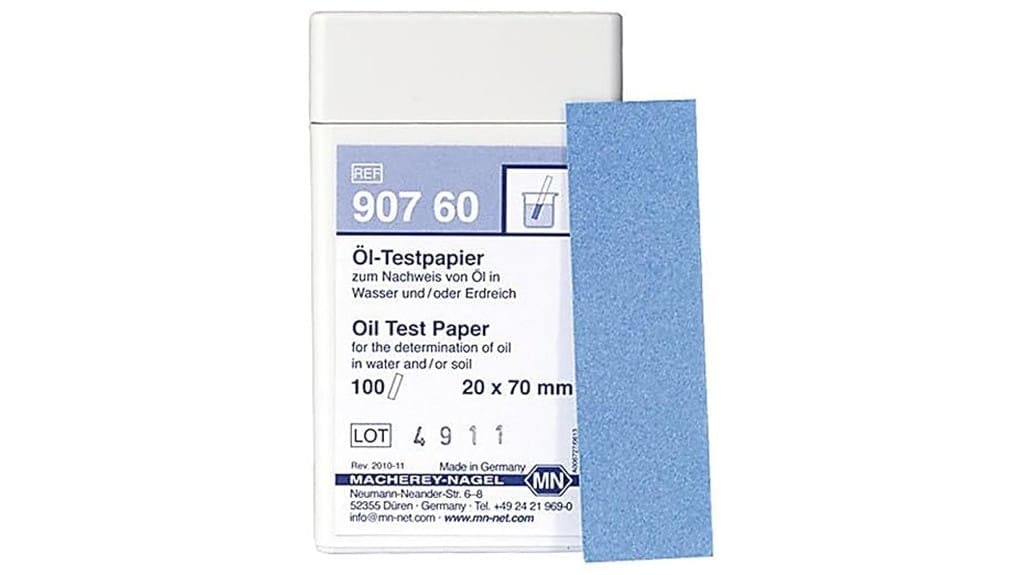
You’ll get a simple, rapid field screen with Macherey‑Nagel 90760 oil test paper: a box of 100 reactive strips that turn dark blue on contact with gasoline, fuel oil, lubricants, and other volatile hydrocarbons. You’ll use them for quick presence/absence checks in water and soil, following basic dip or press-and-rinse steps; they’re not quantitative and won’t speciate contaminants. Sensitivity favors light, soluble fuels over heavy oils. Keep controls and logs; more practical details follow.
Some Key Takeaways
- Rapid field strips turn dark blue on hydrocarbons, providing quick presence/absence screening rather than quantitative results.
- Best for gasoline, fuel oil, lubricants and volatile hydrocarbons; lighter, soluble oils trigger stronger responses.
- Pack of 100 strips (0.05 kg) offers low per-test cost and simple use with minimal training.
- Not suitable for compliance sampling or speciation; follow-up lab analysis needed for quantification.
- Use blanks, duplicates, and proper sample handling (room temp, labeled, agitation/rinse for soils) to avoid false readings.
What the Macherey‑Nagel 90760 Oil Test Paper Actually Is and Who Should Use It
Although it looks like a simple strip of paper, the Macherey‑Nagel 90760 Oil Test Paper is a reactive diagnostic tool designed to reveal hydrocarbons by turning dark blue on contact; you get a box of 100 strips calibrated for quick, visual screening. You’ll use reactive paper to detect gasoline, fuel oil, lubricants and volatile hydrocarbons in water and soil. It’s intended for field screening rather than quantitative analysis. Industrial safety teams, environmental technicians and hobbyists testing small sites will find it useful for rapid triage. Sensitivity varies with solubility; interpret immediate color changes and follow confirmatory laboratory methods when needed.
How to Use the 90760 Strips for Water and Soil Testing (Step‑by‑Step)
When you test water or soil with the Macherey‑Nagel 90760 strips, follow a simple, repeatable routine to get reliable visual results: clearly label samples, use clean tools and containers, and make certain strips and samples are at room temperature. For water, dip and move the strip back and forth for a uniform contact time; note application timing and record start/stop. For soil, press the strip firmly into the sample, then rinse with clear water to remove particulates before reading. Always run blanks and duplicates as contamination controls. Compare immediate color change against controls and log findings precisely. For homeowners testing outdoor spaces, consider pairing strips with a digital pool tester for ongoing water maintenance.
Real‑World Performance: Sensitivity, Color Change Timing, and Limits
Because the 90760 strips rely on a chemical reaction with hydrocarbons, you’ll see a clear, immediate visual response only when sufficient soluble or volatile compounds contact the reactive paper. You should expect variable detection thresholds: soluble fuels and light oils trigger dark blue at lower concentrations than heavy, poorly soluble lubricants. In practice, response latency is short for volatile compounds—evaluate strips immediately—while dissolved or particle-bound oils may require longer contact or agitation to register. You must control contact method and sample mixing to interpret results consistently. Be aware limits exist for trace detection; strips indicate presence, not precise concentration. Pools and other outdoor water features can benefit from routine monitoring with UV-compatible sanitizers to reduce microbial risks and complement oil detection efforts for maintaining safe swimming conditions.
Pros, Cons, and Best Use Cases Compared to Alternatives
If you need a simple, rapid field check for hydrocarbons, the Macherey‑Nagel 90760 strips deliver straightforward presence/absence results with minimal training and no instruments. You’ll appreciate quick visual cues for water and soil screening, low cost per strip, and suitability for broad environmental monitoring. Limitations: they’re qualitative, sensitivity varies with hydrocarbon solubility, and volatile compounds require immediate reading. Compared to lab assays or portable GC, they lack quantification and speciation. In field comparisons with other test papers they’re reliable for screening but not for compliance sampling. Best use: preliminary surveys, site triage, and routine on‑site checks. These simple tools are particularly useful for homeowners maintaining outdoor spaces and monitoring potential hydrocarbon contamination around their properties.
Buying Advice: Where to Buy, Package Details, and When to Choose This Strip
Look for the Macherey‑Nagel 90760 Oil Test Paper from reputable scientific suppliers or major e‑commerce retailers to guarantee genuine product and available user guidance. When deciding where to buy, check supplier credibility, stock availability, and shipping terms; use the manufacturer part number 43188-360625 or ASIN B00S1UQ5MI to confirm authenticity. Package details: the product ships as a box of 100 strips, item weight 0.05 kilograms, with a user guide included. Choose this strip when you need rapid, field‑ready detection of hydrocarbons in water or soil, immediate colorimetric response, and consistent, lab‑grade reactive paper performance. These strips are handy for homeowners maintaining outdoor water features and pools who want to keep their skimmer systems running smoothly by monitoring for oil contamination and related issues pool maintenance.
Some Questions Answered
Are the Strips Reusable After Initial Contact With Hydrocarbons?
No, the strips are single use and aren’t reusable after initial contact with hydrocarbons. You should discard a strip once it’s exposed because residual oil or volatile residues can remain, causing cross contamination and false readings on subsequent tests. For reliable results, always use a fresh strip per sample, follow the provided rinsing and handling instructions for soil or water testing, and store unused strips in their original packaging to prevent contamination.
Do These Strips Expire or Have a Shelf Life?
They don’t list a fixed expiration, but you should assume limited shelf life and follow storage conditions carefully: keep strips dry, sealed, and away from heat and sunlight. You’ll want to check the user guide and packaging for a manufacture date or lot-specific expiry. If uncertainty arises, contact the manufacturer; they’ll confirm stability and any manufacturer warranty coverage for defects or premature degradation of reactive paper.
Are Test Results Affected by Cold or Hot Temperatures?
Yes — temperature effects can influence results. You’ll see slower or weaker color development in cold conditions and faster, possibly stronger reactions when strips or samples are warm. For consistent readings, control storage conditions: keep strips dry, at moderate room temperature, away from extreme heat or freezing. If you test in unusual temperatures, equilibrate strips and samples to recommended conditions before use and note temperature when evaluating color changes.
Can the Strips Detect Oil Emulsions or Dispersants?
No — you won’t reliably detect oil emulsions or dispersant detection with these strips. They respond to free-phase or dissolved hydrocarbons that contact the reactive paper; stable oil emulsions encapsulate oil droplets and dispersants alter surface chemistry, reducing strip contact and color development. For emulsions or dispersant-treated samples, you should use laboratory methods (e.g., GC, TOC, solvent extraction) or validated field kits designed for emulsified oil and dispersant analysis.
Is Any Protective Equipment Required When Using the Strips?
Yes — you should use basic personal protective equipment. Wear gloves: disposable nitrile or latex gloves protect your hands from hydrocarbons and contaminated samples. Use eye protection: safety glasses or goggles shield against splashes when dipping or rinsing strips, especially with volatile or agitated samples. Work in a well-ventilated area, avoid inhaling fumes, and follow the supplied user guide and local safety procedures for handling contaminated water or soil.