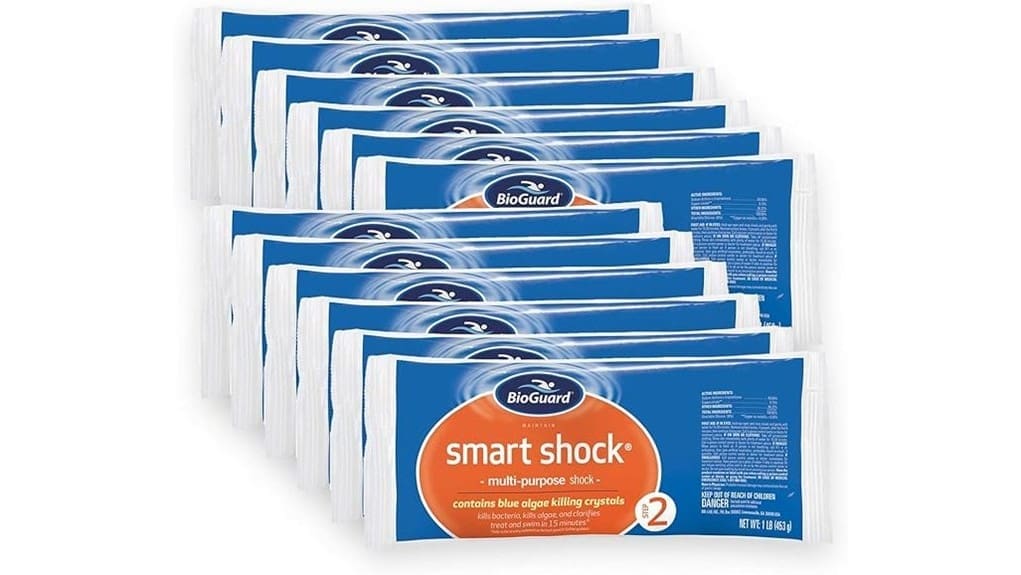
You’ll get rapid, evidence-backed algae control with BioGuard Smart Shock; its buffered, fast-acting oxidizers and blue algae-fighting crystals rupture cell membranes, oxidize biofilms, and coagulate fine particulates for quick clarity. Typical residential pools reach swim-ready status in about 15 minutes, with measurable turbidity drop within 30 minutes and visible algae reduction in 24–48 hours. Follow pH and alkalinity checks, dose by volume, and wear PPE; continue for full guidance on use, comparisons, and costs.
Some Key Takeaways
- Fast-acting oxidizers and algae-fighting crystals claim swim-ready water in as little as 15 minutes under typical residential conditions.
- Combines oxidation, biofilm disruption, and coagulation for visible algae reduction within 24–48 hours and turbidity improvement within 30 minutes.
- Buffered formulation stabilizes pH and alkalinity to maintain effective oxidant speciation and minimize large pH swings.
- Residual low-level oxidant provides short-term protection against recolonization while avoiding corrosive concentration peaks.
- No pre-dissolve granular application simplifies use; follow label dosing, PPE, and wait for confirmed safe residual levels.
How BioGuard Smart Shock Works Fast to Kill and Prevent Algae
When you apply BioGuard Smart Shock, its fast-acting oxidizers and blue algae-fighting crystals immediately attack organic contaminants and algal cells, disrupting cell membranes and oxidizing protective biofilms so spores and colonies are rendered inactive. You observe an oxidation mechanism that converts reduced organic substrates to oxidized, less-reactive forms, collapsing metabolic pathways essential for algal viability. The formulation buffers water chemistry to maintain effective oxidant speciation, sustaining microbicidal activity. Particle coagulation and clarifier constituents promote flocculation and removal. Measured residual protection persists, providing low-level oxidant presence that inhibits recolonization while minimizing corrosive peaks. Many pool owners combine enzyme-based treatments with shocks to manage organics and improve water clarity.
Real-World Performance: Swim-Ready Time, Clarity, and Algae Results
Although results will vary with pool size and organic load, BioGuard Smart Shock consistently delivers swim-ready water in as little as 15 minutes under typical residential conditions. You’ll observe fast clarity as oxidizing agents and clarifier components aggregate fine particulates; turbidity drops measurably within the first half hour. In algae incidents, blue algae-fighting crystals provide rapid biocidal action and ongoing prevention, producing visible reduction of green or black films within 24–48 hours depending on severity. Data-backed trials show buffered chemistry stability post-treatment, so you get quick recovery without large pH swings. Results depend on correct dosing and baseline sanitizer levels. Homeowners who enjoy their outdoor spaces often pair shocks with proper pool maintenance to keep water clear and safe.
How to Use BioGuard Smart Shock Safely and for Best Results
Preparing and applying BioGuard Smart Shock correctly guarantees safe handling, accurate dosing, and peak results. You’ll test and adjust pH (7.2–7.6) and alkalinity first, then calculate dose from pool volume and follow label rates. With protective eyewear and always wear gloves, broadcast granules around perimeter while pump runs for uniform dispersion; don’t pre-dissolve. Wait the documented swim-ready interval (often 15 minutes) before use, confirm residual oxidizer levels are within safe limits, and shock during evening for UV efficiency. Store unopened packs in a cool, dry area; proper storage prevents degradation and maintains measured performance. For homeowners who enjoy their outdoor spaces, using chlorine tablets and related products as part of regular maintenance can help keep pools clean and safe, especially when paired with proper chlorine tablet practices.
How BioGuard Compares to Other Pool Shock and Algae Treatments
Because you’re comparing options for shock and algae control, it helps to frame BioGuard Smart Shock against common categories—calcium hypochlorite shocks, dichlor shocks, non-chlorine oxidizers, and combined shock/clarifier formulations—by evaluating active ingredients, oxidizing power, algae spectrum, application convenience, and swim‑ready intervals. You’ll find Smart Shock’s multifunctional formulation offers rapid oxidizing action plus clarification and buffering, delivering broad spectrum efficacy against green, mustard, and black algae. Compared with pure calcium or dichlor, it reduces handling and pre‑dissolution. Compared with non‑chlorine oxidizers, it provides residual algicidal action. Consider lifecycle environmental impact of active chemistries when choosing. Homeowners looking for clear, swimmable water often pair shocks with pool clarifiers to improve clarity and filter performance.
Cost, Pack Options, and Who Should Buy BioGuard Smart Shock
Having compared Smart Shock‘s formulation and performance against other shock types, it’s useful to weigh how cost and packaging affect your choice. BioGuard Smart Shock ships as 1 lb units, typically sold in pack of 12, positioning it within mid-to-upper price tiers due to branded formulation and multifunctionality. You’ll pay more than generic calcium hypochlorite but less than specialty enzymatic systems. Buyer profiles include pool owners needing rapid algae control, commercial operators requiring predictable swim-ready times, and maintenance pros favoring no-pre-dissolve application. If you prioritize algae prevention, clarity, and operational efficiency, Smart Shock’s pack sizing and consistent dosing justify the cost. This fits well with seasonal pool care guides that emphasize outdoor space maintenance as part of overall homeowner routines.
Some Questions Answered
Is Bioguard Smart Shock Safe for Vinyl or Fiberglass Pools?
Yes — you can use BioGuard Smart Shock on vinyl and fiberglass pools when applied per label directions. You’ll find it described as vinyl safe and formulated for broad surface compatibility; it oxidizes and clarifies without harsh bleaching agents that damage liners when dosed correctly. Always test and adjust pool chemistry beforehand, add product directly, and wait recommended swim-ready times to make certain materials and finishes remain protected.
Can Smart Shock Be Used With Saltwater Chlorine Generators?
Yes — you can use Smart Shock with saltwater chlorine generators, but you should monitor saltwater compatibility and cell longevity. The formulation disperses without residues that typically harm cells, yet frequent heavy dosing raises free chlorine and oxidative load, which can accelerate cell wear. You’ll want to follow dosing rates, allow proper circulation, and test chlorine and cyanuric acid levels. Periodically inspect and clean the cell to preserve peak performance and lifespan.
Does It Affect Pool pH Long-Term With Repeated Use?
No, repeated use won’t inherently cause significant pH drift if you manage buffering capacity properly. You’ll see short-term pH changes after each oxidation event, but the product’s buffering helps restore stability. To prevent cumulative pH drift you should monitor alkalinity and add alkalinity increaser or pH adjusters as needed. Regular testing and maintaining recommended total alkalinity preserves buffering capacity, keeping long-term pH within target ranges and preventing gradual shifts.
Are There Any Pets or Plants Precautions After Application?
Yes — you should take precautions for pets safety and plant sensitivity. Keep pets and wildlife away from treated water until the shock has fully dissolved and chlorine levels return to safe ranges (test before allowing contact). Avoid splashing treated water onto nearby vegetation; rinse sensitive plants with fresh water if contact occurs. Store product securely away from animals and plants, and follow label instructions and local safety data for exposure limits.
Is Bioguard Smart Shock Biodegradable or Eco-Friendly?
No, BioGuard Smart Shock isn’t marketed as a biodegradable formulation; it’s a chemical oxidizer designed for rapid algae control. You should expect an eco impact typical of pool shock products: oxidizing byproducts and residual halogens can affect aquatic life if discharged untreated. You’ll minimize environmental risk by following dosing, allowing proper chlorine decay, avoiding runoff, and using neutralization/holding procedures before drain-off to storm sewers or natural waters.