You’ll get concentrated stabilized trichloro tablets that simplify residential chlorination while demanding strict handling and feeder use. Test and balance pH, alkalinity, and hardness first, then place tablets only in approved feeders or floaters; never mix chemicals in a feeder or let tablets touch pool surfaces. They maintain 2–4 ppm free chlorine, control common algae, and deposit cyanuric acid so monitor CYA to avoid over‑stabilization. Continue for detailed dosing, safety, and performance guidance.
Some Key Takeaways
- Concentrated stabilized trichloro tablets (84.65% available chlorine) provide reliable routine sanitization for residential pools.
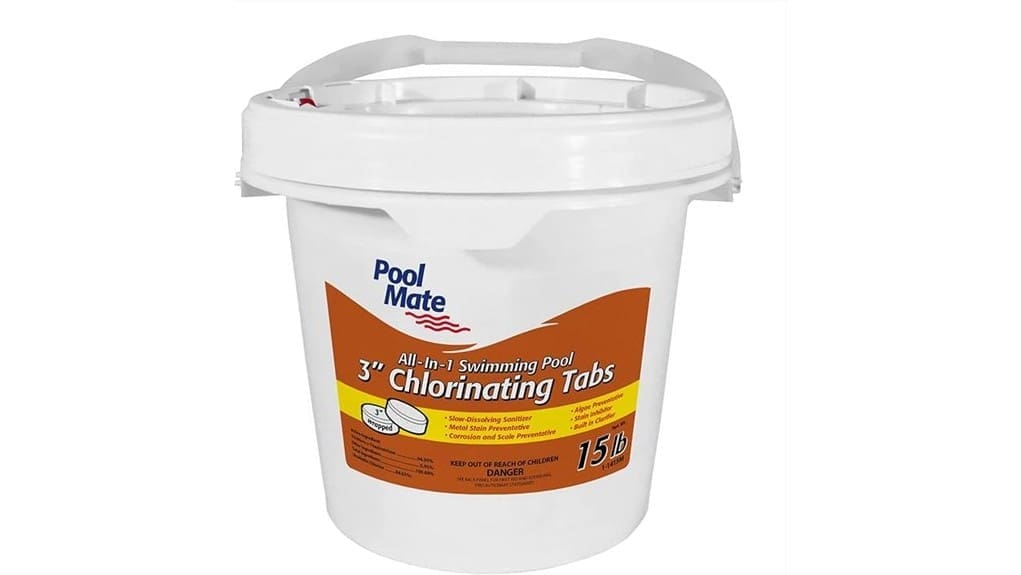
- Each 15-lb container holds thirty individually wrapped 3″ (8 oz) tablets for reduced moisture ingress and cross‑contamination.
- Use in approved feeders or floaters only; avoid direct surface contact and never mix chemicals in the feeder.
- Tablets deposit cyanuric acid; monitor CYA to avoid over‑stabilization (target 40–100 ppm) and shock if cloudy/green.
- Requires PPE, cool dry storage, and restricted pool entry when chlorine exceeds 3 ppm; not ideal for eco‑sensitive settings.
What Pool Mate 15‑lb All‑In‑1 3 Tabs Contain and What They Do
Take a close look: each 15‑lb container holds thirty individually wrapped 3‑inch tablets (8 oz each) of Trichloro‑s‑triazinetrione, with 94.05% active ingredient and 84.65% available chlorine, formulated to sanitize, clarify, control algae, inhibit stains, reduce scaling, and provide stabilizer protection against sunlight. You’ll note packaging details include sealed individual wraps within a rigid container to minimize moisture ingress and cross‑contamination. Follow storage guidelines: cool, dry, ventilated, separate from incompatible chemicals. Stability testing confirms shelf retention under specified conditions. Monitor environmental impact—prevent runoff, avoid direct release. Handle with PPE; inspect seals before use. These tablets are intended for use by homeowners who enjoy outdoor pool spaces and maintaining water quality with shock treatments.
How to Use These 3 Tabs Safely : Start‑Up, Feeder/Floater Setup, and Dosing
Before you add any tablets, test and balance your pool water—adjust pH to 7.4–7.6, total alkalinity to 80–130 ppm, and calcium hardness as needed—because the tablets are intended for use only after water chemistry is correct. For start‑up, superchlorinate if cloudy/green, then place 16 oz (two 8‑oz tabs) per 10,000 gallons into an approved automatic feeder or floater. Verify feeder placement in high‑flow return line, avoid direct contact with pool surfaces, and never mix chemicals in the feeder. Circulate four hours before testing; aim for 2–4 ppm. Post clear safety signage and restrict entry when chlorine exceeds 3 ppm. These tablets are designed for homeowners who enjoy their outdoor spaces and want a reliable chlorine tablet option.
Real‑World Performance: Sanitation, Algae Control, Stain Prevention, and Stabilizer Effects
With your feeder set and chlorine stabilized in the 2–4 ppm range, you’ll observe how these 3″ trichloro tablets perform across sanitation, algae control, stain prevention, and stabilizer maintenance. You’ll get consistent sanitizer residuals that rapidly oxidize organics and control common algae when circulation and weekly shock protocols are followed. The tablets deposit cyanuric acid, so monitor stabilizer to avoid over‑stabilization; adjust to 40–100 ppm before relying solely on tabs. They limit metal staining and scale by inhibiting corrosion, but you must account for sunlight degradation and increased chlorine demand from high swimmer load. Test routinely and maintain equipment to guarantee safety. Homeowners should also routinely check pool chemistry with pool test strips to keep water clear and balanced.
Compatibility, Limitations, and When to Shock or Add Other Chemicals
Because these trichloro 3″ tabs continuously dispense stabilized chlorine and cyanuric acid, you must account for their chemical interactions and equipment compatibility when planning treatments. You should use automatic feeders or floaters certified for trichloro tablets and never place tablets directly on liners or surfaces. Monitor cyanuric acid buildup; excess reduces shock effectiveness. If water is cloudy or green, shock with a non-stabilized or appropriate oxidizer per instructions before relying on weekly tablet dosing. Don’t add other pool chemicals into a feeder containing tablets. Test chlorine, pH, alkalinity, and CYA after four hours circulation to confirm safe, effective levels. Homeowners should also consider seasonal pool opening steps to ensure a sparkling start.
Pros, Cons, and Who Should (or Should Not) Buy These Chlorinating Tabs
If you manage a residential pool and want a reliable, low-maintenance sanitizer, these 3″ trichloro tablets deliver concentrated, stabilized chlorine that keeps free chlorine in the 2–4 ppm range when used in an appropriate feeder or floater and monitored regularly. Pros: multi-function formula reduces ancillary chemicals, simplifies dosing, supports pool aesthetics by preventing staining and cloudiness. Cons: raises cyanuric acid, requires careful feeder use, prohibits immediate reentry above 3 ppm, and has disposal/handling risks. Who should buy: routine residential owners prioritizing simplicity; see cost analysis and user testimonials for value. Who shouldn’t: eco-sensitive operators concerned about environmental impact. These tablets are well-suited for homeowners who maintain their outdoor pool spaces and prefer easy-to-use testing and dosing with simple test kits.
Some Questions Answered
Are These Tablets Safe for Vinyl and Fiberglass Liners Long-Term?
Yes — you can use them, but monitor carefully for vinyl compatibility and long term effects. They’re formulated for routine sanitization and won’t usually damage vinyl or fiberglass when used in feeders/floaters at recommended dosing (16 oz/10,000 gal weekly) and with proper pH (7.4–7.6), alkalinity, and stabilizer levels. Avoid direct tablet contact with liners, maintain circulation, and test chlorine regularly to prevent prolonged high chlorine exposure that causes degradation.
Can I Use One Tab per Floater Instead of Two for Smaller Pools?
Yes — you can use a single tab per floater for smaller pools, but you’ll need dosage testing to confirm targets. Place the floater centrally and near return flow to optimize floater placement and circulation impact. Test free chlorine after four hours and adjust to 2–4 ppm; if levels stay low, use two tabs or supplement with shock. Monitor pH and alkalinity; never let tablet contact pool surfaces directly.
Do These Tabs Affect Pool Water Color or Clarity Immediately?
They won’t cause immediate clarity improvement; you’ll see effects over hours. These tabs begin releasing chlorine on contact, so you may notice a temporary color shift as contaminants oxidize and flocculate. Test and circulate at least four hours before judging clarity. If water’s cloudy or green, shock first—tabs alone won’t clear heavy algae quickly. Maintain pH 7.4–7.6 and free chlorine 2–4 ppm for consistent clarity.
How Should I Store Unused Tablets to Maintain Potency?
Store unused tablets in airtight containers in cool storage away from heat, flames, and direct sunlight. Keep original packaging if intact, or transfer to chemical-resistant, labeled containers. Maintain dry conditions and avoid moisture contact or mixing with other chemicals. Store off the floor on a noncombustible shelf, inaccessible to children and pets, with adequate ventilation and a nearby fire extinguisher. Follow local disposal and spill-response procedures.
Are Pets or Plants Affected by Pool Water Treated With These Tabs?
Yes — treated pool water can affect pets and plants. You should enforce pet safety by keeping animals out until free available chlorine is ≤3 ppm and no strong chlorine odor remains; rinse pets after swimming. Avoid draining chlorinated water onto lawns or garden beds because of plant sensitivity; residual chlorine, stabilizers, and shock chemicals can damage foliage and soil microbiota. Neutralize or dilute water before disposal and follow local disposal rules.