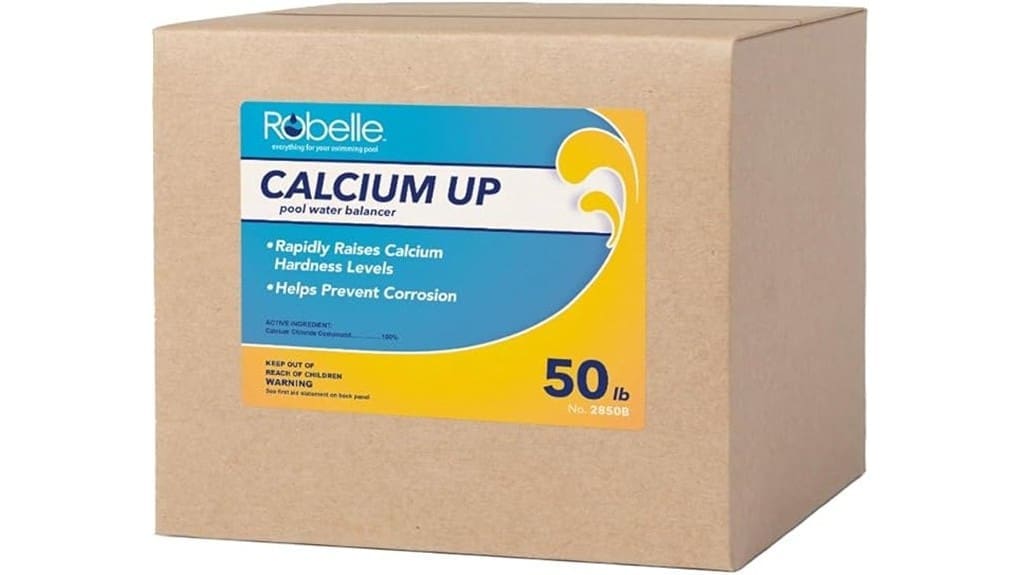
You’ll find Robelle’s 50‑lb Premium Calcium Up gives you a fast, predictable way to raise pool calcium hardness with minimal contaminants and consistent dosing (8 oz ≈ +10 ppm per 5,000 gal). It dissolves readily, protects plaster and vinyl from etching when maintained in the 200–400 ppm range, and suits both homeowners and pros. Measure carefully to avoid excess TDS, add in the evening, and retest after 24 hours—keep going to see detailed dosing tips and comparisons.
Some Key Takeaways
- Robust 50-lb bag of calcium chloride raises pool hardness quickly and predictably for routine adjustments.
- Dosage clarity: 8 oz increases calcium hardness by ~10 ppm in 5,000 gallons.
- Dissolves readily and disperses well when broadcast near return jets with pump running.
- Helps prevent plaster etching and staining when maintaining 200–400 ppm calcium hardness.
- Raises TDS over time; reseal bag, avoid overuse, and retest hardness after 24 hours.
Product at a Glance: What Robelle 50‑Pound Calcium Up Contains and Who It’s For
Robelle’s 50-pound Calcium Up contains calcium chloride formulated to raise pool calcium hardness quickly and predictably. You get a granular calcium chloride product in a heavy-duty bag intended for routine hardness adjustments. You’ll use it when pool chemistry shows calcium below the 200–400 ppm target; dosing is straightforward and scalable for common pool volumes. The formulation minimizes added contaminants so you can focus on controlled hardness increases. Inspect container durability before purchase—seams and closures matter during storage and transport. This product suits pool owners and service pros who need a predictable, practical calcium hardness increaser. Many homeowners rely on calcium hardness increasers to keep their outdoor pool water balanced and protect surfaces and equipment.
How Well It Works: Raising Calcium Hardness and Preventing Staining
Measure a small addition and you’ll see Robelle 50‑Pound Calcium Up raise calcium hardness quickly and predictably; its calcium chloride formulation dissolves readily so 8 ounces will increase hardness by about 10 ppm in 5,000 gallons. You’ll notice restored hardness reduces etching and staining risk on plaster and vinyl, and it stabilizes water chemistry to limit metal discoloration. Monitor levels to avoid surface scaling where hardness exceeds recommended range. The product’s purity and predictable response simplify corrective dosing, and you can expect good equipment compatibility when maintained within 200–400 ppm; it’s an efficient, controllable hardness solution. Regular use alongside proper filtration and maintenance helps keep pool water clear and balanced, supporting clearer pool water.
How to Dose and Apply It Safely (8 Oz = +10 Ppm per 5,000 Gal)
Now that you know how adding calcium restores hardness and prevents damage, here’s how to dose safely: calculate your pool volume, test current calcium hardness, then determine the required increase (remember 8 oz raises 10 ppm per 5,000 gallons). Work methodically: measure, compute ounces needed, and convert to full or fractional doses. For application timing, add calcium in the evening with the pump running to disperse evenly and minimize chlorine interaction. Broadcast granules slowly near return jets; avoid pouring on plaster or vinyl directly. Retest hardness after 24 hours and adjust incrementally, keeping pool chemistry within the 200–400 ppm target. Maintaining proper alkalinity helps ensure balanced water and protects pool surfaces, so monitor total alkalinity regularly.
Pros, Cons, and Performance Compared to Other Calcium Chloride Options
While many calcium chloride products perform similarly, Robelle’s 50-pound bag stands out for consistent purity and straightforward dosing, so you can predictably raise hardness without unexpected contaminants. You’ll appreciate quick dissolution and clear solubility comparison data: Robelle dissolves readily versus bulk industrial grades, reducing application time and uneven spots. Pros: predictable dosing (8 oz = +10 ppm/5,000 gal), rapid hardness correction, protects surfaces. Cons: raises total dissolved solids and needs careful measurement; repeated use influences long term effects like incremental TDS rise. Compared to alternatives, you’ll trade slightly higher TDS for reliable, easy-to-use performance and purity. This product is especially useful for maintaining optimal pool chemistry in homes with sand filter media.
Is It Worth Buying? Price, Package Usability, and Final Recommendation
Given its predictable dosing and purity advantages, you’ll want to weigh price and packaging to decide if Robelle’s 50‑lb bag is the right buy for your pool needs. Do a cost analysis: per‑pound pricing typically matches competitors, and the concentrated formulation means fewer purchases over a season if you treat large volumes. Packaging durability is solid for dry storage but keep it off damp surfaces and seal between uses to avoid clumping. You’ll save time dosing (8 oz raises 10 ppm/5,000 gal) and reduce risk of corrosion or surface damage. Recommendation: buy if you manage medium to large pools and value consistency. Proper pH balance is essential for clearer, safer water and helps protect swimmers and pool surfaces.
Some Questions Answered
Is This Product Safe for Use in Vinyl-Lined Pools?
Yes — you can use it in vinyl-lined pools. You’ll want to dissolve and distribute the calcium chloride carefully to preserve vinyl compatibility and support liner longevity. Add measured doses slowly with good circulation, avoid pouring undiluted granules onto the liner, and maintain calcium hardness within the 200–400 ppm range. Monitoring levels prevents rapid changes that could stress the vinyl; steady maintenance promotes long-term liner longevity and pool component protection.
Can Calcium up Be Added While the Pool Pump Is Off?
Yes — you can add calcium up while the pump is off, but you shouldn’t. You’ll get better mixing and accurate dosing timing if the pump runs during and for at least 1–2 hours after application. With the pump off, granules can settle, causing localized high concentrations and surface damage. For safety and consistent hardness increases, dissolve or broadcast product per instructions, restart pump, and monitor calcium and pH levels afterward.
Will It Affect Pool Chlorine or Other Chemical Levels?
No, it won’t directly affect chlorine levels; calcium chloride has minimal chlorine interaction. You’ll change total hardness and slightly alter ionic strength, which can influence chemical balance and sanitizer effectiveness indirectly. You should test hardness, pH, and free chlorine after dosing, then adjust as needed. Add per label directions, dissolve or broadcast properly, run the pump, and retest to confirm chlorine, alkalinity, and calcium remain within proper ranges.
How Long After Adding Will Hardness Stabilize?
You’ll see hardness stabilize within 2–24 hours after adding, depending on your pool’s circulation and dissolution rate. Stirring or running the filter speeds dissolution; onsite testing at 2, 6, and 24 hours verifies levels. If you dissolved the product in a bucket and added slowly, expect stabilization nearer 2–6 hours. For granular broadcasting, allow full circulation and test at 24 hours to confirm you’ve reached target hardness.
Are There Storage Precautions for Humid Climates?
Yes. You should Store indoors in a cool, dry area away from direct sunlight and heat. In humid climates, keep the bag sealed and place Moisture absorbers (silica gel or desiccant packs) nearby to prevent caking and hydrolysis. Elevate the container off concrete and use a secondary waterproof bin if possible. Inspect regularly for clumping or moisture ingress, and rotate stock to use older product first.