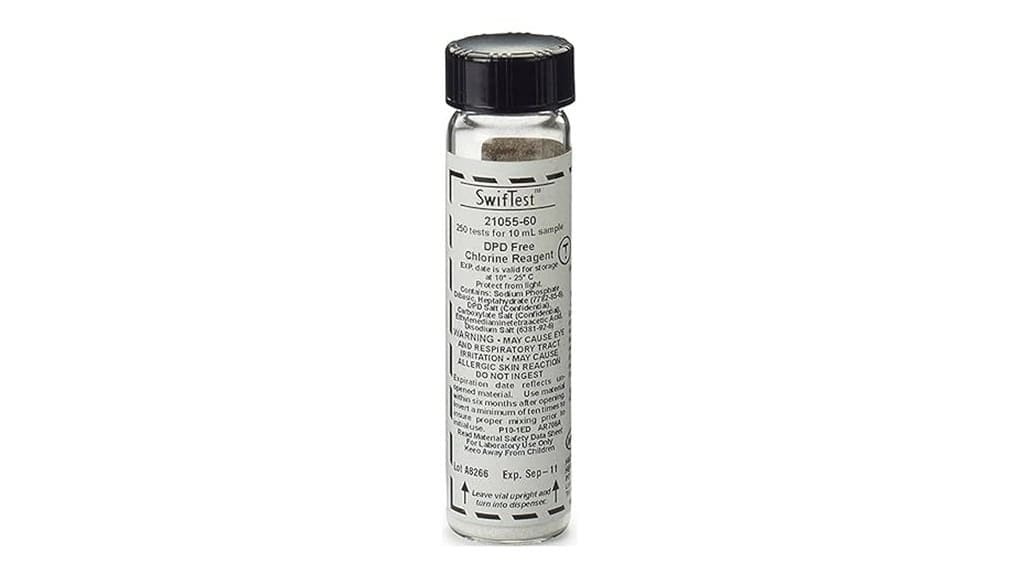
You’ll get EPA‑grade, low‑limit free chlorine testing with Hach’s DPD refill vial: it doses 250 10‑mL tests for 0.02–2.00 mg/L free chlorine, matches Hach Method 8021, and yields rapid, repeatable color development ideal for regulatory reporting. Use the Swiftest squeeze dispenser, prime once, track dispense counts, and replace vials when flow varies >±5%. Per‑test cost is predictable and waste is reduced, and the following sections provide exact procedural and QC details.
Some Key Takeaways
- Powder DPD refill vial measures free chlorine 0.02–2.00 mg/L for 10 mL samples with low 0.02 mg/L detection limit.
- Squeeze-to-dispense design (Swiftest dispenser compatible) delivers consistent dosing when primed and aligned correctly.
- Rated for 250 tests per vial; replace earlier if dispense volume varies by more than ±5%.
- Approved under USEPA Hach Method 8021 and suitable for regulatory drinking-water monitoring with proper QC.
- Cost-effective for high-throughput users; calculate per-test cost by dividing vial price by 250.
Quick Verdict and Key Specs for Hach DPD Free Chlorine Reagent Refill Vial
Although compact in form, the Hach DPD Free Chlorine Reagent Refill Vial (2105560) delivers high-throughput, regulatory-grade performance: it uses powder chemistry for 10 mL samples to measure free chlorine from 0.02–2.00 mg/L, yields 250 tests per vial, and’s approved under USEPA Hach Method 8021 for drinking water analysis. You’ll appreciate the squeeze-to-dispense design: it maintains packaging compatibility with the Swiftest DPD Dispenser, minimizes contamination risk, and speeds dosing. Data-focused users will value predictable test counts and the vial’s documented storage stability, which supports inventory planning and regulatory reporting for both field and laboratory workflows.
Accuracy and Sensitivity for Free Chlorine (0.02–2.00 Mg/L)
When you need reliable detection of low-level residuals, the Hach DPD Free Chlorine Reagent Refill Vial delivers consistent sensitivity across its 0.02–2.00 mg/L range, thanks to powder chemistry optimized for 10 mL samples and the Swiftest dispenser’s precise dosing. You’ll observe a low detection limit near 0.02 mg/L with reproducible calibration across the range; method repeatability meets EPA Hach Method 8021 expectations. Response time is rapid—color development within seconds—so throughput stays high for field or lab work. Data show linearity across the stated range and acceptable precision for regulatory reporting and routine monitoring. This makes it a practical choice for homeowners maintaining their pools with simple test kits.
Using the Squeeze-To-Dispense Vial With a Swiftest DPD Dispenser: Step-By-Step Tips
Having established the reagent’s sensitivity and repeatability across 0.02–2.00 mg/L, you’ll get the most consistent results by pairing the squeeze-to-dispense refill vial with the Swiftest DPD dispenser and following a precise handling sequence. Position the vial into the dispenser with proper alignment marks matched; misalignment increases volume variance. Engage the priming technique: squeeze until steady, colorless flow appears, then dispense and discard first aliquot. Use a controlled squeeze stroke for each 0.10 mL increment, timing pulses for reproducibility. Record dispense count and sample ID. Replace vial after 250 tests or when flow inconsistencies exceed ±5% of target volume. Homeowners should also maintain pool chemistry regularly and use reliable test strips to help keep pool water clear.
Regulatory Acceptance and Method Details (USEPA, Hach Method 8021) : Is It Suitable for Drinking Water?
How does the Hach DPD Free Chlorine Reagent Refill Vial align with regulatory and method requirements for drinking water testing? You can rely on EPA approval and Hach Method 8021: the reagent matches the USEPA-accepted protocol for free chlorine determination. Method range (0.02–2.00 mg/L) and 10 mL sample size meet typical regulatory limits and reporting requirements. You’ll follow prescribed powder reagent delivery with the Swiftest DPD dispenser for consistent dosing and reproducible colorimetric response. Data you collect will be compatible with regulatory reporting when you adhere to Method 8021 procedures, calibration, and quality-control checks specified by the agency.
Cost, Testing Capacity, Waste Reduction, and Who Should Buy This Vial
Now that you’ve confirmed regulatory suitability under EPA/Hach Method 8021, consider cost-per-test, throughput, and waste implications for operational planning. At 250 tests per vial and 10 mL samples, you calculate cost efficiency by dividing vial price by 250; per-test reagent cost becomes predictable and low compared with single-use ampoules. The squeeze-to-dispense design reduces packaging waste and speeds dispensing, improving throughput in high-volume settings. Buy this vial if you run routine drinking-water monitoring, field crews, or lab programs needing EPA-compliant free chlorine data. Buyer recommendations: prioritize centers with ≥100 tests/month to maximize savings and minimize waste. This product is ideal for homeowners and professionals focused on maintaining outdoor water features and pools with digital pool testers.
Some Questions Answered
Can This Vial Be Used for Total Chlorine Testing With Additional Reagents?
Yes — you can use this vial for total chlorine testing if you add the appropriate secondary reagents and account for reagent interactions. You’ll measure free chlorine first (0.02–2.00 mg/L, 10 mL sample), then add the oxidizing reagent for combined chlorine and subtract free from total. Follow USEPA-approved procedures (Hach Method 8021), control volumes precisely, and document any reagent interactions to guarantee regulatory-quality, data-driven results.
How Long Is the Reagent Stable After Opening the Dispenser?
You’ll get about 6 months of usable shelf life after opening the dispenser when stored per manufacturer guidance. Maintain storage conditions: keep the refill vial seated in the Swiftest dispenser, avoid moisture and direct sunlight, and store at recommended temperature (room temperature, typically 15–25°C). Track opening date and discard after 6 months or if reagent shows caking, discoloration, or inconsistent test results to safeguard data integrity.
Are There Temperature Limits for Accurate Powder Reagent Performance?
Yes — you should control temperature for reliable results. Powder hygroscopicity increases at higher temperatures and humidity, which can alter reagent mass and reaction stoichiometry; keep ambient storage between 15–25°C when possible. Extremes (below 5°C or above 30°C) can slow dissolution or accelerate degradation, affecting accuracy around low-range 0.02 mg/L measurements. Store sealed in the dispenser, minimize temperature swings, and record storage conditions for quality control.
Is This Vial Compatible With Other Brands of Dispensers?
No — you shouldn’t assume cross-brand compatibility. Hach vials are engineered for Swiftest dispensers; adapter compatibility depends on exact thread dimensions and sealing geometry. Verify vendor specifications: measure external thread pitch, diameter, and sealing face tolerance against the dispenser’s adapter. If dimensions match and manufacturer confirms chemical/material compatibility, you can use an adapter. Otherwise, use original Hach adapters to guarantee accurate dosing, sealing, and EPA-compliant results.
How Should I Dispose of Leftover Powder and Empty Vials?
You should treat leftover powder and empty vials as chemical waste: don’t dump them down drains. Contain residues, label containers, and follow hazardous waste handling procedures. Check local regulations for segregation, storage, and disposal routes; many areas allow triple-rinsed plastics in regular recycling but require solvent-bearing or contaminated powders to go to hazardous waste disposal. Document quantities and disposal method for compliance and auditing. Contact local waste authority for approved contractors.