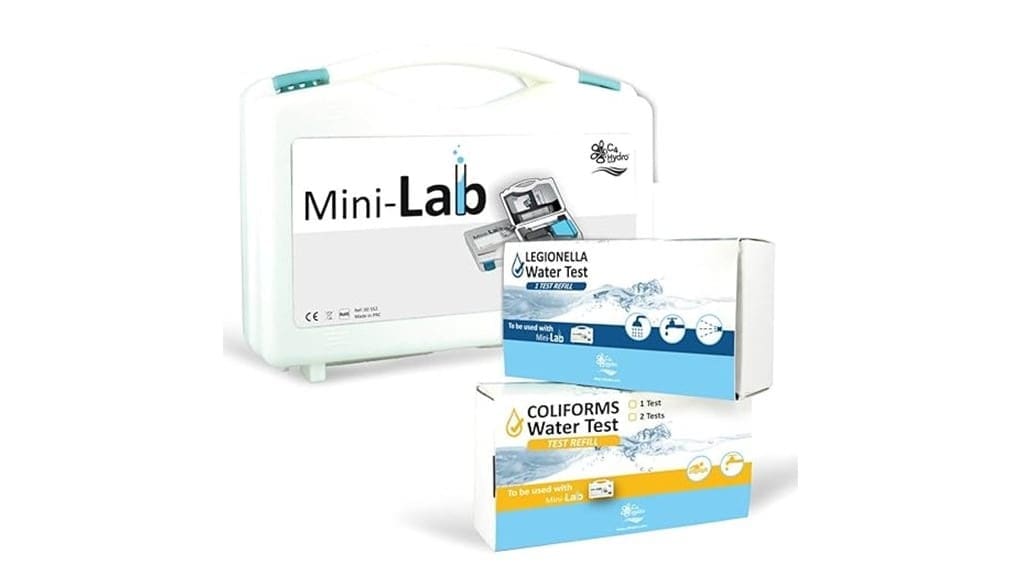
You’ll get a compact, closed-incubation starter kit that lets you screen water for coliforms in 24 hours and presumptive Legionella in 48 hours with color-change indicators and minimal handling. The sealed incubator and enzymatic media reduce contamination risk and simplify workflow, but results are presumptive—confirm with an accredited lab for regulatory or clinical decisions. It’s fast and cost-effective for routine surveillance; continue for setup, accuracy nuances, and purchase tips.
Some Key Takeaways
- Provides fast, lab-quality presumptive screening for Legionella (48 hours) and coliforms (24 hours) using closed incubation and color-change readouts.
- Sealed incubator and enzymatic media reduce contamination and handling-related false positives compared with open home tests.
- Simple home workflow: collect sample, seal vial, incubate, read color strips at 24 and 48 hours, and photograph results for records.
- Results are presumptive; confirmatory testing by an accredited lab is recommended for regulatory, clinical, or public-health decisions.
- Best for rapid triage by homeowners and small managers; compare kit cost to local lab fees before purchasing (ASIN B08NPBZ328).
Quick Verdict: Is the Legionella & Coliforms Water Test Worth Buying?
If you need fast, lab-quality screening at home, this starter kit delivers: it uses a closed cultural method and an electric incubator to detect Legionella in 48 hours and coliforms (including E. coli) in 24 hours, with clear color-change readouts and a straightforward protocol. You’ll get reliable, instrument-free outcomes that address core user concerns: contamination risk, interpretability, and turnaround time. Analytically, its closed incubation and enzymatic indicators reduce false positives from handling. For budget decisions, perform a cost comparison against local lab testing and recurring kit purchases; the starter kit often lowers total cost and shortens response time for routine surveillance. It’s a convenient option for homeowners monitoring pool water quality on their property.
What’s in the Box and How the Closed Incubation Test Works
Having established the kit’s speed and lab-quality approach, let’s examine exactly what you get and how the closed incubation system produces reliable counts. The box supplies a single sealed container incubator, electric plug, inoculation vials with reactive media, color-change strips, enzymatic reagents and a concise user guide. You’ll place sampled vials into the sealed container to cultivate organisms without external contamination; temperature stability and isolation drive reproducible growth kinetics. After specified intervals the color interpretation strips paired with media indicate Legionella (48h) and coliform presence (24h). This closed workflow minimizes handling, contamination risk, and operator error. The kit is especially convenient for homeowners who use digital pool testers to keep their outdoor water spaces safe and balanced, complementing routine pool maintenance practices.
Step-by-Step Home Setup and Reading Results (Legionella 48h, Coliforms 24h)
Start by laying out the incubator, vials, reagents and guide on a clean, level surface near a mains socket so you can power the unit without stretching cables. You’ll collect a measured water sample, seal it in the vial, label clearly and insert into the incubator. Plug in, set timer for coliform read at 24 h and Legionella at 48 h. Use color-change strips per guide; photograph results for record-keeping. If ambiguous, follow sample troubleshooting steps: repeat test, check sterility range, verify incubation temperature and seal integrity. Perform result validation against control indicators provided. Store unused reagents in a cool, secure spot designed for pool chemical storage to maintain safety and product integrity.
Accuracy, Speed, and Safety: Lab-Quality Culture Claims and Limitations
Once you’ve run samples and recorded color-change readouts at 24 and 48 hours, you should scrutinize how the kit’s “laboratory-quality culture” claim maps to real-world performance. You’ll assess sensitivity, specificity, and limits of detection versus reference labs. Expect faster turnaround but note trade-offs: closed incubation lowers contamination risk but doesn’t eliminate false positives from environmental enzymes or cross-reactive flora. For regulatory compliance, home results can guide action but rarely substitute certified lab confirmation required by authorities. Follow manufacturer protocols, document ambient conditions, and treat positives as presumptive until validated by accredited testing to guarantee accurate public-health decisions. Homeowners who maintain pool equipment should also consider routine skimmer inspections to reduce contamination risk and prolong equipment life, as part of general pool maintenance.
Who Should Buy This Kit and Where to Buy It (Uses, Alternatives, Price Pointers)
If you need rapid, at-home screening for Legionella and coliforms in taps, wells, pools, or tanks, this starter kit suits homeowners, small-property managers, and field technicians who want presumptive results before commissioning a certified lab; it’s best when you require quick triage (24–48 hours) to decide on interim actions but still plan confirmatory testing for regulatory or clinical decisions. You’ll want it if you conduct homeowners testing or manage rural properties lacking routine municipal monitoring. Buy from reputable suppliers or Amazon (ASIN B08NPBZ328); compare price to single-sample lab fees. Alternatives: professional lab culture, PCR services, or multi-sample kits. This kit complements other outdoor-maintenance products for pool and property care, helping integrate water screening into routine maintenance.
Some Questions Answered
Can This Kit Be Reused or Are Components Single-Use Only?
No — most components are single use components, but the incubator is a reusable incubator. You’ll discard the culture vessels, reactive strips, and consumable reagents after each test to avoid cross-contamination and preserve sterility. The electric plug incubator operates from mains and can be reused across multiple kits, however you must follow cleaning and handling protocols in the user guide to prevent carryover and guarantee reliable 24–48 hour results.
Does the Incubator Require Ventilation or Can It Run in Bathrooms?
No — the incubator needs ventilation and you shouldn’t run it in bathrooms. You’ll want a dry, ventilated area with stable mains power to maintain set temperature and prevent moisture ingress that can compromise electronics and culture integrity. Bathroom placement risks high humidity, temperature fluctuations and aerosols that affect results and safety. Provide at least moderate airflow, avoid steam sources, and follow the user guide for minimum clearance and environmental limits.
Are Results Affected by Hard Water or Water Treatment Chemicals?
Yes — hard water and chemical residues can affect results. You’ll see reduced bacterial recovery if scale or disinfectant residues inhibit culture growth or alter enzymatic readouts; residual chlorine, bromine, or oxidizers suppress viable counts, while heavy mineral deposits can trap organisms and impede media contact. You should neutralize disinfectants per protocol, pre-filter or dilute turbid/hardy samples, and follow the user guide to guarantee accurate cultural and color-change readings.
Is Overnight Shipping Required for Time-Sensitive Samples?
No — overnight shipping isn’t strictly required for this kit if you follow proper overnight logistics and sample preservation protocols. You should minimize transit time, keep samples cool, avoid direct heat, and use provided closed incubation materials to limit contamination. If delays exceed recommended windows (24–48 hours) or you’re testing sensitive sites, prioritize rapid shipment. Document chain-of-custody and temperature conditions to guarantee reliable cultural-method results.
Can the Kit Detect Legionella Species Beyond L. Pneumophila?
Yes — you can detect species beyond L. pneumophila, but confirm species coverage in the manual. You’ll rely on a cultural method that supports growth of multiple Legionella species, yet cross reactivity risks exist with non-target environmental bacteria. You should follow incubation and readout protocols precisely, and consider follow-up speciation (e.g., lab PCR or MALDI-TOF) if precise identification of non-pneumophila species is required.