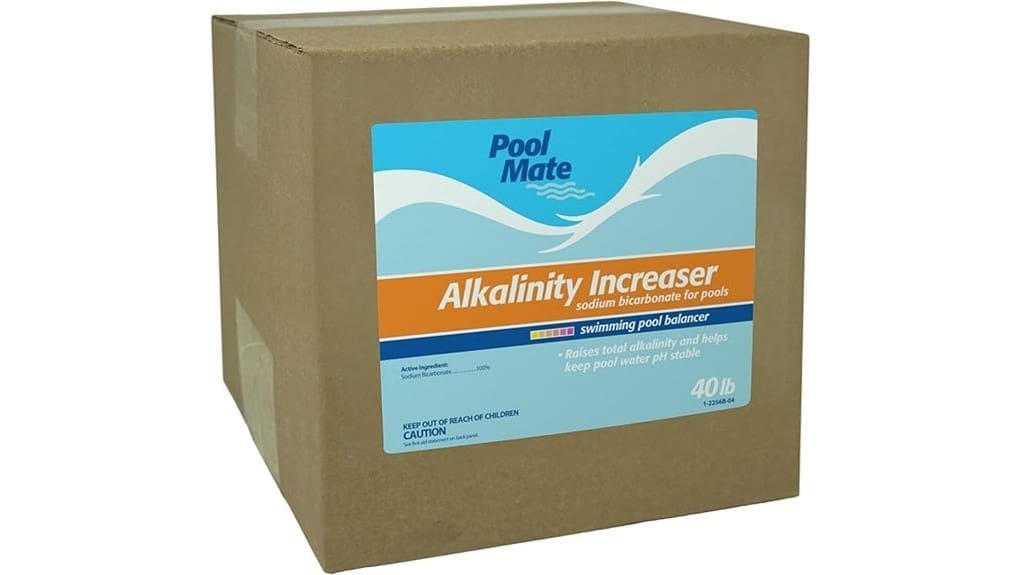
You’ll get a reliable, predictable alkalinity boost with Pool Mate’s 40-lb sodium bicarbonate: 11 oz raises total alkalinity about 10 ppm per 5,000 gallons, so dosing is simple and repeatable. It raises TA with minimal pH overshoot, stabilizing carbonate equilibrium to protect plaster and equipment. Broadcast granules with the pump on, add in 10–20 ppm increments, and retest in 4–6 hours. Keep gloves, goggles, and dry storage; more detailed guidance follows.
Some Key Takeaways
- Reliable 100% sodium bicarbonate raises total alkalinity predictably with minimal pH overshoot.
- Dosing: 11 oz increases alkalinity by 10 ppm per 5,000 gallons; retest after 4–6 hours.
- Bulk 40-lb bag offers cost-effective routine maintenance for homeowners and pool operators.
- Easy application: broadcast granules around deep end with pump running; pre-dissolve optional.
- Safety: use gloves/goggles, keep dry sealed storage, and avoid inhalation or contact.
Quick Verdict : Is Pool Mate 40‑lb Alkalinity Increaser Worth Buying?
If you need a reliable, straightforward way to raise and stabilize total alkalinity, Pool Mate 40-lb Alkalinity Increaser is worth buying: it’s pure sodium bicarbonate, dosed predictably (11 oz raises alkalinity 10 ppm per 5,000 gallons), and keeps alkalinity in the recommended 60–120 ppm band to protect plaster and equipment from pH-driven damage. You’ll find cost comparison favors bulk 40-lb packaging for routine maintenance versus smaller bags. Installation is simple; dosing calculations are reproducible. User testimonials report consistent results and fewer pH swings. For budget-conscious operators who need predictable alkalinity control, it’s a practical choice. Maintaining proper alkalinity also helps prevent rapid pH fluctuations that can lead to corrosion or scaling, an important part of pool shock treatment routines.
What’s in the Bag and How It Works (100% Sodium Bicarbonate, Alkalinity vs. pH)
Open the bag and you’ll find pure sodium bicarbonate—no fillers or additives—so what you’re adding to the pool is a single, predictable compound that increases total alkalinity without directly raising pH as much as lime-based products do. You’ll rely on buffer chemistry: bicarbonate ions resist pH swings by shifting the carbonate equilibrium between CO2, HCO3-, and CO3(2-). That stabilizes water and protects surfaces. For accurate adjustments, verify meter calibration before and after dosing. Pay attention to dose timing relative to circulation and filtration to guarantee uniform distribution and reliable test readings for targeted alkalinity maintenance. Many homeowners use alkalinity increasers to keep pool alkalinity balanced and preserve healthy water and outdoor enjoyment.
Real-World Dosing Guide and How to Raise Alkalinity Safely (11 Oz → +10 Ppm per 5,000 Gal)
Start by measuring your pool’s volume and current total alkalinity so you can calculate an exact dose. Use the product rule: 11 oz raises alkalinity 10 ppm per 5,000 gallons. Plan dosage timing to add increments (max 10–20 ppm per treatment) and retest after 4–6 hours. For application methods, broadcast granules evenly around deep end with pump running; avoid pouring all in one spot. Granule dissolution speeds with circulation; pre-dissolving in bucket isn’t necessary but can reduce local concentrations. Follow Safety precautions: wear gloves, goggles, avoid inhalation, keep children/pets away, store dry. Maintaining proper alkalinity also helps stabilize pH and promotes healthier pool water.
Pros and Cons for Pool Owners (Stability, Corrosion/Plaster Protection, Handling, Storage)
Because Pool Mate is pure sodium bicarbonate, you get a predictable, low-risk way to stabilize total alkalinity and help protect metal fittings and plaster surfaces, but you’ll trade off the need for careful dosing, handling dry powder, and room for storage. You’ll benefit from precise dosing: 11 oz raises alkalinity ~10 ppm per 5,000 gallons, which simplifies stability monitoring and reduces pH drift that causes corrosion or etching. Downsides: you must measure and broadcast-add to avoid localized high concentrations, wear PPE when handling, and allocate dry, cool space. Follow storage tips: sealed container, off concrete, moisture-free environment. It’s also useful for homeowners who want simple tools to maintain safe water with pool water test kits.
How It Compares to Other Alkalinity Products and When to Choose It
When you compare Pool Mate’s pure sodium bicarbonate to other alkalinity products—like sodium carbonate (soda ash), trisodium phosphate blends, or combined alkalinity/pH increasers—you’ll find it delivers predictable, low-risk alkalinity boosts without noticeably raising pH, making it the preferred choice when you need controlled, gradual correction and minimal pH overshoot. You’ll choose it for reliable alkalinity buffering, stable target 60–120 ppm, and measured dosing (11 oz → 10 ppm/5,000 gal). Compared to soda ash it avoids sharp pH shifts; versus blends it simplifies chemistry. Consider application temperature, product longevity, and brand reputation when prioritizing consistent pool protection.
Some Questions Answered
Is This Product Safe for Vinyl and Fiberglass Pools?
Yes — you can use it safely. You’ll find Vinyl compatibility is high because 100% sodium bicarbonate is non-corrosive and won’t attack liners when dosed per instructions. Fiberglass effects are minimal; bicarbonate won’t etch gelcoat or resin. You should dissolve or broadcast evenly, avoid concentrated contact, and maintain total alkalinity 60–120 ppm. Follow dose guidance (11 oz per 5,000 gallons = +10 ppm) to prevent localized high concentrations.
Can I Add It Directly to a Running Pool Skimmer?
No — you shouldn’t add it directly to a running pool skimmer. Avoid direct, skimmer clogging application by broadcasting sodium bicarbonate around the deep end or using bypass dosing via the return line. Follow manufacturer recommendations: pre-dissolve for localized high concentrations or pour slowly while the pump circulates. That prevents localized pH/alkalinity spikes, equipment stress, and skimmer blockage, ensuring even distribution and accurate chemical control.
How Long After Adding Will Alkalinity Stabilize?
You’ll see measurable change within a few hours, but alkalinity will typically stabilize in 24–48 hours. Add sodium bicarbonate evenly, run filtration and circulate water; expect gradual adjustment as the compound dissolves and distributes. Test alkalinity after 24 hours, then again at 48 hours before making further adjustments. This prevents overshooting target 60–120 ppm and protects equipment and surfaces by ensuring accurate, incremental dosing.
Is It Safe to Use With Saltwater Chlorinators?
Yes — it’s safe to use with saltwater chlorinators. You’ll add sodium bicarbonate to raise total alkalinity without disrupting salt cell function; it doesn’t introduce chlorides that harm equipment. Monitor saltwater compatibility by checking electrolyte balance and salinity after dosing, since large additions slightly dilute salt concentration. Adjust dosing to maintain 60–120 ppm alkalinity and verify salt levels remain within the manufacturer’s recommended range for your chlorinator.
Can I Store Opened Bags Outdoors in Summer?
Yes — but you must store opened bags outdoors in summer with precautions. You’ll keep dry and avoid sunlight to prevent caking and chemical degradation. Use airtight secondary containers or heavy-duty plastic bins, seal tightly, and keep offground on pallets to prevent moisture wicking. Check periodically for clumping or contamination. If humidity or temperatures are high, consider relocating indoors; prolonged exposure will reduce effectiveness and complicate dosing accuracy.