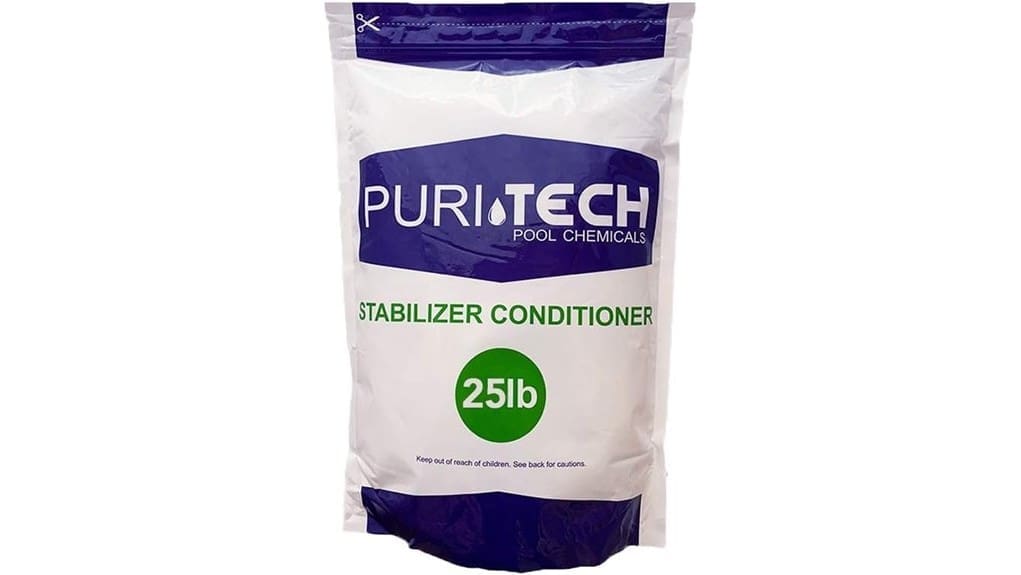
You’ll get a high‑purity cyanuric acid stabilizer that protects your free chlorine from UV loss and gives predictable dosing (1 lb per 10,000 gal ≈ +10 ppm). It dissolves quickly when pre‑dissolved, comes in resealable 25 lb packaging, and is suited for residential or commercial pools and spas. Use calibrated dosing, wear gloves and eye protection, and monitor CYA after 24 hours to avoid buildup. Keep it dry and sealed for best results; more details follow.
Some Key Takeaways
- Pure cyanuric acid formulation that reliably protects chlorine from UV degradation, extending sanitizer life in pools and spas.
- Dosing is predictable: 1 lb per 10,000 gallons raises cyanuric acid by approximately 10 ppm for precise adjustments.
- Fast-acting granules dissolve predictably when pre-dissolved, enabling quick stabilization and reduced daily chlorine demand.
- Resealable 25 lb packaging offers bulk value and spill reduction, but requires secure, dry storage to prevent clumping.
- Watch for CYA buildup from overdosing and use gloves/eye protection during handling to avoid irritation.
What Puri Tech Stabilizer & Conditioner Is and Who It’s For
Although it’s simple in composition, Puri Tech Stabilizer & Conditioner delivers a precise technical function: it’s a 100% cyanuric acid product designed to protect chlorine from UV degradation in pools and spas. You get a pure, fast-acting stabilizer that preserves free chlorine, extending disinfectant efficacy and reducing dosage frequency. If you manage residential or commercial pools, or maintain a spa, this targets sunlight-driven chlorine loss with predictable cyanuric chemistry. It’s suited for routine seasonal maintenance and for operators who need consistent stabilization without additives. Packaging is user-oriented, minimizing spills and simplifying storage for regular maintenance cycles. Regular shock treatments are important to maintain water quality and keep your pool sparkling.
How to Use It: Dosing, Application, and Safe Handling
Now that you know what the product does and who it’s for, here’s how to use it safely and effectively. You’ll measure by pool volume: 1 lb per 10,000 gallons raises cyanuric acid ~10 ppm. Use calibrated dosing equipment or a digital scale; avoid estimating by eye. Pre-dissolve granules in a bucket of warm water if instructed, then broadcast around pool perimeter with circulation running. Monitor levels after 24 hours and adjust. Application timing: add during low bather use and moderate temperatures to guarantee mixing. Wear gloves, eye protection, and store the resealable 25 lb container sealed, dry, away from children. Maintaining proper cyanuric acid levels is essential for protecting chlorine from rapid breakdown due to sunlight exposure.
Performance in Pools: Chlorine Protection, Speed, and Results
When you add Puri Tech Stabilizer & Conditioner to your pool, it directly shields free chlorine from UV degradation so your sanitizer stays effective longer. You’ll see measurable chlorine longevity: the 100% cyanuric acid binds UV energy, slowing sunlight degradation and reducing daily chlorine demand. The fast-acting formula dissolves predictably, letting you adjust ppm precisely (1 lb/10,000 gallons = +10 ppm). That control means fewer shock treatments and steadier free chlorine residuals. In practice, stabilization delivers consistent sanitizer performance with minimal lag. You’ll monitor levels and top up per protocol; results are efficient, repeatable, and technically reliable. Many homeowners also pair stabilizers with pool clarifiers to maintain clear pool water and improve overall water quality.
Pros, Cons, and Real-World Considerations (Packaging, Purity, Storage)
Because Puri Tech Stabilizer & Conditioner is 100% cyanuric acid and comes in resealable, easy-pour 25 lb packaging, you get precise, fast-acting stabilization with minimal mess and predictable dosing (1 lb/10,000 gal = +10 ppm), but you should watch for over-stabilization risks, proper dissolution, and secure storage to prevent moisture ingress or accidental exposure. You’ll appreciate high purity for predictable chemistry and rapid dissolution when pre-dissolved. Packaging durability reduces spills and contamination; check seals on arrival. Cons: cyanuric acid buildup if overdosed, irritation risk if mishandled. Maintain cool, dry conditions to maximize Storage lifespan and avoid clumping or degradation. Store chemicals in cool, dry areas away from children and pets.
Should You Buy It? Cost, Alternatives, and Final Recommendation
If you want reliable, predictable stabilization for your pool, Puri Tech Stabilizer & Conditioner delivers: its 100% cyanuric acid formula gives precise dosing (1 lb/10,000 gal = +10 ppm), fast dissolution when pre-dissolved, and convenient resealable 25 lb packaging that cuts mess and simplifies storage. You should buy it if you prioritize purity, predictable dosing, and bulk value. For small yards, upfront cost may seem high; run a price comparison per pound of active ingredient versus smaller containers. Consider alternative brands with blended stabilizers only if you need combined products, but for pure CYA this is my recommended choice. Many homeowners find maintaining proper pool stabilizer levels improves outdoor swimming enjoyment and protects chlorine effectiveness.
Some Questions Answered
Can Cyanuric Acid Harm Pool Equipment Over Time?
Yes — cyanuric acid can contribute indirectly to equipment scaling and, under certain conditions, to pool corrosion over time. You’ll prevent problems by maintaining proper CYA and chlorine levels, balanced pH and alkalinity, and regular filtration. High CYA concentrates reduce sanitizer efficacy, promoting buildup that leads to scaling on surfaces and stress corrosion in metals. Monitor levels, follow dosage guidelines, and inspect equipment to avoid long-term damage.
Is It Safe for Freshwater Aquariums if Accidentally Transferred?
No — you shouldn’t introduce cyanuric acid into freshwater aquariums; it’s unsafe for fish health and can disrupt tank cycling. Even small amounts can bind chlorine, alter chemistry, and stress or kill sensitive species. If contamination occurs, perform partial water changes, test CYA, ammonia, nitrite, nitrate, and stabilize parameters slowly. Use activated carbon and biological filtration boost to help remove and recover tank cycling balance.
How Quickly Does It Dissolve in Cold Water?
It dissolves slowly in cold water; you’ll see a low dissolution rate compared with warm conditions. Dissolution depends on particle size: finer particles dissolve noticeably faster than coarse granules. In cold pools or tubs expect prolonged dispersion and partial settling, requiring extended mixing or pre-dissolving in warm water. For predictable results, measure particle size distribution and agitate vigorously; don’t assume rapid solubility at low temperatures.
Can It Be Used With Every Type of Chlorine Sanitizer?
Yes — you can use it with most chlorine sanitizers, but be aware of free chlorine interaction and stabilizer compatibility. You’ll add cyanuric acid to protect free chlorine from UV degradation; it’s compatible with sodium hypochlorite, calcium hypochlorite, and stabilized chlorine like trichlor. Avoid over-stabilizing; high CYA reduces sanitizer efficacy. Monitor levels and adjust dosing per pool volume to maintain peak stabilizer compatibility and free chlorine residuals.
Are There Seasonal Limits on Safe Stabilizer Levels?
Yes. You should adjust levels seasonally: lower cyanuric acid during winter stabilization to avoid excessive buildup and reduced chlorine efficacy when pools see less sunlight and use. Follow seasonal dosing—maintain 30–50 ppm in summer for UV protection, but aim toward the lower end (20–30 ppm) or partially drain/replace water in winter. Test regularly and avoid letting CYA climb above ~100 ppm year-round to preserve sanitizer performance.