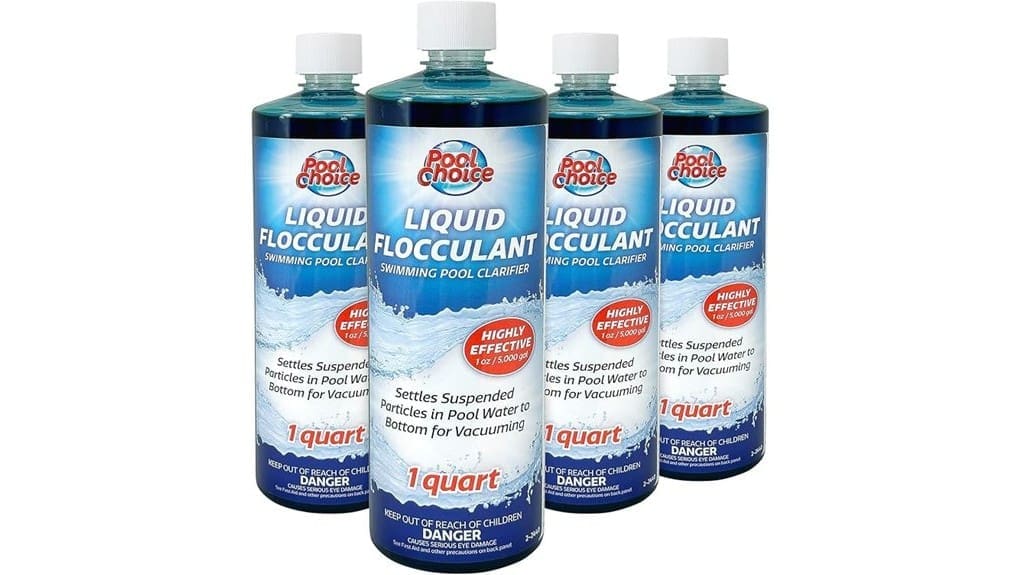
You’ll get a lab-grade liquid flocculant that binds suspended organic and inorganic particles into flocs you can vacuum to waste. Dose precisely: 1 oz per 5,000 gal using the graduated cap, run pump briefly, then stop circulation and allow 4–24 hours for settling. It clears cloudiness predictably when pH and sanitizer are correct and you remove settled residue; the 4‑pack cuts per‑ounce cost and suits multi‑pool or seasonal use — more details follow.
Some Key Takeaways
- Concentrated liquid flocculant bonds and settles suspended particles; dose is 1 oz per 5,000 gallons for predictable clarity restoration.
- Most users see measurable cloudiness reduction within 12–24 hours when circulation is paused and product is allowed to settle.
- Proper results require pH and sanitizer control, adding product with pump on 1–2 minutes, then shutting circulation for 4–24 hours.
- Remove settled flocs by slow vacuum-to-waste; this prevents filter strain and permanently removes residue.
- Four-quart pack lowers per‑ounce cost, suits multiple pools or seasonal use, but requires storage and has expiration considerations.
What SpaChoice Flocculant Is and How It Works
Think of SpaChoice Liquid Flocculant as a targeted clarifier that binds suspended organic and inorganic particles into heavier aggregates so they settle to the pool floor. You’ll apply measured doses; polymer chemistry drives charge neutralization and bridging between colloids, initiating particle aggregation. The settling mechanism converts colloidal suspension into discrete flocs that overcome Brownian motion and settle by gravity. You’ll then vacuum the settled mass to waste, achieving turbidity reduction without prolonged filtration cycles. Instructions specify 1 ounce per 5,000 gallons; follow contact and removal steps precisely to restore clarity while minimizing chemical overuse. This product is ideal for homeowners who enjoy maintaining clear outdoor pools and spas with simple, effective treatments for clear pool water.
Does It Work? Real-World Performance and Results
Having explained how SpaChoice flocculant aggregates particles, let’s examine whether that chemistry produces clear, usable results in real pools. You’ll see measurable cloudiness reduction within 12–24 hours when filtration is paused and particles settle; vacuuming to waste then removes residue. In tests on organic and inorganic turbidity you’ll note rapid floc formation and reduced turbidity units. User testimonials corroborate consistent clearing across varied pool volumes, though efficacy depends on correct pre‑treatment (pH, sanitizer). Expect transient filter strain if you don’t vacuum settled material. Overall, performance is predictable and repeatable when protocol and water chemistry are controlled. Homeowners who use flocculants often enjoy clearer outdoor spaces and simpler maintenance routines when following product directions and pool care basics like clearer pool water.
How to Dose and Use the 1‑Quart Bottle Safely and Effectively
When you’re treating a typical backyard pool, follow the label dose of 1 ounce per 5,000 gallons and measure precisely with a graduated cup or syringe to avoid overdosing. Add measured flocculant to the deepest point with pump and pool circulation running for 1–2 minutes, then shut circulation off to allow particles to settle. Wait 4–24 hours depending on clarity, then vacuum timing is critical: vacuum slowly to waste to remove settled floc. Store bottles upright in cool, ventilated area; safe storage limits degradation. For any spill cleanup use absorbent material, neutralize per label, and dispose of residues properly. Many homeowners pair flocculant use with periodic shock treatments to maintain overall water clarity and sanitation.
Pros, Cons, and Who Should Buy the 4‑Pack
Because a 4‑pack gives you four quarts of concentrated flocculant, you’ll get predictable dosing for multiple treatments and less frequent repurchasing; the bottles are sized and labeled for precise 1‑ounce-per-5,000‑gallon measurements, letting you treat pools up to ~20,000 gallons per bottle if used conservatively. Pros: consistent, labeled dosing; effective on organic/inorganic particulates; vacuum-to-waste workflow; made in USA quality control. Cons: single‑use liquid requires storage space; expired product risk if unused; not a substitute for filtration. Who should buy: budget buyers managing several pools, seasonal users prepping opening/closing procedures, and facilities needing reliable, repeatable clarification. Proper filtration and regular use of filter powder help maintain long-term water clarity and reduce reliance on flocculants.
Price, Packaging, and Where It Fits Compared to Other Clarifiers
Compare the SpaChoice 1‑Quart 4‑Pack to alternatives by cost per treatment and storage efficiency: at typical retail prices the bundle lowers per‑ounce cost versus single bottles and gives you four labeled quarts that support precise 1‑ounce dosing for pools up to ~20,000 gallons each, reducing frequency of repurchase. For price comparison, calculate cost per ounce and per 5,000‑gallon dose; the 4‑pack yields lower unit cost and predictable inventory. Packaging durability is adequate for garage or chemical shed storage; bottles resist minor impact and seal well. It fits between budget clarifiers and premium concentrates for routine maintenance. The 4‑pack is a practical choice for homeowners who maintain outdoor pool and spa areas and want consistent results with pool mineral systems.
Some Questions Answered
Can It Be Used in Hot Tubs or Only Pools?
You can use it in hot tubs, but you’ll want to check thermal compatibility and adjust dosing. For hot tubcare tips, dose proportionally (1 ounce per 5,000 gallons), though typical hot tubs are much smaller so scale down precisely. Add while circulating, allow particles to flocculate, then vacuum to waste. Avoid use if manufacturer advises against concentrated chemical exposure at higher temperatures; test water balance before and after treatment to assure safety.
Is the Product Safe for Vinyl Liners and Pool Surfaces?
Yes — it’s safe for vinyl liners and most pool surfaces when used as directed. You’ll maintain vinyl compatibility by dosing correctly (1 oz/5,000 gal), avoiding concentrated contact, and allowing full dilution. You should perform surface testing on an inconspicuous area first to confirm no discoloration or softening. After flocculation, vacuum to waste promptly. Follow manufacturer guidance and don’t exceed recommended dosage to protect finishes and liners.
Does It Affect Chlorine or Other Sanitizer Levels?
It won’t appreciably consume chlorine, but you should monitor levels after use. The flocculant binds particles; any trapped organics might slightly demand sanitizer, so perform chlorine interaction checks. Test free chlorine and combined chlorine before dosing and after flocculation and vacuuming. If free chlorine drops, shock per manufacturer guidelines. Regular sanitizer testing guarantees disinfection remains adequate during and after treatment to maintain safe pool water.
How Long Is the Shelf Life Unopened and After Opening?
Unopened, you can expect about 2–3 years before an expiration date affects potency if you follow recommended storage conditions. After opening, you should use it within 12 months for reliable performance. Store sealed bottles in a cool, dry place away from direct sunlight and extreme temperatures; keep caps tightly closed and upright to minimize contamination. Document purchase/opening dates to track expiration and maintain efficacy.
Is the Bottle Recyclable or How Should Empty Bottles Be Disposed Of?
You should rinse and triple-drain the empty bottle before recycling; check the label for local recycling instructions and confirm the plastic code. If your municipality accepts the bottle’s plastic, place it in recycling; otherwise follow disposal guidance by treating it as non-hazardous household waste. For contaminated or chemical residue, take the bottle to a household hazardous waste facility. Keep caps separate if local programs request removal.