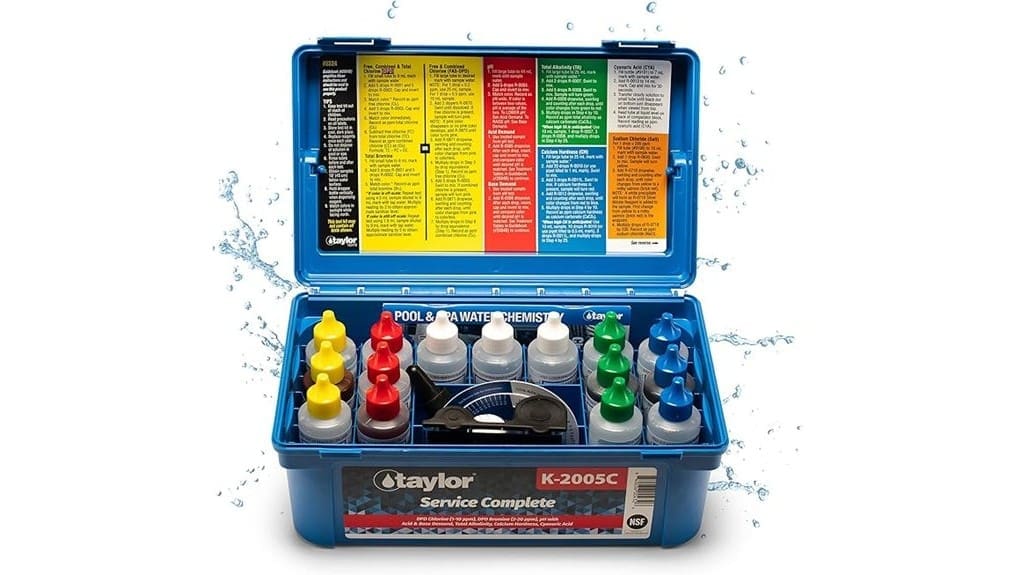
You’ll get lab-grade accuracy and commercial reagent capacity in a field-ready kit with the Taylor K-2005C. You’ll test free/total chlorine, bromine, pH, total alkalinity, calcium hardness and cyanuric acid with DPD chemistry and comparator color matching. The two-ounce reagent bottles give substantially more tests per kit and the robust case stands up to service work. It’s ideal for pros, multi-pool properties, and serious homeowners who want repeatable results; keep going to see full procedure and buying tips.
Some Key Takeaways
- Provides professional-grade accuracy for residential and small commercial pools with laboratory-style reagents and comparator matching.
- Measures free/total chlorine, bromine, pH, alkalinity, calcium hardness, and cyanuric acid for comprehensive water management.
- Uses larger 2 oz reagent bottles, offering roughly 2.5× the test capacity and lower per-test cost than standard kits.
- Comparator method and DPD high-range reagents deliver consistent, repeatable results with field durability.
- Best for frequent testers, service professionals, and multi-pool properties; infrequent users may prefer smaller K-2005.
Which Pool Owners Should Choose the Taylor K-2005C?
If you maintain a residential or small commercial pool and need thorough, professional-grade readings without specialized training, the Taylor K-2005C is the right choice. You’ll find it suits beginner homeowners who want laboratory-level accuracy with straightforward procedures and pictogram instructions. You’ll also rely on it as a commercial operator or for small facilities where reagent volume and durability matter; the 2 oz bottles reduce replacement frequency and support seasonal workloads. The comparator-based method keeps sampling consistent, and Taylor’s U.S. manufacturing and support back performance expectations. Choose this kit when you need reliable, repeatable results without technical certification. For homeowners who enjoy their outdoor spaces, pairing the kit with easy digital testers can simplify routine maintenance and ensure consistent readings for pool care, starting with digital pool testers.
What the K-2005C Tests and Why Those 9 Parameters Matter
Having a kit that balances professional accuracy with user-friendly procedures is only part of maintaining safe water; you also need to know what each measurement tells you. The K-2005C tests Free and Total Chlorine, Bromine, pH, Acid and Base Demand, Total Alkalinity, Calcium Hardness, and Cyanuric Acid. Free/Total Chlorine reveal sanitant strength and chlorine breakdown versus combined chlorine. pH and Acid/Base Demand control sanitant efficacy and corrosion risk. Total Alkalinity buffers pH, while Calcium Hardness indicates scaling or corrosion potential. Cyanuric Acid stabilizes chlorine in sunlight. Together these nine parameters let you diagnose and restore precise water balance. Regular testing and the right products help homeowners keep pool water clear and enjoy their outdoor spaces.
How the K-2005C Works Step-by-Step (Sample, Reagents, Read)
Because accurate results start with a proper sample, you’ll begin by collecting water into the included comparator to the specified mark, avoiding surface skimming and ensuring the sample temperature is near pool temperature. Next, follow the reagent sequence: add measured drops or tablets per test instruction, cap, invert or shake to mix, and wait mandated reaction times. Take care to prevent sample contamination by using clean tools and replacing caps immediately. Finally, place the comparator against the color chart and perform color interpretation under consistent light, matching hue and intensity. Record values promptly and dispose of reagents per label. Many homeowners find that regular testing with simple kits helps maintain a safe pool water environment and prevents common issues.
Performance and Practicality: Accuracy, Reagent Capacity, and Durability
While lab-grade accuracy isn’t expected from a field kit, the K-2005C delivers consistent, precise readings for routine pool and spa management thanks to its DPD high-range reagents and clear comparator system. You’ll get reliable free and total chlorine, pH, alkalinity, hardness and CYA data with minimal measurement drift when procedures are followed. Two-ounce reagent bottles extend service life, reducing reagent change frequency for high-use sites. Construction and packaging emphasize field robustness; the comparator resists wear and reagents store securely. For routine maintenance and commercial cycles you can depend on steady performance and straightforward upkeep. Ideal for homeowners who enjoy their outdoor spaces, it simplifies seasonal pool care and saves time with pool maintenance essentials.
Value and Buying Advice: Kit Size, Replacement Reagents, and Who It’s Best For
If you manage multiple pools or run commercial service, the K-2005C’s 2 oz reagent bottles give you markedly better value—providing over 2.5× the test capacity of the standard K-2005 and reducing downtime for reagent swaps. You’ll want to evaluate bundle options for replacement reagents versus individual purchases; bundles lower per-test cost and simplify inventory. Factor seasonal planning into reagent ordering to avoid winter storage degradation and summer shortages. The K-2005C suits service pros, multi-pool properties, and busy homeowners who test frequently. If you test rarely, the smaller K-2005 remains the more cost-effective choice. Consider stocking essential pool opening chemicals like sanitizers and shock treatments ahead of spring to ensure a sparkling start to the season.
Some Questions Answered
Is the K-2005c Suitable for Saltwater Pools?
Yes — you can use the K-2005C for saltwater pools. You’ll test chlorine, pH, CYA, alkalinity and hardness to control saltwater corrosion risks, and the DPD high-range reagents handle chlorinator output. You should monitor electrode maintenance on any electronic sensors you use alongside the kit, since salt systems stress probes. Follow reagent schedules and replace bottles as needed to maintain accurate, professional-level results and corrosion prevention.
Are the Reagents Safe to Ship Internationally?
Yes — you can ship the reagents internationally, but you’ll need to comply with shipping restrictions and hazardous labeling requirements. Check local and carrier regulations for DPD and acid/base reagents, as some countries classify them as limited quantity hazardous materials. Package securely, declare contents, apply required UN/HAZMAT labels and documentation, and use carriers authorized for chemical shipments. Consult Taylor’s SDS and your freight carrier for route-specific limitations and permits.
Can I Test Hot Tubs With This Kit?
Yes — you can test hot tubs with this kit. You’ll get hot tub specific results for free/total chlorine, bromine, pH, alkalinity, calcium hardness and CYA, despite spa chemicals and elevated temperatures. Collect samples accounting for water agitation and jet effects (turn jets off briefly), follow DPD high-range procedures, and use the comparator. Reagent volumes suit frequent spa maintenance; replacement reagents keep seasonal testing consistent and accurate.
Does Taylor Offer Calibration or Accuracy Certification?
Yes — you can obtain manufacturer certification and accuracy verification. You’ll contact Taylor for documentation or support; they provide guidance on reagent lot performance and traceable procedures. For commercial or regulatory needs, request formal accuracy verification or calibration statements from Taylor’s technical service. Keep records of lot numbers, test dates, and comparison data; Taylor’s customer service can assist with replacement reagents and procedural validation to maintain certified accuracy.
What Is the Kit’s Shelf Life Unopened?
Unopened reagents typically have a printed expiration date of about 2–3 years; check the bottle for the exact expiration date. You should store reagents in cool, dry conditions away from direct sunlight and temperature extremes; recommended storage conditions are room temperature (around 20–25°C). Follow the expiration date and storage conditions to guarantee reagents’ accuracy. Discard expired bottles and replace them with fresh reagents before use.