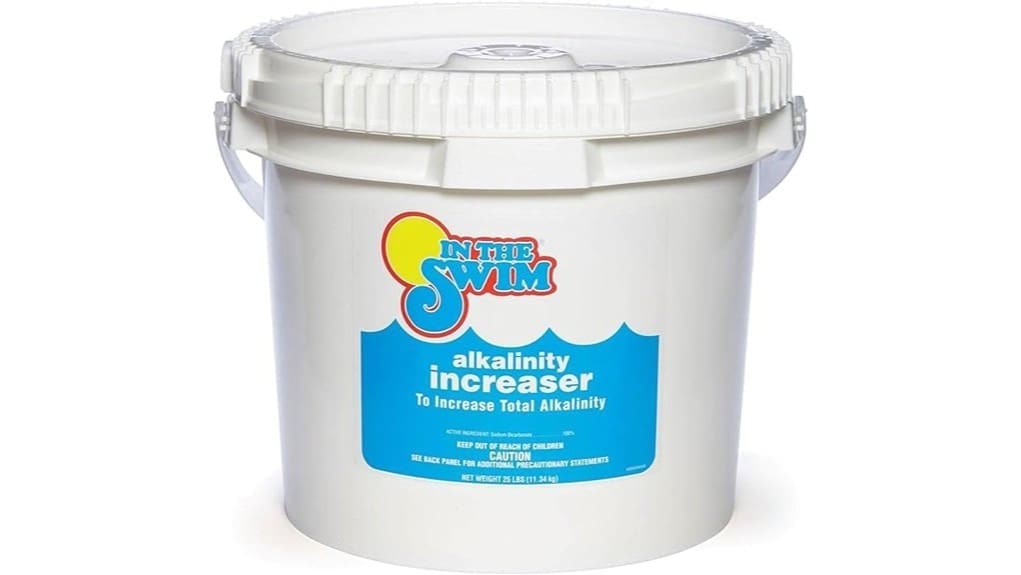
You’ll find In The Swim Alkalinity Increaser is a 100% sodium bicarbonate granular product that raises total alkalinity predictably—about 1.5 lb per 10,000 gallons for a 10 ppm increase. It stabilizes pH by bolstering bicarbonate buffering without the sharp pH jump of soda ash, dissolves quickly, and’s easy to apply around the pool with circulation running. It’s ideal for homeowners and light commercial use; continue for dosing examples, performance notes, and pros/cons.
Some Key Takeaways
- In the Swim Alkalinity Increaser is 100% sodium bicarbonate, dosed at 1.5 lb per 10,000 gallons for a 10 ppm alkalinity rise.
- It stabilizes total alkalinity to the recommended 90–120 ppm, reducing pH drift from swimmers, sunlight, and chlorine reactions.
- Granules dissolve quickly, distribute with pump circulation, and require retesting after about four hours for adjustments.
- Pros: predictable dosing, quick dissolution, skin/eye protection, and low cost; cons: no pH reducer and gradual sodium buildup.
- Best for homeowners and commercial pools needing reliable alkalinity control; measure carefully for large volumes and avoid overapplication.
What This Product Is and Who It’s For
When you need to raise and stabilize your pool’s total alkalinity, In The Swim Alkalinity Increaser delivers a straightforward, technical solution: granular sodium bicarbonate formulated to bring alkalinity into the recommended 90–120 ppm range. You’ll use a 25 lb granular product (item weight listed 27 lb) that’s 100% sodium bicarbonate, dosed at 1.5 lb per 10,000 gallons for a 10 ppm increase. It’s aimed at operators maintaining consistent chemistry—both home pools and commercial facilities. You’ll find it practical for preventing pH drift, protecting skin and eyes, and ensuring chlorine works efficiently in varied conditions. Proper stabilizer use is key to keeping pool chemistry balanced, especially for homeowners who enjoy their outdoor spaces on the property and want to preserve equipment and swimmer comfort while minimizing chemical adjustments with stabilizer tips.
How the Formula Works: 100% Sodium Bicarbonate Explained
Sodium bicarbonate works by supplying carbonate-bicarbonate buffering capacity to pool water, so when you add the granular 100% NaHCO3 it increases total alkalinity without directly raising pH as strongly as soda ash. You’ll rely on buffer chemistry: bicarbonate ions absorb H+ shifts, stabilizing pH through the carbonic acid–bicarbonate pair. Adding NaHCO3 shifts the carbonate equilibrium toward bicarbonate, enhancing alkalinity (ppm as CaCO3) and dampening pH excursions from swimmers, sunlight, or chlorine reactions. Use it to maintain the carbonate reservoir that preserves sanitizer effectiveness and prevents corrosion or scaling linked to unstable pH. Keep your pool pH balanced for clearer, safer water by regularly testing and adjusting alkalinity with products designed for homeowners who enjoy their outdoor spaces and pools like the In the Swim line pool pH.
Dosage, Target Levels, and Step-by-Step Usage for 10,000–50,000 Gal
Because alkalinity adjustments are dose-sensitive, you’ll calculate and add sodium bicarbonate precisely to reach the 90–120 ppm target range: use 1.5 lb per 10,000 gallons to raise alkalinity by 10 ppm, so for 10,000–50,000 gal scale the doses linearly (e.g., 3.0 lb for +20 ppm in 10,000 gal; 7.5 lb for +10 ppm in 25,000 gal; 15 lb for +10 ppm in 50,000 gal). Consult a dosage chart, then follow this step-by-step: measure water volume, determine required ppm increase, weigh product, dilute small batches if needed. Apply granules around perimeter with pump running; use direct mixing technique only in a bucket, not at pool bottom. Retest after 4 hours and adjust. Maintaining total alkalinity within the recommended range supports healthy pool water and helps prevent pH swings.
Performance in Real Pools: Stability, pH Impact, and User Results
Having followed the dosage steps and confirmed target alkalinity, you’ll see how In The Swim sodium bicarbonate performs in real pools: it consistently stabilizes total alkalinity within the 90–120 ppm band and exerts a predictable upward pressure on pH that’s modest and manageable. In practice, you’ll observe reduced pH fluctuation after treatment; routine testing shows smaller corrective dosing needs. User experiences report steady readings over weeks, indicating long term effectiveness. It dissolves quickly, integrates with circulation, and offers weather resilience against temperature-driven swings. Overall, you’ll find control is reliable, measurable, and straightforward to maintain. It’s also a preferred option for homeowners practicing regular shock treatment routines to keep outdoor pool water balanced.
Pros, Cons, and When to Choose This Alkalinity Increaser
When you need a reliable, predictable way to raise and stabilize total alkalinity, In The Swim Alkalinity Increaser delivers consistent, measurable results with minimal side effects; you’ll get 100% sodium bicarbonate in granular form that raises alkalinity by 10 ppm per 1.5 lb/10,000 gallons. Pros: precise dosing, predictable chemistry, protects skin/eyes, low cost option for routine maintenance, quick application method dissolves and distributes easily. Cons: only raises alkalinity (not pH reducer), adds sodium bicarbonate load over time, requires measuring for large volumes. Choose it when you want simple, economical alkalinity control and predictable stabilization. This product is suitable for homeowners maintaining outdoor pools who also monitor calcium hardness.
Some Questions Answered
Is This Safe to Use With Saltwater or Salt-Chlorine Pools?
Yes — it’s safe to use in saltwater or salt-chlorine pools. You’ll add sodium bicarbonate to raise total alkalinity without affecting salt chlorine compatibility. It won’t increase salt levels or interfere with the chlorine generator. Monitor alkalinity (90–120 ppm) and pH after dosing. Be aware of galvanic corrosion risks from dissimilar metals in salt systems; control salinity, maintain proper pH, and inspect metallic equipment regularly.
Can It Be Used in Spas or Hot Tubs?
Yes — you can use it in spas and hot tubs, but monitor carefully. This sodium bicarbonate product is spa compatible for raising total alkalinity; add small, measured doses and dissolve before dispersing. Hot tub considerations: target alkalinity still 90–120 ppm, adjust dosage proportionally for lower volumes, avoid overdosing which can cloud water and affect pH. Test frequently after each addition and circulate before retesting to make certain stability.
How Should I Store the Product After Opening?
Store it in a cool, dry place and keep the bag tightly sealed; transfer to a sealed container if original packaging is damaged. You’ll want a moisture-proof, corrosion-resistant container labeled with contents and date. Keep it away from acids and incompatible chemicals. Use a childproof capped bottle or lockable cabinet for any small portion you dispense. Always reseal immediately after use and avoid humidity to prevent caking and loss of effectiveness.
Is It Safe Around Plants and Grass if Spilled?
Yes — small spills are generally safe, but you should act quickly. Sodium bicarbonate raises alkalinity impact locally; if you leave granules on turf or soil, you’ll alter soil chemistry and can stress plants. Sweep up solids, rinse area with water to dilute and disperse, and avoid heavy accumulations near roots. For large spills, remove contaminated soil and replace it to prevent prolonged alkalinity shifts and plant damage.
Does It Affect Pool Heater or Pool Equipment Warranties?
Yes — using sodium bicarbonate as directed shouldn’t void warranties, but you need to check specifics. You’ll minimize warranty implications by following manufacturer dosing, maintaining recommended alkalinity (90–120 ppm), and ensuring proper dissolution to avoid localized corrosion. Confirm equipment compatibility with your heater and pump manuals; some warranties exclude damage from improper chemistry or chemical misuse. Keep records of treatment and water tests to support any warranty claims.