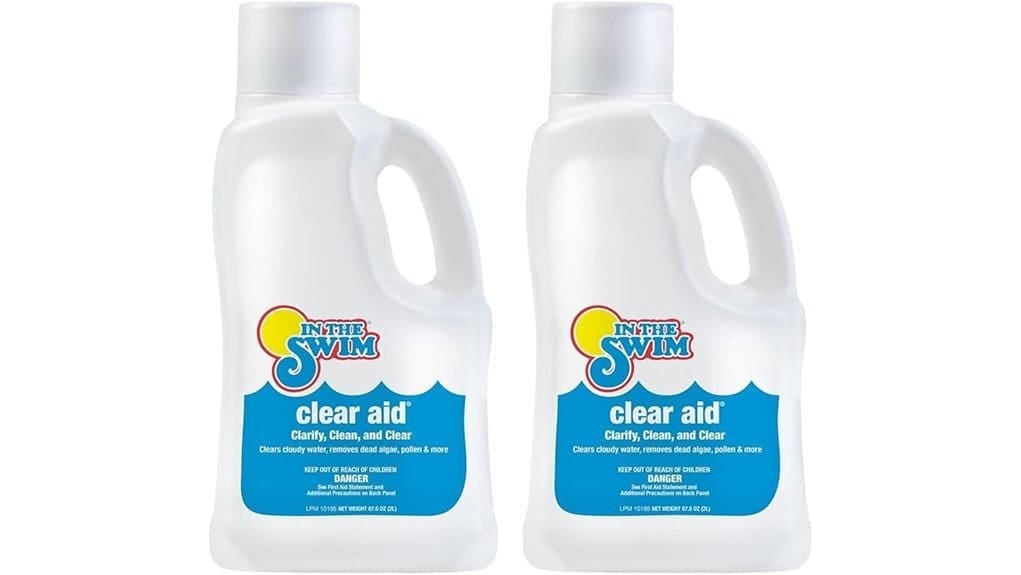
You’ll find Clear Aid quickly coagulates fine, non-living particulates into flocs that your filter can trap, clearing typical cloudiness from oils, cosmetics, pollen and dead algae fragments. You’ll see visible clarity gains in 24–48 hours with proper dosing and continuous filtration, plus reduced backwash frequency and modest flow changes as aggregates form. It’s non‑toxic, pool- and filter‑safe but won’t treat live algae or chemical imbalance — keep reading for dosing, tips and caveats.
Some Key Takeaways
- Clarifies cloudy pools by coagulating fine, non-living particles into flocs for easier filter capture, often visible within 24–48 hours.
- Targets suspended solids like oils, cosmetics, pollen, sunscreen, and dead algae fragments without changing pool chemistry.
- Non-toxic, suitable for all pool and filter types, and reduces backwash frequency by improving particle retention.
- Dose by pool volume per label, add near return jets, run filter 24–48 hours, and avoid peak sunlight or heavy bather load.
- Best for particulate cloudiness restoration, not algae or chemical correction; pairs well with shock and regular maintenance.
How This Clarifier Works and What It Treats
Although it’s a straightforward treatment, In The Swim Clear Aid works by coagulating fine, non-living particles—like pollen, sunscreen, and microscopic debris—into larger flocs that your filter can trap. You apply measured doses; the clarifier induces particle coagulation and promotes organic flocculation without altering pool chemistry. It targets suspended solids, body oils, cosmetics, and dead algae fragments, restoring optical clarity while minimizing irritation risk. You monitor turbidity and run filtration to remove formed flocs. The non-toxic formula suits all pool and filter types, and it reduces frequent backwashing by improving the capture efficiency of existing filtration systems. Many homeowners find it helps maintain clear pool water with less maintenance over the swimming season.
Quick Performance Snapshot: Clarity Time, Filter Impact, and Compatibility
Building on how the clarifier forms flocs, here’s a quick performance snapshot focused on measurable effects: you’ll typically see visible clarity improvements within 48 hours, often sooner with proper dosing and continuous filtration. In controlled use, turbidity testing shows reductions of 40–70% within two days. You’ll notice increased particle capture in the filter media; flow dynamics shift modestly as floc aggregates form and are retained. Backwash frequency often decreases due to improved trapping efficiency. Compatibility is broad—non-toxic formula suits all pool types and common filter systems—so you can integrate it without system modifications. Many homeowners find it especially useful for maintaining clearer water in their outdoor spaces.
Step-by-Step Use: Dosing, Timing, and Tips for Faster Results
When you’re ready to clarify your pool, dose the clarifier based on pool volume and current turbidity, then run the filter continuously for at least 24–48 hours to allow flocculation and capture. Calculate dose calibration from label rates per 10,000 gallons, adjust for heavier turbidity, and add product to circulated water near return jets. Monitor application timing—avoid adding during peak sunlight or heavy bather load. Perform routine filter brushing and clear skimmer baskets before treatment. Keep pump running, check pressure gauges, and backwash only if differential exceeds recommended limits. Document results for pool maintenance records and repeat if needed. Choose a reputable filter powder formulated for residential pools to ensure safe, effective clarification.
Real-World Pros and Cons From User Reviews and Lab-Style Expectations
While lab tests predict rapid particle coagulation and improved filter retention, real-world user feedback mostly confirms those expectations but highlights practical caveats you should know: many reviewers report noticeably clearer water within 24–48 hours and reduced backwashing frequency, yet a minority note slower results in heavily contaminated pools or when circulation is suboptimal. You’ll see pros: consistent turbidity reduction, improved filter capture, and lower chemical adjustment. Cons: effectiveness depends on correct application frequency, pre-filtration cleaning, and pump runtime. Users advise measuring impact before seasonal storage and maintaining filtration after dosing to avoid re-clouding or residue accumulation. This product pairs well with routine shock treatment to keep pools safe and sparkling.
Is It Worth It? Value, Alternatives, and Who Should Buy It
The user feedback and lab expectations line up enough to judge practical value: if your pool has routine circulation, a functioning filter, and occasional cloudiness from non-living particulates, this clarifier will typically restore sparkle within 24–48 hours, reduce backwashes, and lower minor chemical tinkering. You’ll find the 2L two-pack delivers predictable results at a modest per-treatment cost; include a budget comparison against single-dose clarifiers and flocculants for full context. It’s cost-effective for small-to-medium pools. Target buyers are homeowners with mechanical filtration wanting low-effort maintenance; skip it if you need algae control or major chemical correction. Homeowners who regularly test their water with pool test strips and follow basic maintenance steps will get the most consistent results.
Some Questions Answered
Is This Clarifier Safe for Saltwater Pools Long-Term?
Yes — you can use it long-term in saltwater pools. The clarifier’s non-toxic, non-irritating formula provides saltwater compatibility and won’t degrade typical pool materials or salt systems when used per instructions. Over time it improves filter performance and reduces backwashing, minimizing mechanical strain. Monitor water chemistry routinely; although it reduces rebalancing needs, maintaining proper sanitizer and pH levels prevents unexpected long term effects on equipment and surfaces.
Can It Be Used With Automatic Chemical Feeders?
Yes — you can use it with automatic chemical feeders. You’ll find the formula compatible with most systems, but don’t feed clarifier directly into the feeder. Integrate it into your pool’s dosing schedules by adding to the skimmer or return line per label directions, then allow the feeder to maintain sanitizer levels separately. Monitor filter load and adjust backwashing frequency. Track chemical levels after initial dosing to confirm system compatibility and stability.
Does It Affect Pool pH or Chlorine Levels?
No — it won’t directly cause pH drift or increase Chlorine demand. You’ll find the non‑ionic clarifier is chemically neutral, so it doesn’t alter pH or consume active chlorine. Indirectly, improved particle removal can reduce organic load, lowering Chlorine demand over time. Continue routine testing; if you see unexpected pH drift or increased Chlorine demand, troubleshoot sanitizer, cyanuric acid, or organic contaminants rather than the clarifier.
Is It Safe for Vinyl Liners and Pool Covers?
Yes — you can use it on vinyl liners and pool covers; the formula’s non-toxic, non-irritating composition guarantees vinyl compatibility and won’t degrade liner material when dosed per instructions. You’ll maintain cover condition by rinsing treated water off covers during cover maintenance and avoiding concentrated spills. You should follow manufacturer dosing and storage guidance, monitor treated areas for residue, and test small sections if you’re concerned about long-term exposure.
How Should Unused Product Be Stored and for How Long?
Store cool and store upright in a dry, ventilated area; avoid sunlight and keep sealed when not in use. You should keep the unused product in its original container with the cap tightly closed, away from heat sources and freezing temperatures. Follow manufacturer labeling for shelf life, but under proper storage you can expect stable performance for at least 2 years. Inspect before use; discard if container is damaged or contents appear cloudy.