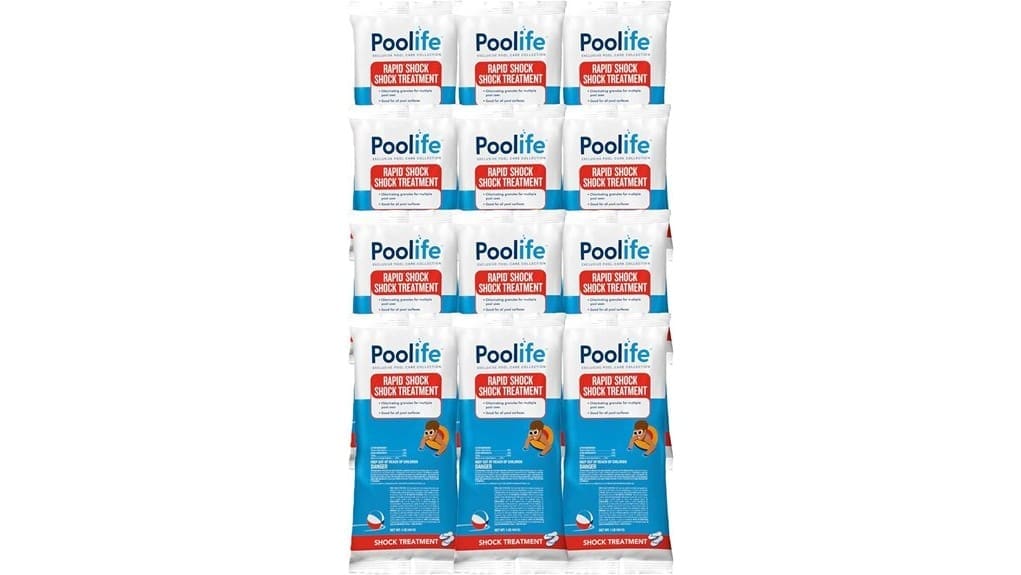
You’ll get a fast‑dissolving, CYA‑free calcium hypochlorite shock that quickly restores free chlorine to ~5–10 ppm for predictable, residue‑free dosing. It releases HOCl/OCl– for rapid oxidation of contaminants, making it effective for storm or heavy‑use recovery and breakpoint treatments when dosed properly. One‑pound premeasured bags simplify accurate dosing, though repeated use raises water calcium and requires cautious handling and storage. Continue below to see precise dosing, comparisons, and safety tips.
Some Key Takeaways
- Fast-dissolving calcium hypochlorite granules restore free chlorine to 5–10 ppm quickly for predictable shock dosing.
- CYA-free formula keeps chlorine highly reactive, making it effective for rapid algae control and contaminant removal.
- Pre-measured 1 lb bags offer convenient, accurate dosing for roughly 12,500–14,000 gallons per bag.
- Use 9–16 oz per 10,000 gallons for maintenance; double or triple for breakpoint shock treatments.
- Handle dry, wear PPE, avoid mixing with acids or other chemicals, and store in a cool, dry, ventilated area.
Quick Verdict: Is Poolife Rapid Shock Worth Buying?
While you want fast, reliable chlorine boosts, Poolife Rapid Shock delivers—it’s a calcium hypochlorite granule that dissolves quickly, is residue-free, and restores free chlorine to the 5–10 ppm target rapidly. You’ll find it worth buying if you need predictable, high-concentration shock dosing that clears contaminants and prevents common pool problems. Its CYA-free profile preserves sanitizing potency. Cost comparison favors pre-measured 1 lb bags for convenience and dosing accuracy versus bulk cal-hypo. Buyer testimonials cite rapid clearing and consistent results after storms or heavy use. Use recommended weekly doses; you’ll maintain swim-ready water with minimal intervention. Homeowners who enjoy outdoor spaces often prefer products designed for pool shock treatments like this one, which help keep outdoor pools inviting and well-maintained.
How Poolife Rapid Shock Works and Why Calcium Hypochlorite Is Effective
Now that you know its performance, here’s how Poolife Rapid Shock achieves those results: the product supplies a high-concentration dose of calcium hypochlorite (cal-hypo) granules that liberate free chlorine (HOCl/OCl–) on contact with water, producing a rapid spike in free available chlorine to the 5–10 ppm target. You’ll see immediate disinfection because cal-hypo rapidly releases HOCl, the active biocide. Chlorine chemistry drives microbial inactivation via oxidation mechanisms: electron transfer disrupts cell membranes, enzymes, and nucleic acids. Being CYA-free, Rapid Shock avoids stabilization issues, so your free chlorine remains reactive and effective for quick shock treatments. It’s a popular choice for homeowners who want clearer water and simple treatment options for their outdoor pools clear pool water.
Exact Dosing and Application: Weekly Maintenance and Shock Treatments
Typically, you’ll dose Poolife Rapid Shock to raise free chlorine to 5–10 ppm for routine weekly maintenance and to apply a higher, quick spike when shocking after heavy use or contamination. Use exact measurements: 9–16 ounces per 10,000 gallons for weekly maintenance; one 1 lb pre-measured bag treats ~12,500–14,000 gallons depending on starting chlorine. For shock treatments, double or triple the maintenance dose to reach breakpoint chlorination, guided by pool volume and current ppm. Add granules directly to deep water with pump running, avoid localized granule contact with surfaces. Maintain records of application timing and post-dose chlorine verification. Many homeowners pair this approach with regular chlorine tablet maintenance to keep their pools consistently sparkling.
Performance, Pros, and Cons Compared With Other Pool Shocks
Having covered exact dosing and application, compare Poolife Rapid Shock‘s performance against other common pool shocks to pick the right tool for your needs. You’ll find Rapid Shock restores free chlorine rapidly, delivering superior algae prevention versus slower dichlor or liquid bleach. Its cal-hypo chemistry offers longer chlorine longevity in active sanitization windows without CYA buildup. Residue comparison favors Rapid Shock: it’s fast-dissolving and marketed as residue-free, reducing filter load and brushing. Downsides: higher oxidative strength can raise calcium slightly and requires careful dosing. Overall user experience is efficient and predictable for routine maintenance and post-storm shock treatments. For homeowners managing filtration and clarity, pairing Rapid Shock with the right filter powder can help maintain sparkling water and reduce strain on the system.
Safety, Surface Compatibility, Storage, and Handling Tips
Because Poolife Rapid Shock is a concentrated calcium hypochlorite product, you should handle it with care: keep it dry, avoid breathing dust, and never mix it with acids or other pool chemicals (especially liquid chlorine or cyanuric-acid–based products). You should wear personal protective gear — gloves, goggles, and a dust mask — when measuring and dispersing 1 lb packets. Apply granules directly to pool water at recommended doses; avoid pouring on pool surfaces to prevent localized bleaching. Store unopened bags in a cool, dry, ventilated area away from combustibles. Have emergency procedures posted and a neutralizing plan and eyewash available. Consider storing chemicals in labeled, ventilated storage containers away from direct sunlight and moisture.
Some Questions Answered
Can Poolife Rapid Shock Be Used With a Salt Chlorine Generator?
Yes — you can use Poolife Rapid Shock with a salt chlorine generator. You’ll maintain salt system compatibility by dosing according to guidelines and avoiding overdosing; Rapid Shock is CYA-free and won’t interfere chemically with electrolysis. Add granules to pool water, wait for full dissolution and circulation, and monitor free chlorine to stay within 5–10 ppm. Don’t add directly into the skimmer; follow manufacturer dosing to prevent electrolysis impact on cell performance.
Will It Affect Pool Water pH Long-Term?
No, it won’t cause significant long-term pH drift if you monitor and manage alkalinity. You’ll see a short-term pH rise when cal-hypo dissolves, but that normal spike stabilizes as chlorine reacts and dissolves. Alkalinity interaction is the key: low total alkalinity lets pH swing more, high alkalinity buffers it. Maintain TA within recommended range and test regularly to prevent cumulative pH drift and assure long-term stability.
Can I Swim Immediately After Dosing?
No — you shouldn’t swim immediately after dosing. Rapid Shock raises free chlorine to 5–10 ppm; that concentration and active oxidizers can cause skin irritation and eye discomfort. Wait until chlorine falls to normal swim levels (1–3 ppm) and readings show stable pH. Typical swim delay ranges several hours depending on dose, water volume, and circulation. Test before entering, and only swim when chemical levels are within recommended limits.
Is It Safe to Mix With Other Pool Chemicals?
No — you shouldn’t mix it directly with other pool chemicals. Chemical compatibility requires you add cal-hypo separately, following handling precautions: dissolve or broadcast granules with pump running, avoid contact with acids, cyanuric acid products, or other oxidizers, and keep bags closed. Wait for full dispersion and normal chlorine readings before adding others. Store dry, cool, and isolated from incompatible substances to prevent hazardous reactions and degradation.
Does It Add Calcium Hardness to My Pool?
No — it won’t appreciably raise calcium hardness. Poolife Rapid Shock uses calcium hypochlorite, so repeated heavy dosing can contribute small amounts of calcium over time, but routine weekly use at 9–16 ounces per 10,000 gallons won’t cause notable calcium accumulation. You’ll maintain effective free chlorine for water clarity without rapid hardness increases. Monitor hardness periodically; if levels trend upward, adjust source water or reduce cal-hypo frequency.