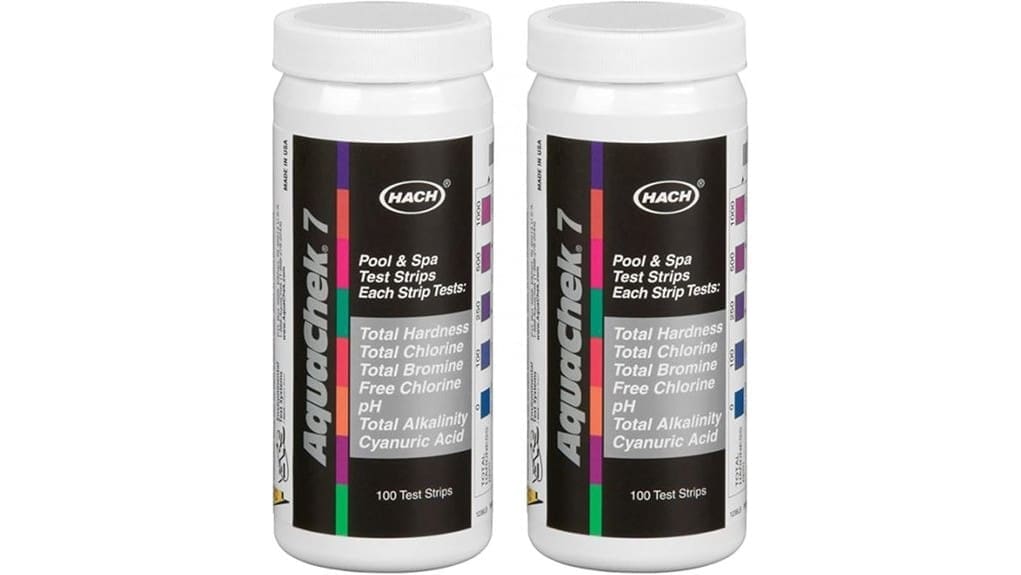
You’ll get fast, lab-comparable multi-parameter readings with the AquaChek 551236-02 Pro Silver strips when you dip, wait 15 seconds, and compare under neutral light. The seven-pad format reports pH, free and total chlorine, total bromine, alkalinity, hardness, and stabilizer with medical-grade reagents and reliable short-term color stability. They cut operator error and save time versus titrations, but store bottles properly and time precisely to avoid drift. Continue for setup, protocol, and limitations.
Some Key Takeaways
- Measures seven analytes (pH, free/total chlorine, total bromine, alkalinity, hardness, stabilizer) for comprehensive pool monitoring.
- Delivers lab-comparable accuracy when timing and handling protocols are strictly followed.
- Fast 15-second development time with clear, medical-grade reagent color changes for easy reading.
- Midrange price: pricier than basic strips but significantly cheaper than handheld photometers.
- Common issues: storage sensitivity, occasional batch inconsistency, and misreads if timing or lighting are improper.
Quick Verdict: Is AquaChek 551236-02 Pro Silver Worth Buying?
Although you could choose other testers, the AquaChek Pro Silver (551236-02) delivers fast, multi-parameter readings with lab-comparable accuracy and minimal operator error, making it a reliable choice for routine pool maintenance. You’ll appreciate the concise workflow: dip, wait 15 seconds, compare against the bottle chart. In a cost comparison it sits midrange—higher than basic strips but cheaper than handheld photometers—yielding strong value given its technical performance. User satisfaction metrics (4.7/5 from 236 reviews) confirm consistent real-world reliability. You can consequently justify purchase when you need rapid, repeatable chemical checks without investing in more complex instrumentation. It’s particularly well-suited for homeowners who want to keep their outdoor spaces pristine with digital pool testers.
What the Pro Silver Strips Test and How Accurate They Are
Having established the Pro Silver’s practical value, let’s examine exactly what it measures and how reliable those readings are. You get seven analytes: pH, free and total chlorine, total bromine, total alkalinity, total hardness, and stabilizer (cyanuric acid). Each pad is engineered with medical-industry reagents to deliver rapid, objectively graded color changes within specified measurement ranges, minimizing ambiguity. Accuracy rivals liquid titrations for routine monitoring when you follow timing and comparison protocol. Color stability remains strong for seconds after immersion, reducing drift during reading. Expect consistent, reproducible results suitable for pool maintenance decision-making. These strips are ideal for homeowners who want to keep pool water clear with straightforward, at-home testing.
Real-World Use: Step-by-Step Testing, Timing, and Interpreting Results
When you test with AquaChek Pro Silver strips, dip a strip into mid‑depth water, withdraw it horizontally, and hold it still while starting a 15‑second timer—this timing is critical because each pad’s reagents develop on a precise schedule that yields accurate, reproducible color changes. Use a consistent dip technique: submerge for one second, avoid swishing, and prevent touching the pads. After 15 seconds, compare pads to the bottle color chart under consistent daylight or a neutral light source. Interpret values by prioritizing free chlorine and pH first, then alkalinity, hardness, bromine and stabilizer; record results and adjust chemicals accordingly. Many homeowners find regular testing with simple kits helps maintain safe swim conditions and protect pool equipment, especially when following basic testing steps.
Pros, Cons, and Common Issues Based on User Feedback
After you complete the 15‑second timed read, users consistently report both strengths and predictable limitations of the AquaChek Pro Silver strips. You’ll find precise, fast multi-parameter readings comparable to liquid tests, with minimal handling error. Pros: clear color matches, rapid results, and robust detection for pH, chlorine, alkalinity, hardness, bromine, and stabilizer. Cons: occasional color fading on older bottles and sensitivity to storage conditions. Common issues: inconsistent pack consistency between batches, occasional misreads if you don’t time exactly 15 seconds, and degraded accuracy if strips contact moisture. Follow storage and timing protocols to mitigate most problems. Consider proper pool thermometer placement and maintenance to ensure overall backyard water quality with your testing routine and pool thermometers.
Who Should Buy These Strips and Where They Fit vs. Alternatives
If you need fast, lab-comparable multi-parameter readings with minimal handling error, these AquaChek Pro Silver strips are a practical choice for pool owners, service technicians, and facilities managers who prioritize speed and consistency over the extra granularity of titration methods. You’ll find them suited to pool professionals and home owners who require rapid pH, free/total chlorine, bromine, alkalinity, hardness, and stabilizer checks. They balance accuracy and competitive pricing versus digital photometers; choose strips for routine monitoring, photometers or titration kits when you need trace-level precision or regulatory documentation. Salt pools are supported, but confirm chlorine-type readings for saline systems. They’re especially useful for homeowners maintaining outdoor pool areas who regularly use chlorine tablets as part of their routine.
Some Questions Answered
Are These Strips Safe for Use in Hot Tubs or Spas?
Yes — you can use them in hot tubs and spas; they’re hot tubcompatible and meet spa safety needs. You’ll test pH, free/total chlorine, total bromine, alkalinity, hardness and stabilizer quickly with medical-grade accuracy. Dip, wait 15 seconds, then compare to the color chart. They’re designed for pool/spa chemistry monitoring, so you’ll get reliable results to adjust sanitizer and pH for safe, balanced spa water.
Do the Strips Expire, and How to Check Expiration Date?
Yes — they do expire. You’ll find expiration indicators printed on the bottle or foil pouch; check for a clear “EXP” date. If no explicit date appears, use batch codes: contact the manufacturer with the batch code to confirm manufacture and shelf-life. Store sealed strips in a cool, dry place; once opened, they’ll degrade faster. Discard strips that show faded or off-color pads, as accuracy can’t be guaranteed.
Can I Use Strips in Saltwater Pools With Chlorine Generators?
Yes — you can use the strips in saltwater pools with chlorine generators. They’re saltwater compatible and measure free chlorine, total chlorine and stabilizer accurately. Dip, wait 15 seconds, then compare to the chart. Use results to guide generator adjustments; aim for target free chlorine and cyanuric acid ranges. If levels drift, recalibrate generator output and shock manually as needed to restore proper sanitizer concentration.
Are Replacement Color Charts Available if the Bottle Is Lost?
Yes — you can obtain replacement charts. You’ll contact AquaChek/Robelle customer service to request a new color chart; provide model 551236-02 and purchase details. They’ll confirm compatibility and may email a PDF or mail a physical insert. Keep serial/UPC info handy to speed verification. If customer service can’t supply one, use the official digital chart on AquaChek’s site for accurate, calibrated comparisons with your test strips.
Do These Strips Require Special Storage Conditions (Temperature, Humidity)?
Yes — you should store them in a cool, dry place with stable storage temperature and humidity control. Keep strips sealed in their original bottle, tightly closed, away from direct sunlight, heat sources, and high humidity (like pool houses without ventilation). Avoid refrigeration or freezing; extreme temperatures degrade reagents. Follow manufacturer shelf-life and discard after the indicated expiration or if strips show moisture exposure or color shifts.