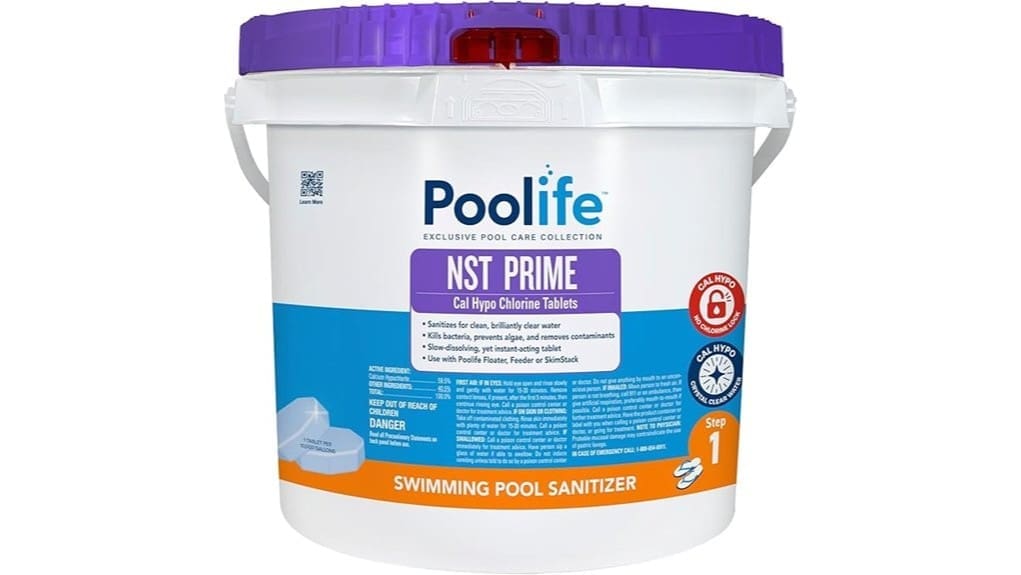
You’ll get predictable, non‑stabilized chlorine dosing with Poolife NST Prime tablets, designed to sustain 1–4 ppm free chlorine without adding cyanuric acid. They’re slow‑dissolving calcium hypochlorite tablets made for NST feeders, floaters, or skimmer baskets, giving steady chlorine flux and rapid oxidizing action against bacteria and organics. Expect clear water within 24–48 hours under normal turnover, but you’ll need to monitor pH, calcium, and storage/handling; continue for full usage and comparison guidance.
Some Key Takeaways
- Slow-dissolving calcium hypochlorite tablets provide non-stabilized chlorine ideal for avoiding CYA buildup in pools.
- Designed for NST feeders, floaters, or skimmers to deliver steady 1–4 ppm free chlorine with predictable dissolution.
- Rapid oxidizer improves clarity and recovers residuals quickly after heavy bather loads or organics.
- Requires more pH and calcium monitoring, careful handling, and more frequent dosing than stabilized tabs.
- Best for experienced owners or commercial ops prioritizing low CYA (e.g., saltwater systems) and consistent chlorine availability.
What Poolife NST Prime Tablets Are and How They Work
Poolife NST Prime Tablets are slow-dissolving calcium hypochlorite tablets formulated to deliver non‑stabilized chlorine for pool sanitation. You’ll handle a 4.5 lb package of cal hypo tablets that release free chlorine without cyanuric acid, reducing CYA accumulation. The description focuses on calcium chemistry effects—hardness contribution and reaction pathways—while tablet mechanics govern dissolution rate and chlorine flux. You’ll deploy tablets in designated feeders or floaters to maintain 1–4 ppm free chlorine. The formulation provides consistent sanitant availability, minimizes shock frequency, and reduces fluctuating residuals. Data’s presented objectively; operational parameters determine performance in specific pool systems. Homeowners can find related chlorine tablet tips for maintaining proper sanitizer levels and equipment.
Who Should Use Non‑Stabilized Calcium Hypochlorite Tablets?
If you manage a pool where keeping cyanuric acid (CYA) low is a priority—such as a saltwater system, a pool with recurring CYA buildup, or a facility that regularly shocks—you should consider non‑stabilized calcium hypochlorite tablets. You’ll find them appropriate if you prioritize direct chlorine availability, want to avoid chlorine lock, or run systems sensitive to CYA accumulation. They’re suited to experienced poolowners and commercial operators who monitor chemistry regularly and use NST feeders or floaters. Choose them when you need predictable, strong chlorine demand control and cyanuric control without introducing stabilizers that complicate sustained maintenance. For homeowners who want to maintain outdoor water quality, pairing effective shock treatments with proper application techniques helps keep your pool sparkling.
Real‑World Performance: Sanitation, Dissolve Rate, and Water Clarity
When you test NST Prime tablets in typical pool conditions, they deliver strong, fast sanitation while maintaining stable free chlorine when fed correctly; their calcium hypochlorite formulation provides rapid oxidizing action against bacteria and organics without adding cyanuric acid. You’ll observe consistent sanitization longevity when tablets are dosed to maintain 1–4 ppm free chlorine; residuals recover quickly after bather load and mild algae stress. Dissolve rate is predictable in NST feeders and floaters, producing steady chlorine release with minimal particulate fallout. Clarity observations show rapid improvement after treatment, with filters clearing fine organics and turbidity within 24–48 hours under normal turnover. Many homeowners pair these tablets with the right filter powder to help maintain pool water clarity and extend filter life.
How to Use NST Prime Tablets: Feeders, Floaters, and Skimmer Tips
Because consistent dosing is key to effective sanitation, set up your NST feeder, floater, or skimmer so tablets dissolve at a steady rate to maintain 1–4 ppm free chlorine. Position feeder placement where turnover draws treated water evenly; avoid placing feeder inlet downstream of returns or where short-circuiting occurs. In a floater, use floater adjustment to expose tablet surface progressively; start conservative and increase exposure if levels drop. If using skimmer, secure tablets in a basket to prevent clogging and monitor pump runtime. Test free chlorine daily after changes and log adjustments until stable. For best long-term performance, regularly inspect and replace worn components on your skimmer and feeder to keep system turnover consistent.
Pros, Cons, and Buying Advice (When to Choose NST Prime vs. Alternatives)
Although non‑stabilized cal‑hypo tablets require a bit more monitoring than stabilized forms, you’ll get predictable, high‑available chlorine without CYA buildup, making NST Prime a strong choice for owners who want to avoid chlorine lock and limit long‑term CYA accumulation. You’ll benefit from reliable sanitation, slow dissolution, and compatibility with feeders/floaters; equipment wear is minimized versus frequent shock dosing. Downsides: you must handle and store powdered cal‑hypo safely, monitor pH and calcium, and dose more frequently than stabilized tabs. Consider cost comparison versus stabilized tablets and liquid bleach, and evaluate environmental impact from calcium load when choosing NST Prime over alternatives. This product suits homeowners who enjoy their outdoor spaces and need consistent, effective pool opening chemicals pool opening chemicals.
Some Questions Answered
Are These Tablets Safe to Store With Other Pool Chemicals?
No — you shouldn’t store them mixed with other pool chemicals. For safe storage, maintain storage compatibility by keeping these calcium hypochlorite tablets segregated and dry, away from acids, metals, organics, and heat sources. Use dedicated, ventilated, labeled containers and chemical segregation to prevent reactive hazards, chlorine release, or fires. Follow manufacturer guidance, local regulations, and first-aid instructions, and keep away from children and pets.
Do NST Prime Tablets Affect Pool Water pH Significantly?
They can cause modest pH drift; you should monitor it. Calcium hypochlorite releases chlorine and raises total alkalinity marginally, so buffer interaction with your alkalinity/borate system can shift pH upward over time. You’ll need to test pH regularly and add acid or alkalinity adjusters as required to maintain 7.2–7.8. In closed systems or with heavy use, expect more frequent adjustments to counter cumulative buffer interaction.
Can Pets Swim Immediately After Tablet Use?
No, you shouldn’t let pets swim immediately after tablet use. Pet exposure to high chlorine levels can cause skin irritation, eye redness, and respiratory discomfort. Wait until chlorine stabilizes within the recommended 1–4 ppm range and pH is balanced to avoid irritation. Test water before allowing animals back in; rinsing your pet with fresh water after swimming further reduces residual chlorinated compounds and minimizes the risk of skin irritation.
Are These Tablets Allowed in Public or Commercial Pools?
Yes — you can use them in public pools and for commercial use if local regulations allow non-stabilized calcium hypochlorite. You’ll need to verify compliance with municipal and health-department codes, dosing limits, and record-keeping requirements. Make sure appropriate feeder or floater delivery, monitor free chlorine (1–4 ppm) and calcium levels, and follow safety protocols for storage and handling. Consult your pool inspector or facility manager before implementing.
Do Tablets Leave Calcium Scale on Heaters or Plaster?
Yes — you can get heater buildup and plaster etching if calcium levels and pH aren’t controlled. Poolife NST Prime’s calcium hypochlorite adds calcium hardness; if hardness, pH or total alkalinity rise, you’ll promote scale on heaters and scaling/etching on plaster. You should monitor and maintain balanced chemistry (especially calcium hardness 200–400 ppm, pH 7.2–7.6), use proper feeders, and perform routine brushing and descaling to minimize risks.