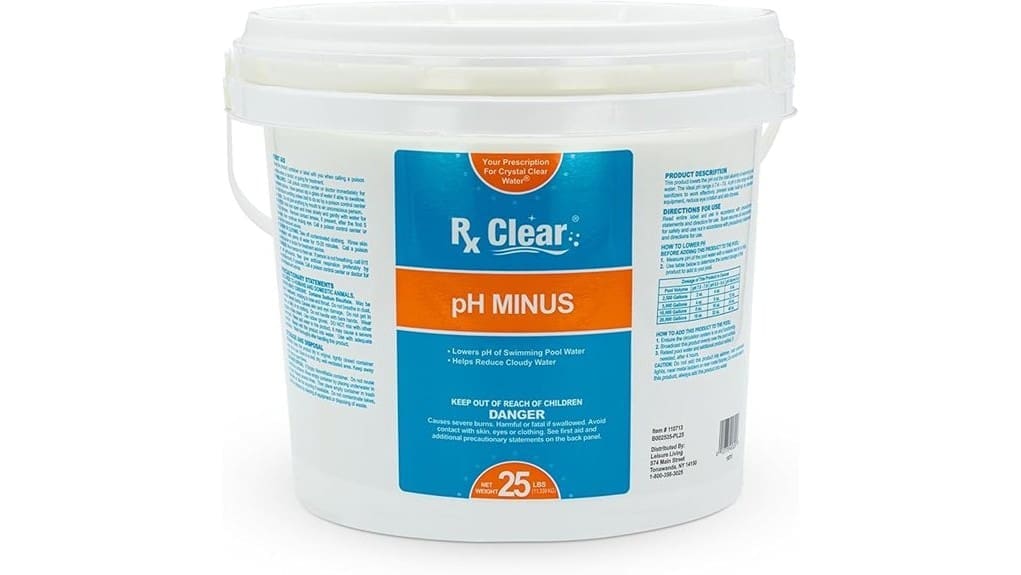
Rx Clear pH Minus is a granular sodium bisulfate you’ll dose by weight or calibrated scoop for fast, predictable pH drops and measurable alkalinity reduction. You’ll get uniform granules with minimal fillers, good storability in a sealed 25‑lb bucket, and less fuming and metal risk than muriatic acid. Apply slowly to circulating water with PPE, wait 30–60 minutes to retest, and expect temperature‑dependent response and occasional small follow‑up doses—keep going to see detailed dosing and safety guidance.
Some Key Takeaways
- Rx Clear pH Minus is granular sodium bisulfate sold in 25-lb buckets, offering predictable, measured pH correction.
- Dosage is consistent by weight or scoop; for 10,000 gallons, 0.2–0.3 pH drop needs about 4–8 ounces.
- Works rapidly when water is warm; circulate 30–60 minutes before retesting and watch for 24–48 hour rebound.
- Safer and less fuming than muriatic acid, but still requires gloves, eye protection, and dust avoidance.
- Good value for routine residential pool/spa maintenance with reduced corrosion risk and long sealed storage life.
Quick Verdict : Is Rx Clear pH Minus Worth Buying?
Wondering if Rx Clear pH Minus is worth buying? You’ll find it delivers predictable pH correction: measured granular dosing, rapid action, and clear instructions suitable for routine maintenance. Technical metrics—effective pH decrease per ounce in typical pool volumes—match manufacturer claims, and customer testimonials report consistent results without frequent overdosing. You’ll appreciate reduced corrosion risk versus muriatic acid and the convenience of a 25-pound bucket for long term storage, provided you seal it from moisture. For cost-conscious operators who need reliable, methodical pH control and documented performance, this product is a practical, defensible choice. Many homeowners pair shock treatments and pH adjustments to keep pools sparkling and maintain overall water quality.
What’s in the Bucket and How It Works (Sodium Bisulfate Basics)
Although it looks simple, the 25‑lb bucket contains granular sodium bisulfate — a dry acid that delivers controlled, measurable pH reduction when dissolved — and you dose it by weight or volume to achieve predictable changes in pool chemistry. You’ll find uniform granules; composition is primarily sodium bisulfate with minimal fillers. For accuracy you weigh doses or use calibrated scoop volumes, then broadcast or pre-dissolve per label. Granular dosing yields rapid dispersion and predictable molarity change per gallon. Handle with PPE, avoid inhalation and moisture. Storability is high when sealed; batch consistency supports repeatable, calculable adjustments to pH and alkalinity. It’s a practical choice for homeowners maintaining outdoor pools who want to keep their pump baskets and overall system running smoothly by managing water chemistry with routine maintenance.
Real-World Performance : Lowering pH, Reducing Alkalinity, and Results
When you dose Rx Clear pH Minus into a pool, it delivers rapid, predictable drops in pH and measurable reductions in total alkalinity, so you can calculate required amounts by pool volume and starting chemistry. You’ll perform measured dosing based on test results, add granular sodium bisulfate evenly, and circulate for 30–60 minutes before retesting. Note temperature effects: cold water slows reaction, warm water accelerates pH change. Monitor for ph rebound over 24–48 hours and adjust with smaller follow-up doses if needed. Results show accurate initial correction and reasonable long term stability when you maintain routine testing and incremental adjustments. This product pairs well with proper chlorine tablet maintenance to keep your pool water clear and sanitary.
Safety, Handling, and Pool-Surface Protection Compared to Muriatic Acid
Because Rx Clear pH Minus uses granular sodium bisulfate rather than muriatic acid, you’ll handle a product that’s less volatile and less fuming yet still requires careful PPE and measured application; wear chemical-resistant gloves and eye protection, avoid inhaling dust, add granules slowly to circulating water (never the reverse), and store the sealed 25 lb bucket in a cool, dry, well-ventilated area away from alkalis and metals. You’ll appreciate improved worker safety versus liquid hydrochloric acid: reduced fumes, easier spill control, and predictable dosing. Surface compatibility is superior for common finishes when applied per instructions, minimizing etching and metal corrosion risk. For homeowners testing and maintaining safe pool water, consider using simple pool water test kits regularly to monitor pH and sanitizer levels.
Who Should Buy It and Dosing/Cost Considerations
Having covered safety and surface compatibility, let’s look at who benefits most from Rx Clear pH Minus and how dosing and cost factor into routine maintenance. If you manage residential pools, spas, or light commercial systems and prefer granular sodium bisulfate over muriatic acid, this product suits you. Calculate dosage: raise 10,000 gallons down 0.2–0.3 pH requires roughly 4–8 ounces; adjust per lab or test kit results. For routine maintenance, plan weekly dosing based on bather load and alkalinity drift. Perform a budget comparison versus acids and tablets—Rx Clear’s 25 lb bucket often yields cost-effective, controlled pH correction. Many homeowners find that keeping stabilizer levels in check improves overall pool chemistry and equipment longevity, especially when monitoring cyanuric acid.
Some Questions Answered
Does Sodium Bisulfate Affect Pool Calcium Hardness?
Yes — sodium bisulfate doesn’t change total dissolved calcium, but it can promote conditions that cause Calcium deposition. When you add sodium bisulfate, it lowers pH and can cause pH drift if not buffered, which reduces carbonate alkalinity and raises the risk of calcium precipitating as scale. You should monitor calcium hardness and total alkalinity, adjust dosing slowly, and use sequestering agents or partial dilution to prevent unwanted deposition.
Can I Mix It With Other Pool Chemicals Safely?
Yes—you can mix it only in the pool water, not directly with other chemicals; confirm chemical compatibility and follow handling precautions. Add sodium bisulfate separately, dissolve or broadcast per label, then circulate for at least 30 minutes before adding chlorine, algaecide, or metal sequesterants. Avoid combining with acids, alkalis, or oxidizers in concentrated form. Wear PPE, keep dry, store sealed, and consult manufacturer data for specific interactions.
Is It Safe to Use in Vinyl-Lined Pools?
Yes — you can use it in vinyl-lined pools if you dose correctly to preserve vinyl compatibility and liner integrity. You’ll add granular sodium bisulfate to the deep end with the pump running, pre-dissolve for large doses, and avoid local high concentrations on the liner. Aim for gradual pH adjustment, retest frequently, and maintain recommended pH and alkalinity ranges to prevent chemical stress, discoloration, or premature liner degradation.
How Long Does It Take to Dissolve Completely?
You’ll see complete dissolution typically within 5–15 minutes once granules contact water, though dissolution rate depends on particle size, temperature and agitation. Fine particle size dissolves near-instantly (around 3–7 minutes); coarser granules may take up to 15 minutes. To guarantee rapid, uniform dissolution, broadcast slowly into circulating water or pre-dissolve in a bucket, agitating to accelerate dissolution rate and avoid local pH spikes.
Are Pets Affected by Treated Pool Water?
Yes — treated pool water can affect pets if pH and sanitizer levels aren’t balanced. You should monitor pet skin for redness or irritation after swimming; low pH or high sanitizer concentrations increase risk. Maintain recommended pH and chlorine, rinse pets with fresh water post-swim, and limit ingestion. For aquatic life, avoid draining treated water into natural bodies; sodium bisulfate and altered pH can stress or harm fish and other organisms.