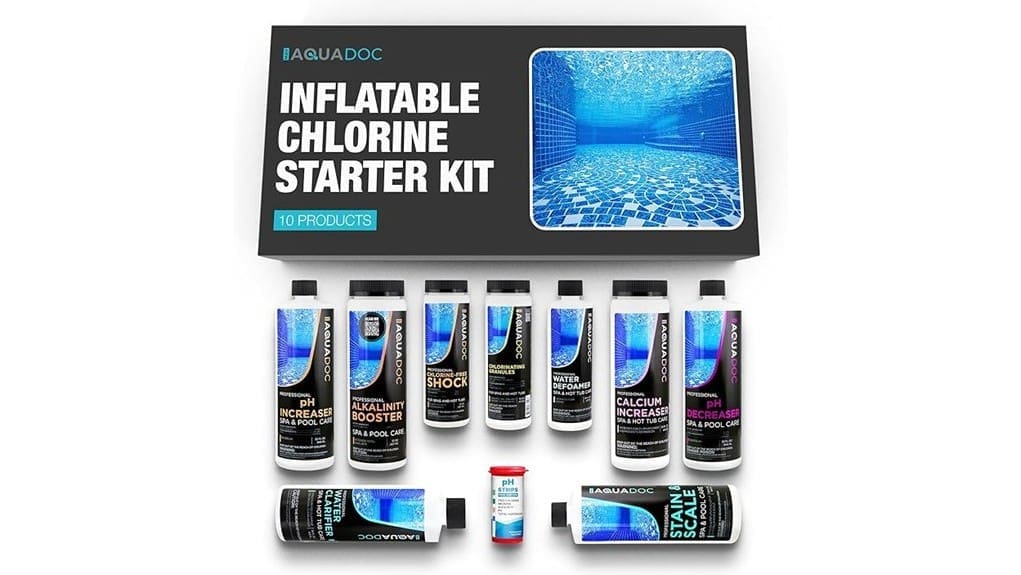
You’ll find the AquaDoc Inflatable Hot Tub Chemical Kit a simple, budget-friendly starter that gives you sanitizer, pH and alkalinity adjusters, calcium increaser, chlorine-free shock, defoamer, and test strips. It’s designed for easy routine maintenance, keeping sanitizer levels steady and foam, stains, and metals under control with predictable dosing. For new tub owners it’s practical and economical, though heavy users may need more frequent refills—keep going to see full usage tips and alternatives.
Some Key Takeaways
- All-in-one kit provides chlorine sanitizer, pH/alkalinity adjusters, calcium increaser, shock, and test strips for beginner-friendly hot tub care.
- Routine dosing maintains 1–3 ppm chlorine, keeps water safe without strong odor, and test strips simplify monitoring.
- Clear instructions and granular formulations dissolve predictably, making maintenance straightforward for inflatable tub owners.
- Includes defoamer, stain & scale remover, and metal preventer to control foam, discoloration, and calcium buildup when used as directed.
- Economical for first-time owners versus buying individually; consider larger quantities or eco alternatives for frequent or large tubs.
Quick Verdict: Is the AquaDoc Inflatable Hot Tub Chemical Kit Worth It?
While no kit is perfect, the AquaDoc Inflatable Hot Tub Chemical Kit is worth it if you want a simple, all-in-one solution for startup and routine maintenance. You’ll find the essentials organized and straightforward, so you’ll spend less time guessing and more time enjoying clean water. In a cost comparison, it’s competitively priced versus buying individual chemicals, especially for first-time owners. You’ll still check concentrations for large tubs, but routine upkeep is easier. User testimonials often praise convenience and clear instructions, though a few note they wished for larger quantities. Overall, it’s practical, economical, and user-friendly. Many homeowners also appreciate that proper shock treatment helps keep outdoor water safe and clear.
What’s Included and Why Each Chemical Matters for Inflatable Hot Tubs
Because proper water balance and sanitation keep your inflatable hot tub safe and enjoyable, this kit gives you the core chemicals you’ll actually use: chlorine granules to kill bacteria, pH increaser and decreaser to keep pH in the ideal 7.2–7.8 range, alkalinity increaser to stabilize pH, calcium hardness increaser to prevent corrosion or cloudy water, chlorine-free shock to break down organics and reduce chlorine odor, stain & scale remover and metal prevent to protect surfaces, defoamer to eliminate foam, and test strips to monitor everything—each component is sized and formulated for straightforward startup and routine maintenance.
You’ll get clear roles: sanitizer, pH balance control, alkalinity buffering, hardness protection, metal control, foam reduction, and easy monitoring, so small inflatable systems stay safe without complicated dosing.
Maintaining clear water in your outdoor tub is easier when you routinely monitor sanitizer and pH levels with test strips.
Real-World Performance: Sanitation, Foam Control, Stain and Scale Prevention, and Ease of Use
Now that you know what each product in the kit does, let’s look at how they perform in real use. You’ll find sanitizer residuals hold steady with routine dosing of the chlorine granules, keeping water safe without strong odor. Foam control works: the defoamer quickly collapses surface bubbles and reduces foam longevity after heavy use. Stain & scale remover and metal prevent limit discoloration and calcium buildup when you follow recommended amounts. Granular forms dissolve predictably, and test strips make checks straightforward. Overall, the kit balances effectiveness and simplicity, making maintenance manageable for first-time inflatable hot tub owners. It’s especially helpful for homeowners preparing their pools with essential pool opening chemicals to ensure a sparkling start.
How to Use the Kit Step-by-Step for New Spa Owners (Dosage, Sequence, and Testing)
Before you add any chemicals, drain or fill your inflatable hot tub to the recommended water level and run the pump so the water’s circulating; this guarantees each product disperses evenly and lets you test baseline levels. Start by testing pH, alkalinity, and chlorine with the included strips. Adjust alkalinity first, then pH, using small doses per label instructions; retest after 30 minutes. Add calcium hardness if low. Shock with chlorine-free shock after heavy use. Dose chlorine granules to reach 1–3 ppm for routine sanitation. Follow weekly maintenance: test, adjust, shock, and treat for stains/foam as needed. If you also use your backyard pool space for exercise or aesthetics, consider installing lane dividers to define swim areas and enhance the outdoor layout.
Who Should Buy This Kit and Practical Alternatives to Consider
If you’re a new inflatable hot tub owner or someone who wants a simple, all-in-one maintenance solution, this AquaDoc kit makes sense: it bundles the basic sanitizers and balance chemicals you’ll use most often, plus test strips and specialty treatments for foam, stains, and metals. You should buy it if you value convenience, clear instructions, and a compact kit for routine care. Budget shoppers will appreciate the included essentials over buying parts separately. If you prefer greener choices, look into eco alternatives like mineral sanitizers, biguanide systems, or concentrated refill packs to reduce plastic and chemical waste. For environmentally conscious pool and hot tub owners, integrating eco-friendly chemical options can help minimize environmental impact while keeping water safe and clear.
Some Questions Answered
Does This Kit Work With Non-Inflatable, Hard-Shell Hot Tubs?
Yes — you can use it in hard-shell hot tubs, but you’ll want compatibility testing to make certain chemical balances match your water and materials. You’ll address chlorine, pH, alkalinity, and calcium similarly, though dosing may differ. Watch filtration impact: stronger filters in hard tubs can alter chlorine demand and circulation, so test frequently and adjust doses. If metals or surfaces react, stop use and consult manufacturer or a pool pro for guidance.
Is Any Individual Chemical Sold Separately for Replenishment?
Yes — individual chemicals are typically sold separately as replacement options. You can buy chlorine granules, pH increaser/decreaser, alkalinity and calcium increasers, shock, stain & scale remover, metal prevent, defoamer, and test strips on their own. You’ll evaluate needs by testing water and replacing only what’s low, which saves money and avoids waste. Check manufacturer or retailer listings to confirm compatible sizes and formulations before purchasing.
Are These Granules Safe for Use With Hot Tub Covers and Liners?
Yes — you can use these granules with most hot tub covers and liners, but you should verify surface compatibility first. You’ll want to follow label directions and avoid overfeeding chemicals that can degrade materials. If you’re concerned, do material testing on a hidden area or small patch to confirm no discoloration or softening. Regular maintenance and correct dosing will minimize chemical exposure and extend cover and liner life.
Does the Kit Include Instructions in Languages Other Than English?
No, the kit typically includes only English instructions. You’ll find clear multilingual labeling on the packaging for key warnings, but translated instructions aren’t usually provided inside the box. That means you’ll need to rely on the English manual, on-package symbols, or the manufacturer’s website for translated instructions and safety data. If you want assurances, contact MAV AquaDoc customer support to request multilingual documentation or confirm availability of translated instructions.
Are There Childproof or Tamper-Evident Seals on the Containers?
No, the kit doesn’t list child safe packaging or tamper indicators on the product page or label. You’ll want to treat containers as standard granular chemical packaging—secure them out of reach and inspect seals yourself. For added safety, consider storing chemicals in a locked cabinet and using your own childproof caps or external tamper-evident tape. If seals are essential, contact the manufacturer to confirm current packaging and request child-resistant options.