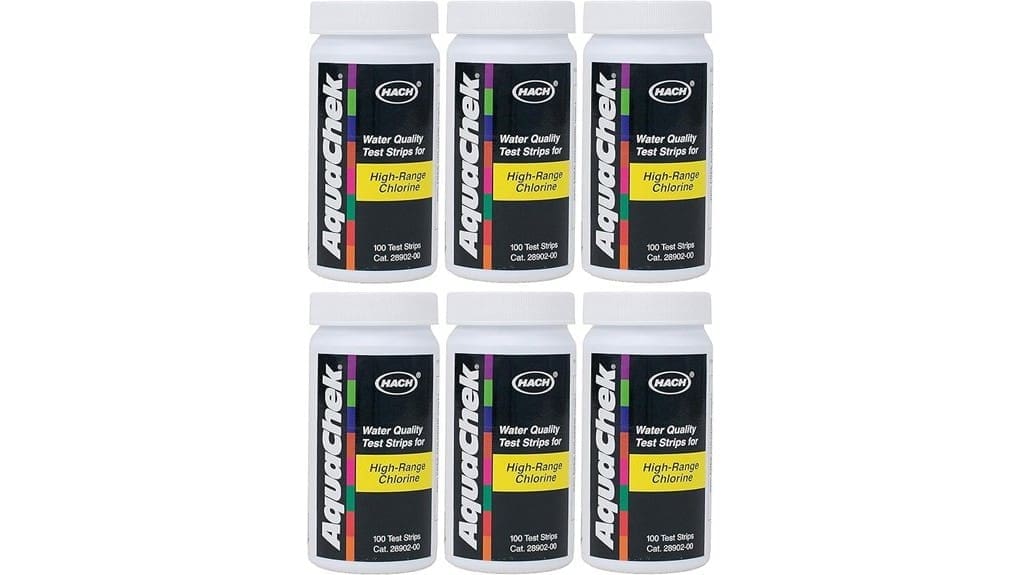
You’ll get a fast, portable way to confirm very‑high free‑chlorine levels (0–600 ppm) for surface disinfection and emergency use with AquaChek High‑Range strips. Dip once, shake, and match the oxidation‑based color pad to the chart for a rapid pass/fail check; accuracy is sufficient for verification but not lab‑grade quantitation. Pack size lowers per‑test cost and supports field operations, though resolution is coarse and lighting affects matching — keep bottles sealed and follow storage guidance to learn more.
Some Key Takeaways
- Designed for rapid, high‑range free‑chlorine verification up to 600 ppm, ideal for surface disinfection and emergency response rather than pool routine testing.
- Single‑dip pads give seconds‑scale color changes compared to a reference chart, enabling quick pass/fail decisions on high chlorine levels.
- Accuracy is sufficient for on‑site verification but coarse across wide bands and not a replacement for lab‑grade quantitative measurements.
- Pack of six 100‑count bottles (600 strips) lowers per‑test cost; store sealed, cool, and dry to preserve reagent reliability.
- Faster and simpler than bench kits or sensors for high concentrations, but lacks fine resolution below ~10 ppm and is sensitive to lighting during color matching.
Quick Verdict: Who These AquaChek High‑Range Chlorine Strips Are Best For
If you need rapid confirmation of very high free-chlorine levels, these AquaChek Hi‑Range strips are a practical choice. You’ll find them suited to commercial settings and industrial facilities where surface disinfection demands objective verification. They work for teams managing high risk environments, giving single-dip results in seconds so you can make immediate decisions. In emergency response scenarios you’ll appreciate the portability, pack size, and fast readout for detecting dangerously elevated chlorine. Use them when quantitative confirmation—rather than routine monitoring—is required. They aren’t for routine pool testing; they’re for incident-driven, high-concentration verification tasks. Consider pairing them with pool chlorine tablets for comprehensive on-site chlorine control and verification.
How the Strips Work and What the 0–600 Ppm Range Means
Having established when to use these high‑range strips, here’s how they function and what the 0–600 ppm scale represents. You dip a strip; reactive pads undergo an oxidation–reduction color change proportional to free chlorine concentration. The chemistry translates chlorine’s oxidation potential into a chromatic response you compare to a reference chart. The 0–600 ppm range quantifies very high free‑chlorine levels used in surface disinfection verification, not routine pool testing. For meaningful readings, manufacturers align pad response to calibration standards during production so you get consistent color-to-ppm correlation. Proper storage preserves pad chemistry and calibration integrity. These testers are especially useful for verifying high-range chlorine levels in non-pool disinfection applications.
Real‑World Performance: Speed, Accuracy, Ease‑of‑Use, and Limits
Typically, you get a readable result in seconds with a single dip, making these strips practical for quick verification tasks. You’ll appreciate the rapid results when confirming surface disinfection or diagnosing extremely high chlorine. Accuracy is adequate for pass/fail decisions up to 600 ppm, though you shouldn’t treat readings as laboratory‑grade quantitative data. The procedure is straightforward: dip, shake off excess, and compare color. You’ll find handling intuitive and packaging supports field durability, but avoid contaminating bottles. Limits include coarse resolution between wide concentration bands and sensitivity to lighting when matching colors, which affects repeatability. For homeowners aiming to Keep Pool Water Clear, regular testing with reliable strips like these helps maintain safe swimming conditions and prevent common issues pool maintenance.
How These Strips Compare to Other Chlorine Test Options (Sensors, Kits, Low‑Range Strips)
While test strips won’t match the quantitative precision of electronic sensors, they deliver rapid, practical results for on‑site screening and high‑concentration checks. You’ll get seconds‑scale, single‑dip readings up to 600 ppm, which suit surface disinfection verification and extreme concentration detection. Compared with bench kits, strips sacrifice adjustable chemistry and kit calibration options but gain speed and simplicity. Compared with low‑range strips, these handle much higher concentrations but lack fine resolution under 10 ppm. Compared with sensors, they avoid ongoing sensor maintenance and power needs yet can’t provide continuous logging or trace accuracy. Choose by required range, resolution, and operational constraints. These strips are ideal for homeowners who use pool shock treatments to keep outdoor spaces clean and safe, especially when monitoring shock treatment dosing.
Buying Guide: Pack Sizing, Cost Per Strip, When to Choose This 6‑Pack (and Tips for Accurate Testing)
Because you’ll likely use these strips for routine surface checks or to confirm very high chlorine, buying the 6‑bottle pack makes sense when you need long-term supply and lower per‑test cost. You get 600 strips total; calculate cost per strip by dividing pack price by 600 to compare retailer discounts and bulk storage premiums. Store bottles sealed, cool, and dry; implement expiration tracking per bottle to avoid false negatives from degraded reagents. Use single-dip technique, immediate read in seconds, and record results. Dispose used strips per environmental disposal guidelines; avoid flushing. Choose this 6‑pack if frequency and range (0–600 ppm) justify inventory. Keep your pool water safe by testing regularly with simple kits and following manufacturer instructions for accurate readings and maintenance pool water safety.
Some Questions Answered
Are These Strips Suitable for Testing Pool Water Regularly?
No — these strips aren’t suitable for regular pool water testing because they’re designed for very high free chlorine up to 600 ppm, not typical pool ranges. You’ll want to test pool water at a suitable frequency (daily to weekly) with strips or kits calibrated for 0–10 ppm free chlorine. For maintenance tips, store strips dry, avoid sunlight, use single-dip timing, and verify with a secondary test if levels seem abnormal.
Do Temperature or pH Affect the Strip Readings?
Yes — water temperature and pH influence strip readings. You’ll see faster reagent reaction at higher water temperature, which can slightly raise apparent free chlorine values; colder water slows color development. pH influence shifts chlorine speciation (HOCl vs OCl–), altering strip response; readings at high pH may underreport active disinfectant. To minimize error, test at consistent temperature, note pH, and interpret results considering potential biases from both water temperature and pH influence.
How Should Unused Strips Be Stored for Longevity?
Store unused strips in cool, dry conditions inside airtight packaging to maximize longevity. Keep them away from sunlight and moisture; resealable bags add a secondary barrier against humidity and contaminants. Maintain stable room temperature, avoid heat sources, and minimize bottle opening frequency to limit air exposure. Label storage date and rotate stock by first-in, first-out. If sealed packaging is damaged, transfer strips immediately into new resealable bags.
Are These Strips Safe to Use on Painted Surfaces?
Yes — they’re generally safe for painted surfaces because testing involves a quick single-dip contact and minimal reagent transfer, reducing risk of paint compatibility issues. Still, you’ll want to avoid prolonged wetting or rubbing; some paints can exhibit surface staining if saturated or left to dry with concentrated reagent. For sensitive finishes, test a discreet area first and blot immediately to prevent potential surface staining or chemical interaction.
Do the Strips Detect Combined Chlorine (Chloramines)?
No — the strips measure free chlorine, not combined chlorine (chloramines). You’ll detect free chlorine up to 600 ppm quickly with a single dip, but chloramines require specific combined chlorine tests. For analytical accuracy, use a DPD or N,N-diethyl-p-phenylenediamine method to quantify combined chlorine and evaluate breakpoint chlorination progress. During breakpoint chlorination, monitor both free and combined species with appropriate reagents to confirm ammonia oxidation and total chlorination.