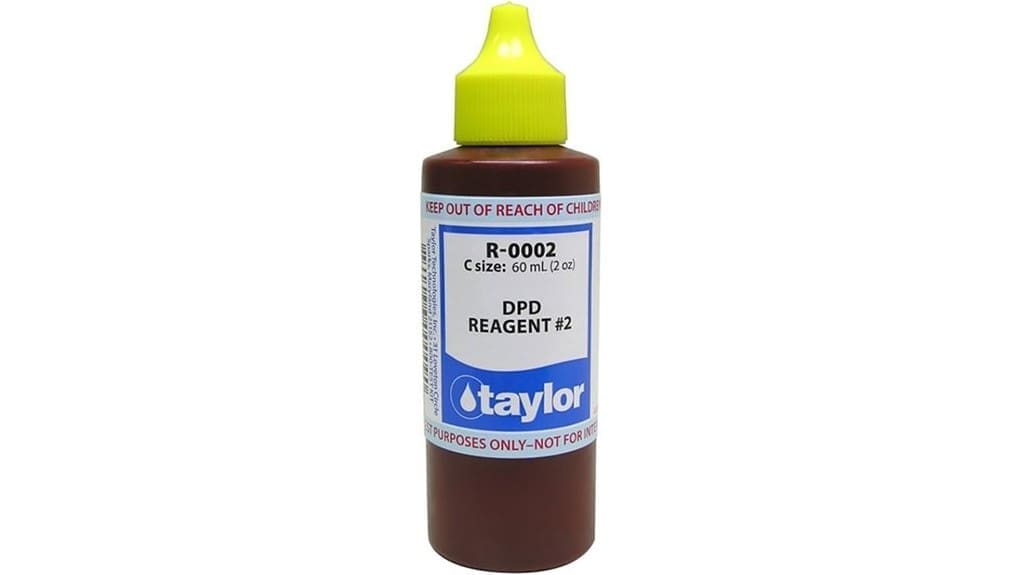
You’ll get four 2‑oz concentrated DPD No.2 reagent bottles (Taylor R‑0002‑C) intended for residential and light‑commercial free‑chlorine testing. Each bottle is labeled with part/lot IDs, yields repeatable 0.5–3.0 ppm endpoints in comparator or titration kits, and claims ±0.1–0.2 ppm accuracy under controlled conditions. Store sealed, protect from heat/light, and monitor control samples for drift after opening. If you want usage steps, stability notes, and suitability comparisons, keep going for details.
Some Key Takeaways
- Taylor R-0002-C is a concentrated 2‑oz DPD No.2 reagent for free/chlorine testing, sold as four bottles per kit.
- Optimized for residential and light‑commercial pools, compatible with comparator/titration methods and many standard test kits.
- Delivers typical accuracy of ±0.1–0.2 ppm under proper storage and handling conditions.
- Best used with correct sampling, calibration, and prescribed drop/reaction procedures to minimize chloramine interference.
- Stability depends on sealed storage and temperature; monitor control samples for degradation after opening.
Quick Verdict: Is Product R-0002-C No.2 DPD Right for Your Pool?
Wondering if the R-0002-C No.2 DPD is right for your pool? You’ll find it’s optimized for residential and light-commercial pool suitability: 2-ounce liquid reagent bottles deliver standardized DPD formulation compatible with common test kits. Use frequency ties to maintenance frequency — weekly automated testing or immediate testing after shock events. Each 2 oz bottle yields multiple test cycles, supporting consistent free chlorine measurement and decision thresholds (0.5–3.0 ppm target ranges). Accuracy reduces false positives from chloramines when used per kit protocols. You’ll prefer this if you require compact storage, predictable reagent volume, and repeatable, data-driven chlorine monitoring. Homeowners who enjoy their outdoor spaces will appreciate these reagents for straightforward pool care and simple testing routines.
What’s in the Box and Key Specs for R-0002-C No.2 DPD
Although compact, the R-0002-C No.2 DPD kit gives you four 2‑ounce liquid reagent bottles (Taylor Technologies, part R-0002-C, ASIN B0B7RX9B1X) designed for standard residential and light-commercial pool test kits. You get a set of four identical bottles, unit count 1.0, each bottle labeled with part and lot identifiers. Key specs: 2 oz (56.7 g) per bottle, liquid reagent formulation concentrated for DPD free/chlorine testing. Chemical composition: proprietary DPD-based oxidizable organic compound in aqueous solution; MSDS referenced on seller page. Packaging dimensions and weight optimize shelf storage and shipping efficiency; item weight listed per bottle. These reagents are intended to help homeowners maintain safe pool water through routine testing.
How to Use the 2‑oz DPD Liquid Step‑by‑Step for Accurate Chlorine Tests
Begin by collecting a representative pool water sample in a clean test vial at elbow depth (about 18–24 inches) away from return jets, then note the sample temperature and pH because both affect chlorine readings. Follow this step sequence: zero the comparator or calibrate photometer per manufacturer instructions. Add the prescribed number of drops of Product R-0002-C No.2 DPD liquid to the vial, cap, invert gently 5–10 times, and wait the specified reaction time (typically 15–30 seconds). Observe color change, compare to color chart or measure absorbance, record free chlorine concentration, and rinse vial after each sample collection. Regular testing helps keep your pool skimmer and filtration system running efficiently by ensuring proper sanitizer levels and reducing debris buildup in the skimmer basket pool skimmer maintenance.
Performance and Reliability: Accuracy, Shelf Life, and Real‑World Results
After you’ve practiced the sampling and reagent-addition steps, assess R-0002-C’s analytical performance by comparing measured free chlorine values against reference standards and field conditions. You’ll quantify accuracy via mean bias and standard deviation across replicate tests; expect ±0.1–0.2 ppm under controlled conditions if storage and handling follow manufacturer guidance. Monitor measurement drift by running control samples over weeks; significant slope indicates reagent degradation. Reagent stability depends on sealed storage, temperature, and light exposure; unopened 2-oz bottles usually retain potency for months, opened bottles less. Document lot numbers, expiration dates, and routine QC to guarantee reliable real-world results. For homeowners maintaining backyard pools, follow best practices for chlorine tablet handling, storage, and dosing to keep test results and pools consistent.
Who Should Buy This Taylor Reagent and Where It Fits Among Test Kit Options
If you maintain a residential or small commercial pool and prioritize quantitative free-chlorine readings, this 2-oz Taylor DPD reagent set fits into test kits where colorimetric accuracy and reagent traceability matter. You’ll choose it if you need ASTM-consistent DPD chemistry for titration or comparator kits, compact packaging for field service, and predictable shelf-life per lot. Pool owners benefit from straightforward replacement for Taylor kits; service technicians gain batch traceability and consistent endpoint definition across samples. It’s less appropriate for bulk municipal testing or digital photometers requiring proprietary cartridges. Select it when precision, compatibility, and inventory control drive your testing workflow. Many homeowners use these reagents alongside digital testers to keep routine maintenance simple and reliable.
Some Questions Answered
Is This Reagent Compatible With Saltwater Pools?
Yes — you can use it in saltwater pools. You’ll get accurate free chlorine readings because the DPD reagent reacts with hypochlorous acid/hypochlorite similarly in saline matrices; manufacturers validate saltwater stability for typical residential salinity (~3–4 ppt). Make sure you account for combined chlorine readings if cyanuric acid is present. Avoid direct electrode interference by removing probes before colorimetric testing; electrodes can skew absorbance if left immersed during measurement.
Can I Carry These Bottles on a Plane?
Yes — you can usually carry these 2-ounce reagent bottles in carry-on luggage if you follow airline regulations and carry on restrictions. Each bottle is under the typical 3.4 oz (100 mL) limit for liquids; pack them in a single quart-sized, clear plastic bag. Declare hazardous materials if airline or TSA guidance requires it. Check specific carrier and international rules, since chemical classification or quantity limits may vary by airline and destination.
Are the Bottles Child‑Proof or Leak‑Resistant?
No — the bottles don’t explicitly state child‑proof caps, but they do use standard screw caps with leak‑resistant seals. You’ll want to treat them as non–childproof: store them locked or out of reach. Data: 2 oz polyethylene bottles, threaded closures, factory-installed gasket providing liquid retention under normal handling. For transport or household safety, add tamper‑evident tape or an additional child‑proof secondary container to guarantee compliance and prevent spills.
Do These Reagents Expire After Opening?
Yes — reagents degrade after opening. You should store bottles per label instructions, maintaining recommended storage temperature to maximize reagent stability. Once opened, use within the manufacturer’s stated shelf-life (typically months); document open date and discard if color or clarity changes. For quantitative testing, reagent stability affects accuracy; replace reagents at indicated intervals or when degradation is observed to maintain reliable chlorine readings and meet assay precision requirements.
Is This Product Safe for Vinyl‑Lined Pools?
Yes — you can use it on vinyl‑lined pools. The DPD liquid is a diagnostic reagent; when dosed per kit instructions you’ll get accurate free chlorine readings without compromising vinyl compatibility. Avoid concentrated spills and prolonged contact to prevent localized surface staining; rinse any spills immediately. Store capped, away from heat and light to maintain reagent stability and reduce degradation that could produce stains or erroneous readings.