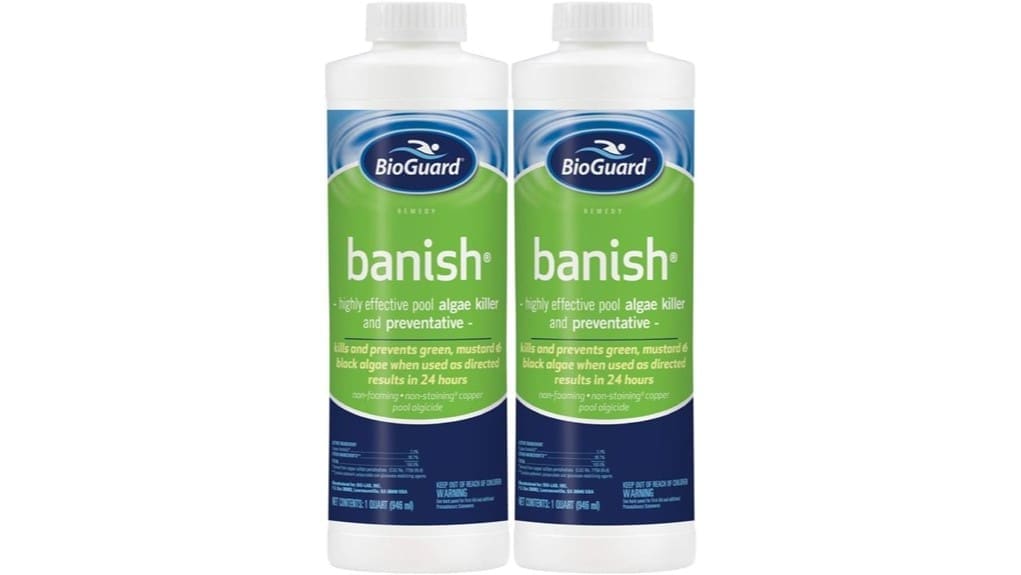
You’ll get fast, dependable algae control with BioGuard Banish, a two‑bottle 64 fl oz liquid algaecide that clears common green algae in about 24 hours when you dose by pool volume and sanitizer level. It’s non‑foaming, safe for gunite, plaster, vinyl and fiberglass, and works with chlorine or bromine systems while being filter‑compatible. Follow the manufacturer chart, circulate during application, and retest after 24 hours; continue if heavy blooms persist to learn how to optimize use.
Some Key Takeaways
- Fast-acting liquid algaecide that typically clears common pool algae within 24 hours at recommended doses.
- Sold as a twin 64 fl oz non-foaming formulation compatible with chlorine and bromine systems.
- Easy dosing via volume charts or calculator; repeat treatment may be needed for heavy blooms.
- Safe for gunite, plaster, vinyl, and fiberglass when used as directed; backwash filters after use.
- Twin-pack reduces unit cost but requires storage and consumption before shelf-life limits.
Quick Verdict : Is BioGuard Banish Worth Buying?
While BioGuard Banish works quickly to kill and prevent a broad spectrum of pool algae, you’ll mainly buy it for fast, reliable clearing and compatibility with chlorine or bromine systems. You get a two-bottle, 64-ounce liquid formulation that’s non-foaming and surface- and filter-compatible. Expect measurable improvement within 24 hours and quick return-to-swim times. Testing across the BioGuard line supports its targeted algae elimination and consistent performance. For you, key considerations are customer satisfaction metrics, predictable dosing, and documented long term efficacy within integrated maintenance protocols. It’s a pragmatic choice if you need dependable algae control. Many homeowners use shock treatments to maintain their outdoor pools and prolong usable swim seasons, especially when following shock treatment tips for best results.
How Fast and Effectively It Clears Algae (Real-World Results and Test Scenarios)
When you treat a visibly green or cloudy pool with BioGuard Banish at the recommended dose, you’ll typically see substantial clearing within 24 hours as the formulation targets and neutralizes common algae strains. You’ll observe a rapid onset of efficacy in both residential and commercial settings; testers reported green-to-clear shifts overnight without excessive foaming. Field trials and pooled user data confirm broad-spectrum kill rates and compatibility with chlorine/bromine systems. In practice you’ll measure reduced turbidity, lower microscopic algae counts, and quicker filter clearing within one day. Results scale with load; heavy blooms may require repeat treatment, but overall clearance is fast and reliable. It’s a convenient option for homeowners who want to keep their pool clear while enjoying outdoor spaces on their property.
Step-by-Step Use: Dosing, Application Timing, and When It’s Safe to Swim
Before you dose, measure your pool’s volume and current sanitizer level so you can apply the correct amount of BioGuard Banish and avoid over- or under-treatment. Use a dosing calculator or manufacturer chart to determine precise quart-per-gallon rates based on algae severity. Apply evenly around the perimeter with pump running and circulation active; avoid localized overdosing. For persistent blooms, repeat treatment after 24 hours as directed. Monitor sanitizer and pH; adjust to target ranges. Observe swimmer wait times posted by BioGuard—typically short due to rapid action—but don’t allow swimming until sanitizer and chemical concentrations return to safe, recommended levels. Also, follow essential closing tips like balancing chemicals and removing debris to close your pool safely and cleanly, which helps prevent algae growth and prolongs equipment life by reducing winter strain and corrosion; see essential closing tips.
Compatibility and Safety : Pools, Surfaces, Filters, and Chlorine/Bromine Systems
Although designed for broad compatibility, you should confirm BioGuard Banish is suitable for your specific pool system before treating algae: it’s formulated to work with both chlorine and bromine sanitizers, is safe on all common pool surfaces (gunite, plaster, vinyl, fiberglass), and won’t harm typical filter media or equipment when used at recommended doses. You should assess pool compatibility by checking sanitizer levels and material exposure. For surface safety, apply per label concentrations and avoid prolonged contact with concentrated product. Backwash or clean filters after treatment to remove dead algae. Follow manufacturer guidance to maintain system integrity and swimmer safety. Many homeowners find that using pool opening chemicals at the start of the season helps prevent algae growth and simplifies maintenance.
Value and Buying Considerations : Pack Size, Price Per Quart, Alternatives, and Return Policy
Since pack size directly affects per-quart cost and storage needs, you should weigh the 2-bottle (64 fl oz total) configuration against your treatment frequency and budget; buying the twin-pack typically lowers the unit price and reduces ordering frequency, but only if you can store and use both bottles before the warranty/return window or product shelf-life constraints affect viability. For pack comparison, calculate price per quart, treatment dosage, and expected consumption rate. Consider alternatives like single-quart bottles or concentrated algaecides if you need less volume. Verify retailer return terms and any manufacturer warranty; retain receipts and inspect product promptly to enable returns. Consider also how well the product integrates with your overall pool maintenance routine and outdoor living priorities.
Some Questions Answered
Does Bioguard Banish Have a Noticeable Scent After Application?
You won’t notice a strong smell; BioGuard Banish has a mild fragrance and minimal application odor. After dosing, you’ll detect a faint chemical scent for a short period, but it dissipates quickly as the product disperses and reacts with pool water. The formulation’s non-foaming, fast-acting chemistry reduces persistent odors, and you’ll be able to resume swimming soon after treatment without lingering noticeable scent.
Can It Be Used Preventatively on a Weekly Schedule?
Yes — you can use it preventatively on a weekly dosing schedule. You’ll apply the recommended dose consistently as part of proactive maintenance to inhibit algae growth and maintain clear water. The non-foaming formula is compatible with chlorine or bromine systems and all surfaces, so weekly use won’t harm equipment when dosed per label. Monitor pool chemistry and adjust dosage for heavy use, rain, or temperature swings to guarantee effectiveness.
Is This Product Safe for Pools With Children and Pets?
Yes — you can use it safely around kids and animals when directions are followed. The child safe formulation and pet friendly labeling indicate it’s compatible with recreational use after proper treatment and dilution. You should wait the recommended clearance time, confirm pool chemistry is back in range, and avoid direct contact during dosing. Store securely, keep pets and children away until levels are safe, and rinse any gear that contacted concentrated liquid.
Does It Affect Saltwater Pool Chlorinators or SWG Systems?
Yes — you won’t harm salt chlorinators; the formula is salt tolerant compatibility rated and won’t alter recommended salt levels. You’ll avoid significant electrochemical effects on SWG cells when used per label directions. Maintain normal dosing and monitor cell performance briefly after treatment. If you’re running high-output systems, rinse cell plates during heavy treatment and follow manufacturer guidance to make sure no transient scaling or efficiency changes occur.
Are There Any Special Storage or Freeze-Thaw Precautions?
Yes. You should follow storage precautions: keep bottles upright, tightly sealed, stored in a cool, dry, well-ventilated area away from direct sunlight and incompatible chemicals. Avoid temperatures below freezing and above manufacturer recommendations. The product has freeze thaw sensitivity; repeated freezing and thawing can degrade effectiveness and packaging integrity. If exposed to freeze-thaw cycles, inspect for separation or damage and replace if compromised to maintain reliable performance.