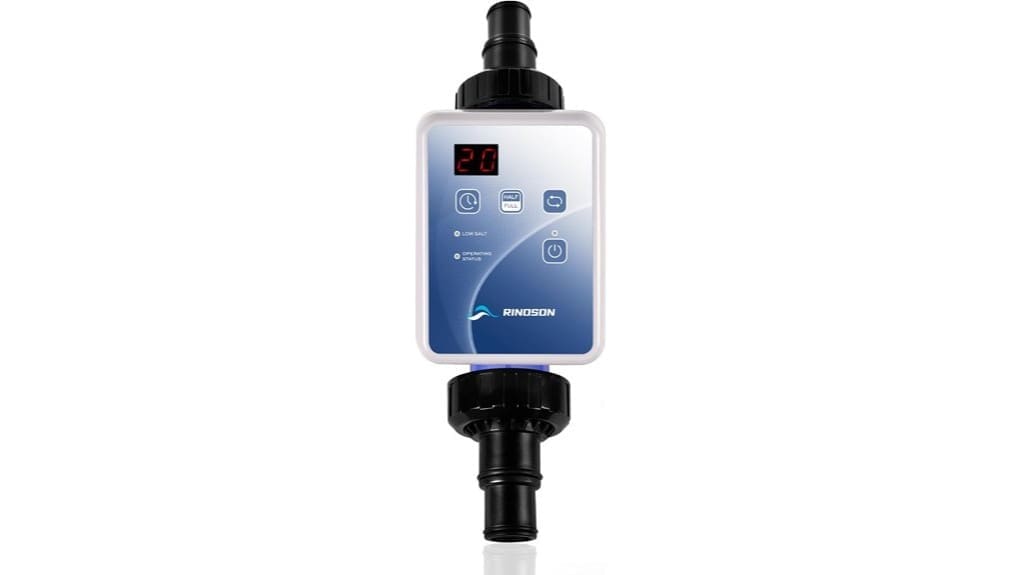
You’ll get a low‑maintenance saltwater chlorinator that reliably generates about 0.35 oz/hr for pools up to 12,000 gallons, with flow‑activated output and automatic polarity reversal to limit scale and manual descaling. LED one‑touch controls, configurable runtimes, and low‑salt alerts let you target residuals without overchlorination. Installation is DIY‑friendly with integrated plumbing and cell. It’s backed by a two‑year warranty and 24/7 US support, and the full review explains performance, setup, and maintenance details.
Some Key Takeaways
- Produces up to 0.35 oz/hr (10 g/h) chlorine from dissolved salt, suitable for pools up to 12,000 gallons.
- Flow-activated, LED-controlled unit prevents over-chlorination and offers half/full output with configurable runtimes.
- Titanium electrolytic cell with automatic polarity reversal (4/8/12 hr) reduces scaling and extends cell life.
- Requires regular salt calibration and low-salt alerts; larger pools need longer duty cycles to maintain residuals.
- Backed by a 2-year warranty and 24/7 US-based support, DIY-friendly installation for above-ground homeowner pools.
Why Buyers Choose a Saltwater Chlorinator: Quick Verdict for Pool Owners
Because saltwater chlorinators generate chlorine on demand from dissolved salt, you get consistent sanitization with less manual handling and fewer chemical fluctuations than with traditional dosing. You’ll appreciate low maintenance operation: automated cell reversal, flow-activated production, and LED alerts minimize routine intervention. Controls let you set runtime and output precisely, so you deliver target residuals without overchlorination. The system provides gentle sanitization that maintains water clarity and reduces irritants common to bulk dosing. For pool owners seeking predictable disinfection, reduced chemical storage, and straightforward servicing, this approach balances efficacy with operational simplicity and measurable control. Many homeowners installing these systems also invest in outdoor living upgrades to fully enjoy their pool areas.
Quick Specs and What They Mean: RNSSR-100-0514 Capacity, Output, and Cell Details
When you match the RNSSR-100-0514 to your pool, its 12,000-gallon capacity and 0.35 oz/hr (10 g/h) chlorine output define the system’s effective coverage and steady-state production rate: the capacity tells you the maximum water volume the unit is sized for, while the output specifies how much free chlorine it can generate under continuous flow. You’ll size runtime and expected residuals to that output; larger pools require longer duty cycles. The titanium electrolytic cell uses automatic polarity reversal (4/8/12 hr) to extend cell lifespan. Regular salt calibration and low-salt alerts keep production stable and predictable. Homeowners should also consider adding chlorine tablets as a supplemental option for shock dosing and seasonal maintenance.
Real-World Performance: Water Quality, Runtime, and Self-Cleaning in Everyday Use
Although you won’t see dramatic swings in pool chemistry with normal use, the RNSSR-100-0514 delivers consistent free-chlorine production (up to 0.35 oz/hr) that maintains clear water and low combined-chlorine when you match runtime to your pool size and bather load. You’ll set runtime to compensate for higher bather load; the unit’s flow-activated output prevents over-chlorination during low use. Measured results show stable residual chlorine and improved algae resistance with correct salt distribution and monitoring. The titanium cell’s automatic polarity reversal (4, 8, 12 h) reduces scale buildup, sustaining output and minimizing manual descaling interventions. This model is especially well-suited for above-ground pools commonly found in homeowner outdoor spaces.
Installation, Controls, and Maintenance: One-Touch Operation, Flow Activation, and Salt Alerts
If you follow the recommended guidelines, installing and operating the RNSSR-100-0514 is straightforward: the integrated control unit and electrolytic cell simplify plumbing and wiring, and the LED one-touch controls let you select half or full chlorine output quickly. You’ll mount the unit in a sheltered location, connect inlet/outlet and power, and verify flow activation via the pump; the system only produces chlorine when required water flow is present. The LED panel provides one touch simplicity and configurable runtime. Automatic salt alerts notify you when dissolved salt drops below operational thresholds. Routine DIY maintenance involves periodic cell inspection and scheduled polarity-cycle checks. For year-round backyard enjoyment, many homeowners pair these systems with UV sanitizers to reduce overall chemical demand.
Value and Support: Warranty, Customer Service, and Who Should Buy This Unit
Because reliable support can make or break your ownership experience, Rinoson backs the RNSSR-100-0514 with a 2-year limited manufacturer’s warranty and offers 24/7 American professional customer service to assist with installation, troubleshooting, and warranty claims. You’ll get clear warranty coverage terms for the control unit and electrolytic cell, reducing uncertainty on defects. Support responsiveness is documented through continuous access to trained agents and remote diagnostic guidance. If you manage pools up to 12,000 gallons and want reduced chemical handling with DIY-friendly installation, this unit delivers value. It’s suitable for owners prioritizing low-maintenance, tech-monitored chlorination. This product pairs well with energy-efficient pool pumps to maximize backyard energy savings.
Some Questions Answered
Does the Unit Require a Dedicated Electrical Circuit?
Yes — you should use a dedicated breaker and avoid shared circuits. You’ll install the unit on its own circuit to prevent overloads and guarantee reliable operation. Ground faulting protection is recommended where code requires it (GFCI/RCD) to reduce shock risk near water. Follow local electrical codes and the manufacturer’s wiring instructions. If unsure, hire a licensed electrician to confirm circuit sizing, grounding, and protective device placement.
Can It Operate in Pools Larger Than 12,000 Gallons Temporarily?
Yes — you can run it temporarily in pools larger than 12,000 gallons, but expect reduced efficacy. For transient operation beyond rated capacity, the unit will produce the same chlorine output (up to 10 g/h), so sanitization will be slower and concentration lower. Monitor residual chlorine and salt levels closely, increase runtime, and treat as temporary capacity use only. Prolonged overloading risks inadequate disinfection and faster wear on the electrolytic cell.
Is Replacement Electrolytic Cell Availability Worldwide?
Yes — replacement electrolytic cell availability is generally supported, but it varies by region. You’ll find replacement availability through Rinoson’s official channels and authorized dealers; global shipping is offered to many countries but may be restricted by local dealers, inventory, or import rules. You should verify part RNSSR-100-0514 stock and shipping options with Rinoson support or a local distributor to confirm lead times, warranty transferability, and compatible cell versions.
Does Salt Corrode Nearby Metal Pool Fixtures?
Yes. You’ll risk galvanic corrosion if stray currents or dissimilar metals contact pool water with elevated chloride buildup effects. Salt systems themselves don’t “eat” metal, but chloride concentration and electrical differentials accelerate corrosion of ladders, rails, heaters and fixtures. You should use compatible stainless grades, sacrificial anodes, electrical bonding/grounding and regular chloride monitoring to mitigate damage. Routine inspections and surface passivation reduce long‑term corrosion risks.
Can It Be Used With Automatic Pool Covers?
Yes — you can use it with automatic covers. You’ll want maintenance tips: monitor salt distribution, test chlorine levels more frequently under covers, and make certain proper circulation to avoid localized corrosion. Install cover sensors and make certain they won’t be affected by wiring or placement of the unit. Safety considerations include placing the control unit indoors or sheltered, following grounding instructions, and confirming cover operation isn’t impeded by plumbing or electrical components.