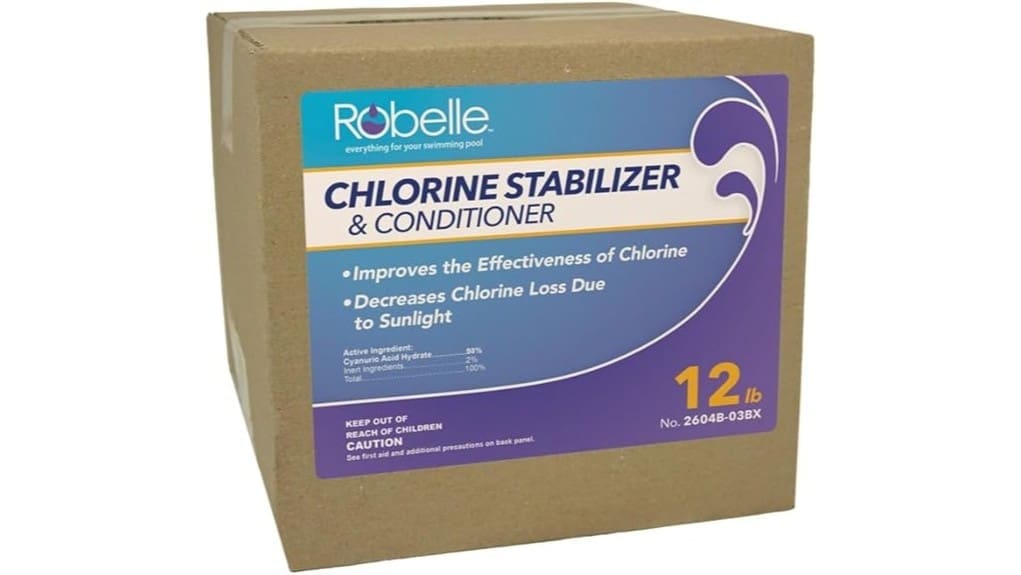
Robelle Premium Chlorine Stabilizer gives you concentrated granular cyanuric acid to reliably hold CYA between 40–100 ppm, slowing UV-driven chlorine loss and cutting chlorine use by up to ~25%. You’ll dose precisely using pool volume math (6 oz ≈ +10 ppm per 5,000 gallons), dissolve or add slowly to the skimmer, run filtration 24 hours, then verify with a reliable test kit. It’s cost-effective for sun-exposed pools; continue for practical dosing, troubleshooting, and comparison details.
Some Key Takeaways
- Robelle is a concentrated granular cyanuric acid that stabilizes chlorine, reducing UV-driven chlorine loss and extending residual life.
- Proper dosing (6 oz raises CYA 10 ppm per 5,000 gallons) enables precise control to target 40–100 ppm for optimal stabilization.
- Users can expect up to ~25% lower chlorine consumption and more consistent sanitation when CYA is correctly maintained.
- Apply slowly via skimmer or pre-dissolve, run pumps 24 hours, and retest CYA to avoid overshoot and ensure full dissolution.
- Pair with routine algaecide and filter maintenance; monitor CYA weekly and maintain calcium hardness to prevent equipment or surface issues.
Quick Verdict : Who Should Buy Robelle Premium Chlorine Stabilizer and Conditioner
Choose Robelle Premium Chlorine Stabilizer and Conditioner if you manage an outdoor pool exposed to significant sunlight and need a precise, cost-effective way to maintain cyanuric acid (CYA) between 40–100 ppm to cut chlorine loss and consumption. You’ll benefit when you’re a pool owner or summer caretaker seeking measurable reduction in chlorine decay and up to 25% lower chemical usage. Apply granular concentrated cyanuric acid per dosage guidelines, verify with a reliable test kit, and maintain recommended free chlorine and pH. This product suits those prioritizing analytical control, predictable dosing, and operational efficiency in high-UV environments. For homeowners caring for outdoor spaces, using an algaecide treatment as part of regular maintenance helps keep pools clear and algae-free.
How Robelle Works and the Benefits of Concentrated Cyanuric Acid
Having established who benefits from Robelle Premium Chlorine Stabilizer and Conditioner, let’s examine how its concentrated cyanuric acid functions at a molecular and operational level. You’ll see cyanuric acid forms reversible complexes with free chlorine (hypochlorous acid), reducing photolytic breakdown under UV exposure and providing measurable sunlight protection. That complexation lowers instantaneous oxidizing potential but extends residual lifetime, enabling chlorine preservation and steadier sanitation. Operationally, concentrated granular dosing lets you adjust cyanurate concentration precisely, reducing chlorine consumption up to ~25% by maintaining target ppm. You’ll monitor with a reliable test kit to balance stabilization against diminished disinfection kinetics. Homeowners often pair stabilizer use with proper filter powder maintenance to keep water clear and circulating efficiently.
Real-World Dosing Guide and How to Reach 40–100 Ppm Safely
When you need to bring your pool’s cyanuric acid into the safe 40–100 ppm range, calculate required dose from volume and current CYA, then add granular Robelle slowly to the skimmer or premix it in warm water to avoid clumping. Use pool math: 6 oz raises CYA 10 ppm per 5,000 gallons; scale linearly. Determine current CYA with a reliable test kit, compute ounces needed, and split additions if large. Account for slow dissolution; run pumps 24 hours and clean filter. Monitor CYA after full circulation before making further adjustments to avoid overshoot and make certain target 40–100 ppm. Many homeowners find that testing with a reliable test kit and following the dosing guidance keeps pools safe and reduces chlorine waste.
Application Tips, Troubleshooting, and Maintenance Best Practices
Because proper application and routine checks directly affect stabilizer performance, you should follow targeted steps to guarantee Robelle dissolves fully, distributes evenly, and maintains the intended cyanuric acid range. Add measured doses slowly to the skimmer or pre-dissolve in warm water; keep circulation 24 hours and verify filter cleanliness for slow dissolving prevention. Monitor cyanuric acid with a reliable kit; adjust dose per 5,000-gallon guidelines. If granules accumulate, perform skimmer clog troubleshooting: power down pump, remove debris, inspect basket and suction lines, then restart and re-circulate. Log readings and inspect weekly to sustain 40–100 ppm. For homeowners enjoying outdoor pool spaces, consider maintaining proper calcium hardness alongside stabilizer care to protect surfaces and equipment, especially when using pool chemicals that affect water balance and calcium hardness.
Value, Packaging, and How Robelle Compares to Other Stabilizers
Although Robelle’s 12-pound granular package looks standard, you’ll find its cost-per-ppm and dosing clarity make it a strong value for routine pool maintenance. You calculate dosing precisely: 6 oz raises CYA 10 ppm per 5,000 gallons, so a 12-lb bag treats large volumes before replacement. In cost comparison, Robelle reduces annual chlorine spend by up to 25% via stabilized residuals, yielding predictable savings versus unstabilized pools. Packaging durability resists moisture when stored properly; resealable container would be preferable but the current pail tolerates handling. Compared to competitors, Robelle offers concentrated active content and straightforward dosing, maximizing technical value. Homeowners who enjoy outdoor spaces will appreciate how stabilized chlorine helps maintain clear pool water with less frequent adjustments.
Some Questions Answered
Does Robelle Stain Pool Liners or Surfaces Over Time?
No, it typically won’t stain liners or surfaces if you follow directions and monitor levels. You’ll rely on staining tests and material compatibility checks to confirm safety: maintain cyanuric acid within 40–100 ppm, use recommended dosing, premix granules, and make certain thorough dissolution with 24-hour recirculation. If you see discoloration, run targeted staining tests, clean filters, and verify pool materials’ compatibility; adjust application or consult manufacturer for anomalies.
Is This Product Safe for Saltwater or Mineral Pools?
Yes — you can use it in saltwater and mineral pools; cyanuric acid is saltwater compatible and has minimal mineral interaction. You’ll dose to target 40–100 ppm CYA, monitor with a reliable test kit, and avoid overdosing which can impair chlorine activity. Add slowly via skimmer or premix, guarantee continuous circulation 24 hours for dissolution, and maintain chlorine 2.0–4.0 ppm and pH 7.4–7.6 for peak performance.
Can Robelle Be Used With Chlorine Tablets or Liquid Chlorine?
Yes — you can use it with chlorine tablets or liquid chlorine. You’ll maintain chlorine compatibility by following dosing guidelines: add stabilizer per volume (6 oz raises CYA 10 ppm per 5,000 gal; initial 4 oz/1,000 gal to reach 40–100 ppm), then use your usual chlorination method. Monitor stabilized chlorine residual 2.0–4.0 ppm and verify CYA with a reliable test kit to avoid over-stabilization and reduced sanitizer efficacy.
How Long Does Cyanuric Acid Remain Effective After Adding?
Cyanuric acid remains effective for months; you’ll see residual efficacy persist until dilution, backwashing, or water replacement lowers levels. Typical breakdown timeline is not chemical degradation but gradual loss via drainage, splash-out, and replacement—often 6–12 months in stable pools. You’ll monitor ppm; when levels drop below 40 ppm, re-dose. Use a reliable test kit to track concentration and plan replenishment to maintain 40–100 ppm for peak performance.
Is Robelle Safe to Handle Around Pets and Children?
Yes — you can handle it with care, but you shouldn’t assume pet exposure or child safety is risk-free. You’ll treat the concentrated cyanuric acid as an irritant: avoid ingestion, inhalation, and skin or eye contact. You’ll store it locked and upright, out of reach, and use gloves, eye protection, and good ventilation when dosing. Keep pets and children away until the product’s fully dissolved and the pool’s returned to proper chemistry.