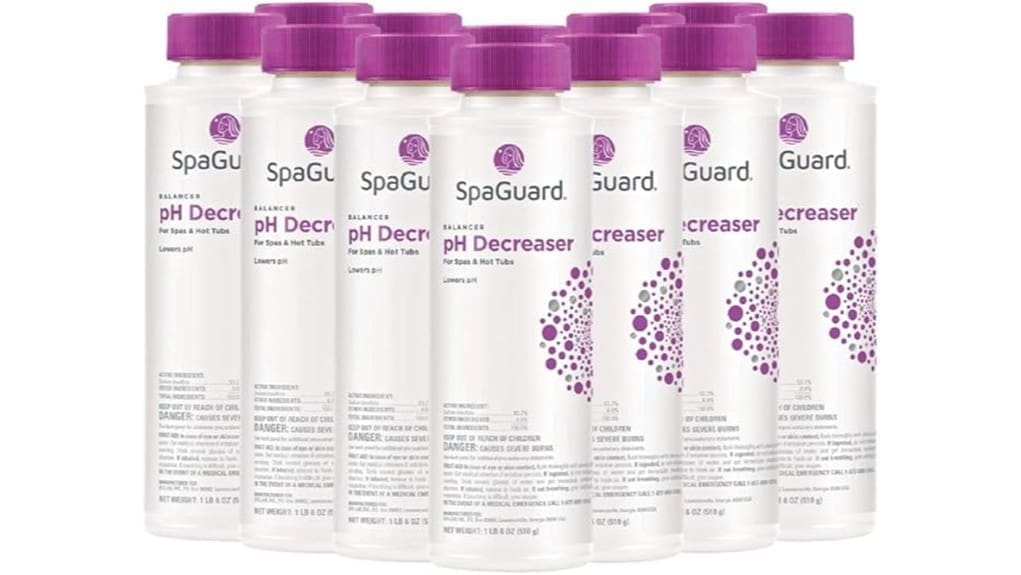
You’ll get twelve sealed 22‑oz units (264 oz total) of SpaGuard pH Decreaser (model 42254BIOX12) for residential or service use. The granular formula lowers pH and gradually reduces total alkalinity while minimizing scale and protecting equipment. You dissolve doses in warm water, circulate, and retest after 30–60 minutes for incremental control. It’s cost‑effective for regular maintenance but risks overcorrection without testing; keep measurements and records and learn the full usage details.
Some Key Takeaways
- Twelve 22‑oz granular units (264 oz total) provide bulk value for regular spa maintenance and multi‑spa use.
- Effectively lowers pH and gradually reduces total alkalinity when dosed per label and retested.
- Dissolve first, add with circulation, and retest after 30–60 minutes to avoid overcorrection.
- Helps prevent scale and improves sanitizer efficacy, supporting clearer water within hours.
- Bulk purchase lowers per‑ounce cost but risks excess product if adjustments are infrequent.
What SpaGuard pH Decreaser Pack of 12 Contains and Who It’s For
Containing twelve 22‑ounce units (264 total ounces) of SpaGuard pH Decreaser, this pack supplies granular pH-lowering agent formulated for routine spa water balancing. You’ll receive twelve sealed 22‑oz units, model 42254BIOX12, granular formulation optimized to lower pH and reduce total alkalinity gradually. As spa essentials, these units minimize scale formation, protect equipment, and maintain sanitizer efficacy through controlled acidification. Target users are residential spa owners, service technicians, and facility managers who require predictable, measured adjustments and inventory efficiency. Packaging and unit sizing support periodic maintenance schedules and reduce procurement frequency for consistent water chemistry control. Regular use helps keep your spa water clear and safe by maintaining balanced pH and sanitizer efficacy.
How to Use SpaGuard pH Decreaser (Dosage and Timing)
Start by testing your spa water to determine current pH and total alkalinity, because accurate dosing depends on those measured values and your spa’s volume. Calculate required grams per gallon from label guidelines, converting 22 oz unit values to your volume. Add granular product to a bucket of warm water, dissolve fully, then distribute evenly around spa with circulation running. Re-test pH after 30–60 minutes; repeat if necessary in incremental doses. For routine maintenance set application frequency based on stability: check weekly, dose only when pH exceeds target range. Log dosage timing and amounts for reproducible adjustments. Homeowners who enjoy outdoor spaces should also use simple pool water test kits regularly to keep water safe and balanced.
Performance: How Well It Lowers pH, Controls Scale, and Clarifies Water
When you use SpaGuard pH Decreaser as directed, it reliably lowers pH and incrementally reduces total alkalinity, allowing you to bring spa water into the target range without abrupt swings. You’ll observe predictable pH stability as granular doses dissolve and react; adjustments are measurable with standard test kits within hours. The formulation aids Scale prevention by reducing carbonate saturation and limiting mineral precipitation on heaters and plumbing. Clarification follows as high pH–induced cloudiness clears and sanitizer efficacy improves. For routine maintenance you’ll get controlled, gradual corrections rather than rapid overcorrections, preserving equipment and chemical balance. Maintaining proper alkalinity is essential for overall water health and protecting surfaces and equipment, so monitor levels regularly with alkalinity testing.
Packaging, Size & Value: Is the 12‑Pack Cost‑Effective?
Having seen how the product performs in stabilizing pH, reducing alkalinity, and preventing scale, now consider whether buying SpaGuard pH Decreaser in a 12‑pack makes economic and operational sense. You get twelve 22‑oz granular units (264 oz total), labeled Model 42254BIOX12. Do a cost comparison per ounce against single‑unit offers and competing brands; factor storage, shelf life, and dosing frequency for your spa volume. Bulk savings appear when you regularly treat multiple spas or perform frequent adjustments, reducing per‑use cost and procurement time. If you rarely adjust chemistry, the 12‑pack may be excessive and risk degradation. For homeowners who enjoy outdoor spaces, keeping supplies on hand can simplify routine maintenance and ensure timely shock treatments.
Pros, Cons, and Best Practices for Routine Spa Maintenance
Although spa chemistry is often overlooked, keeping pH and alkalinity within ideal ranges is critical for sanitizer efficacy, equipment longevity, and user comfort, so you’ll want a disciplined, data‑driven maintenance routine. You’ll benefit from SpaGuard pH Decreaser’s predictable, granular dosing to lower pH and control scale; it supports routine spa maintenance and extends equipment longevity when used per test results. Cons: granular handling risks uneven dispersion and overcorrection if you don’t test frequently. Best practices: measure pH/TA before dosing, dose incrementally, circulate 15–30 minutes, retest, and record values. Prioritize shock and sanitizer balance. Many homeowners find that following a seasonal pool opening checklist helps ensure all necessary chemical and physical maintenance tasks are completed before regular use.
Some Questions Answered
Is This Product Safe for All Types of Spa Surfaces and Materials?
Generally yes, but you shouldn’t assume universal compatibility. You’ll find SpaGuard pH Decreaser is formulated for typical spa surfaces, yet surface compatibility varies; perform material testing on a small, inconspicuous area first. You’ll avoid etching, discoloration, or sealant damage by following dosage guidelines and rinsing splashes promptly. For atypical or delicate materials, consult the manufacturer’s specifications or a professional water-care technician before regular use.
Can Spaguard pH Decreaser Be Used With Natural Hot Springs or Mineral Spas?
No — you shouldn’t routinely use SpaGuard pH Decreaser in natural springs or geothermal pools. The product’s granular chemistry is formulated for engineered spa systems; mineral-rich, variable-buffered waters in natural springs can react unpredictably, altering mineral equilibrium and harming ecosystem microbiology. If you must adjust pH, you’ll need site-specific water analysis, conservative dosing, and consultation with geothermal or environmental specialists to avoid precipitates, equipment corrosion, or ecological impact.
Does This Granular Formula Contain Any Dyes or Fragrances?
No, the granular formula contains no added dyes and shows no detectable fragrance presence. You’ll observe a technical, inert white granular composition intended for pH adjustment and alkalinity control without colorants or scent agents. This minimizes interference with spa water chemistry and analytical testing. If you require absolute confirmation for sensitive applications, request a manufacturer ingredient statement or material safety data sheet to verify dye content and fragrance presence against your specific tolerances.
Is the Product Safe to Handle for People With Sensitive Skin?
No—it can cause skin irritation, so you shouldn’t handle it barehanded if you have sensitive skin. You’ll want to use protective gloves and avoid contact; wash immediately if exposure occurs. The granular alkaline chemistry can abrade or chemically irritate epidermis, especially with prolonged contact. In technical practice, perform a small patch exposure test, use eye protection and ventilation, and follow label safety instructions to minimize dermatological risk.
Do Any Local Regulations Restrict Disposal of Treated Spa Water?
Yes — you’ll likely face local ordinances limiting discharge of treated spa water. Check municipal codes and wastewater rules before draining; some areas require chemical neutralization to specific pH and contaminant thresholds or disposal to sanitary sewers via permitted drains. Measure pH and alkalinity, adjust to allowed ranges, and document compliance. When in doubt, contact local authorities or a licensed waste hauler to avoid fines and environmental harm.