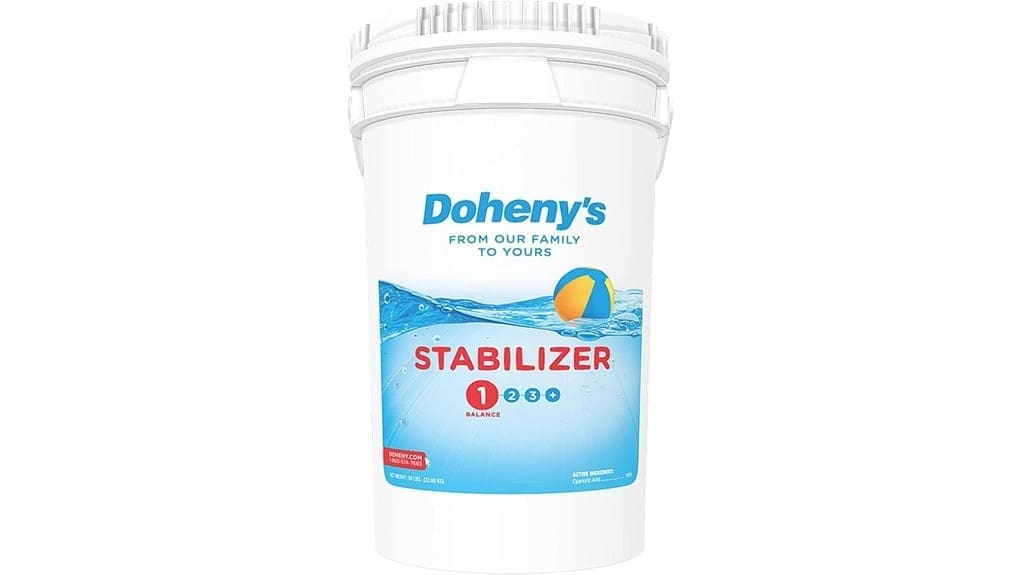
Doheny’s Swimming Pool Stabilizer is a fast‑dissolving, 100% cyanuric acid powder that helps your chlorine last longer by shielding it from UV. You’ll find it predictable and easy to dose: clear guidelines for unstabilized versus stabilized systems and quick dissolution, especially in warm water. It reliably brings CYA into the 40–60 ppm window when used correctly, reducing shock frequency for outdoor pools. Keep safety gear on and test after 24 hours to confirm levels if you want more specifics.
Some Key Takeaways
- 100% cyanuric acid powder that dissolves quickly to extend chlorine life by UV protection.
- Best for outdoor pools using stabilized or unstabilized chlorine, especially with chlorine tablets.
- Dose per guidelines (2 lb/5,000 gal unstabilized; 1 lb/5,000 gal stabilized) and retest after 24 hours.
- Comes in 50-lb (plus 5- and 10-lb) packaging; larger bags lower unit cost but need storage.
- Predictable CYA increases to 40–60 ppm when dosed correctly, reducing shock frequency in sunny conditions.
Quick Verdict and Who This Stabilizer Is Best For
While it won’t solve every pool problem, Doheny’s Swimming Pool Stabilizer delivers a straightforward, pro-grade way to keep your chlorine working longer by adding 100% cyanuric acid in a fast-dissolving powder form. You’ll find it practical: dosing is clear, effects are predictable, and the 50 lb unit suits frequent users or larger pools. Choose it if you want reliable UV protection for chlorine during sunny maintenance cycles and fewer shock treatments. It’s less useful if you need multi-function chemicals or very small packaging. For seasonal storage, measure and treat before closing to preserve sanitizer levels. Many homeowners rely on pool stabilizers to maintain proper stabilizer levels and reduce chlorine loss during sunny periods.
What Doheny’s Swimming Pool Stabilizer Is and How It Works
Think of Doheny’s Swimming Pool Stabilizer as a targeted UV shield for your chlorine: it’s a fast-dissolving powder made of 100% cyanuric acid that binds with free chlorine in the water to slow photodegradation and keep sanitizer levels steady. You add measured doses to achieve stable cyanuric chemistry; the stabilizer complexes with hypochlorous acid molecules, reducing sunlight-driven breakdown while leaving disinfection capability intact. You’ll handle a pro-grade formula designed for rapid incorporation and predictable interaction with both unstabilized and pre-stabilized chlorine systems. Overall, it provides controlled UV protection so your sanitizer lasts longer between treatments. Proper cyanuric acid levels help chlorine remain effective, especially when using chlorine tablets in outdoor pools.
Real-World Performance: Effectiveness, Dissolving Speed, and Ideal PPM
Now that you know how the stabilizer chemically protects chlorine from UV, let’s look at how it performs in real pools: you’ll find Doheny’s 100% cyanuric acid powder reliably raises and holds cyanuric levels, dissolves quickly for faster stabilization, and helps maintain the recommended chlorine-protecting range. In practice, field measurements show consistent increases to the 40–60 ppm window when dosed per guidelines. Dissolution temperature affects solubility—warmer water speeds dissolution—yet the pro-grade powder still dissolves faster than granular alternatives. You’ll see steady CYA retention over weeks with routine monitoring, indicating dependable real-world effectiveness without over-stabilizing. Homeowners who enjoy their outdoor spaces will appreciate the product’s simplicity and reliable results for pool opening and maintenance, especially when calculating dosages to reach target cyanuric acid levels.
How to Dose and Use It Safely (Step-by-Step for Different Pool Types)
Because correct dosing depends on your pool type, start by identifying whether you use unstabilized chlorine (liquid or salt systems) or stabilized chlorine, then calculate the required amount based on water volume. For unstabilized systems, add 2 lb per 5,000 gallons; for stabilized systems, add 1 lb per 5,000 gallons. Use a dosing calculator to convert your pool gallons to pounds. Dissolve Doheny’s powder in a bucket, pour evenly with return jets running, and retest cyanuric acid after 24 hours. For pool safety, wear gloves and eye protection, avoid adding near swimmers, and store sealed away from children. Keep your pool thermometer level and visible to help monitor temperature while you treat the water and optimize outdoor comfort.
Packaging, Price Options, and Alternatives to Consider
After you’ve calculated and applied the correct dose, it helps to take into account how the product’s packaging and pricing affect ongoing maintenance. You’ll find Doheny’s sold as a 50-lb powder unit with 5-lb and 10-lb pouches available, so retail packaging fits both bulk and smaller needs. Do a cost comparison per pound against competing cyanuric acid brands to gauge value; larger sacks lower unit cost but increase storage needs. If you prefer alternatives, consider other 100% cyanuric acid powders or stabilized chlorine products, balancing dissolution rate, price, and your pool’s usage pattern. Proper maintenance also includes keeping pool alkalinity balanced to ensure stable water chemistry and protect equipment.
Some Questions Answered
Is This Safe for Vinyl or Fiberglass Pool Liners?
Yes — you can use it with vinyl and fiberglass liners if you follow directions and avoid overconcentration. The powder (100% cyanuric acid) is vinyl compatible when properly dissolved and diluted; improper use or sudden high CYA can contribute to liner discoloration over time. You should pre-dissolve, add gradually, test CYA levels, and keep within recommended ppm to protect liners and maintain chlorine effectiveness without causing staining.
Can It Be Used With Algae Treatments or Shock Products?
Yes — you can use it with algae treatments and shock products, but manage timing to avoid algae compatibility and shock interaction issues. You’ll add cyanuric acid separately from oxidizing shocks; wait until free chlorine returns to normal after shocking before adjusting stabilizer. For non-oxidizing algaecides, follow label directions; for oxidizing shocks, apply shock first, let chlorine settle, then dose the stabilizer to maintain ideal protection and effectiveness.
How Long Does One 50 Lb Unit Last With Regular Use?
A 50 lb unit will typically last a single season for a medium pool; you’ll get roughly 25–50 applications depending on pool size and seasonal dosing. For a 20,000-gallon pool using 2 lb per 5,000 gallons, plan about 8 lb per seasonal top-up, so 50 lb covers multiple seasons for smaller pools or one season for larger, high-use pools. Keep water balance ideal to avoid overuse.
Is Cyanuric Acid Buildup Reversible or Removable?
Yes — cyanuric acid buildup is removable, though it’s not easily reversed by simple dilution. You’ll need to use chemical recycling approaches like partial drain-and-refill cycles, specialized media or enzymatic treatments to break down CYA, or perform substrate binding removal via ion-exchange or adsorption filters. You’ll want to test levels frequently and repeat treatments; professional labs or pool pros can recommend safe procedures and confirm that CYA has been sufficiently reduced.
Does It Affect Salt Cell or Chlorine Generator Warranties?
Generally, warranty concerns can arise if cyanuric acid levels damage salt cells or chlorine generators, so you should check equipment compatibility and manufacturer guidelines. You shouldn’t assume protection: many manufacturers void warranties if CYA exceeds specified limits or causes scaling. Measure CYA regularly, follow dosage instructions, and keep levels within your generator’s recommended range. If unsure, contact the equipment maker before using stabilized products to avoid warranty issues.