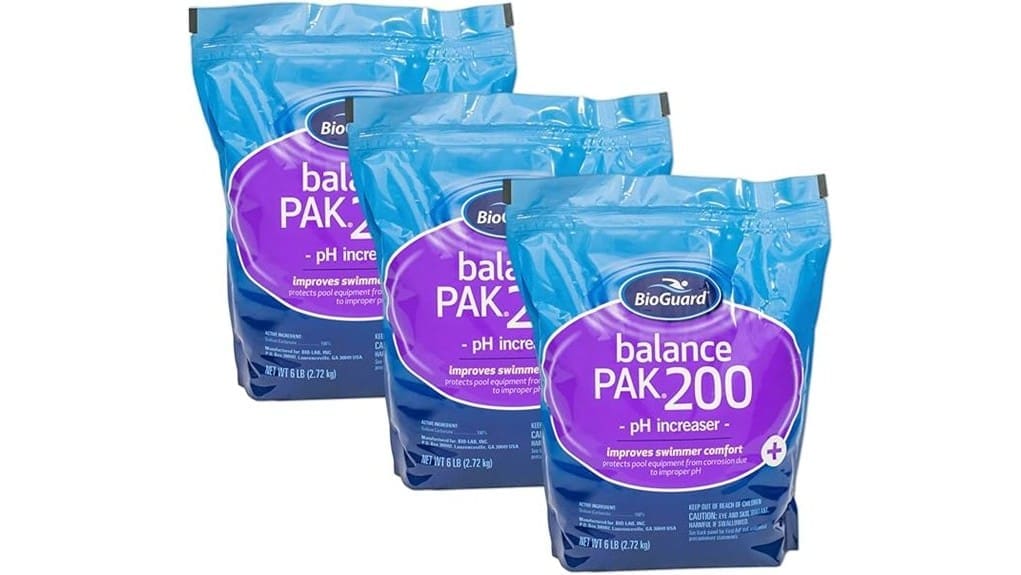
You’ll get a concentrated, predictable pH and alkalinity booster that’s ideal if you manage a residential or small commercial pool and need fast, scalable adjustments to protect plaster, liners, and equipment. It uses carbonate/bicarbonate chemistry to raise pH and buffer total alkalinity without adding unwanted ions, dissolves predictably for reliable dosing, and minimizes etching, corrosion, and scale when used per label. Keep monitoring after application — more details follow below.
Some Key Takeaways
- Concentrated carbonate-based formula reliably raises pH and total alkalinity with predictable, dose-chart-based results.
- Works well for residential, small commercial, and plaster pools needing protection against etching and liner problems.
- Dissolves predictably when applied per label, showing measurable changes within 2–6 hours under moderate circulation.
- Regular dosing helps prevent corrosion and scale, preserving equipment, tile, and plaster surfaces.
- Sold in single 6 lb or economy three‑pack bags; store dry, use gloves/goggles, and compare unit cost to soda ash alternatives.
Quick Verdict : Who Balance Pak 200 Works Best For
If you maintain a residential or small commercial pool and need a reliable, concentrated pH increaser that also stabilizes total alkalinity and mineral balance, Balance Pak 200 is for you. You’ll find it ideal if you’re homeowners with plaster surfaces needing protection against etching and liner issues, since it targets mineral balance and reduces corrosion risk. Commercial pool managers will appreciate the concentrated formulation for predictable, scalable dosing across multiple systems. You’ll use it to raise pH, adjust alkalinity, control scale and metallic staining, and support pH‑dependent treatments. It’s precise, tested, and designed for routine maintenance efficiency. It also helps maintain proper calcium hardness to protect plaster and other pool surfaces.
How Balance Pak 200 Fixes Low pH and Alkalinity (What’s Inside)
Having covered who benefits most from Balance Pak 200, let’s look under the hood: the product contains concentrated alkaline agents—primarily sodium carbonate (soda ash) or a blended carbonate/bicarbonate mix—formulated to raise pH while contributing buffering capacity to total alkalinity. You’ll find a targeted carbonate blend and other alkaline boosters that neutralize excess acidity, shifting equilibrium toward higher pH and increasing carbonate alkalinity. The formulation dissolves predictably, supplying CO3(2-) and HCO3(-) species to restore buffering without introducing unwanted ions. That predictable chemistry protects surfaces and equipment while stabilizing conditions for downstream sanitizers and treatments. Many homeowners use such stabilizers to keep pools balanced and maintain enjoyable outdoor spaces.
Real-World Performance : Dosing, Speed, and Pool Results
When you dose Balance Pak 200, the product delivers predictable pH and alkalinity shifts so you can correct low readings with minimal trial and error. You’ll notice consistent results when you follow label dosing charts; dosage accuracy reduces swings and repeat adjustments. Dissolve or broadcast as instructed, monitor over 2–6 hours, and retest before adding more. Application timing matters: add during moderate circulation and avoid immediate heavy bather load or chemical shocks. In routine use you’ll restore target pH and total alkalinity reliably, enabling other treatments to work as intended and reducing time spent chasing unstable readings. Many homeowners pair shock treatments with pH control products to keep outdoor pools sparkling and safe.
Protecting Equipment and Surfaces : Corrosion, Scale, and Plaster Effects
Because pH and alkalinity directly drive corrosion and scaling reactions, using Balance Pak 200 to keep those parameters in range protects metal components, plaster, and liners from chemical attack. You’ll reduce acidic etching of plaster and metallic corrosion by maintaining pH within target bands, which preserves heater elements, pumps, and fittings. Controlled alkalinity limits scale nucleation on tile and plumbing, aiding surface preservation and preventing liner distortion. Routine, measured dosing supports equipment longevity by minimizing stress from cyclical corrosion or scale buildup. For system health, monitor pH/alkalinity frequently and adjust with Balance Pak 200 before visible damage appears. Proper storage in dedicated chemical containers and secure outdoor areas further reduces risk and preserves both chemicals and surrounding surfaces.
Buying and Use Considerations : Package, Cost, Safety, and Alternatives
Although you’ll often see Balance Pak 200 sold in economy three‑packs of 6 lb bags, evaluate your usage rate and storage before buying to avoid waste and extra cost. You’ll choose package options based on pool size and frequency: single 6 lb bags if you adjust intermittently, three‑pack for heavier seasonal demand. Factor unit cost, shipping, and shelf life. Handle product with recommended safety precautions: gloves, goggles, store dry and ventilated, keep away from acids. If you need alternatives, consider granular sodium carbonate or liquid soda ash; validate dosing compatibility with your sanitizer and equipment to prevent damage. Many homeowners find closing supplies and chemicals helpful when preparing outdoor spaces for winter, especially items that protect water quality like pool closing chemicals.
Some Questions Answered
Is Balance Pak 200 Safe for Saltwater Pools?
Yes — you can use Balance Pak 200 in saltwater pools, but you’ll want to monitor salt compatibility and dosing carefully. It raises pH and alkalinity without introducing chlorides, yet high pH can increase electrode corrosion risk in salt chlorination systems. You should follow manufacturer dosing, test pH/alkalinity frequently, and inspect the salt cell and probes regularly. Doing so keeps water balanced and minimizes equipment degradation.
Can It Be Used With Other Bioguard Chemicals Simultaneously?
Yes — you can use it with other BioGuard chemicals, but you should consult the compatibility chart to avoid adverse chemical interactions. You’ll add Balance Pak 200 separately, allow full dissolution and circulation, then introduce oxidizers, algaecides, or clarifiers per label directions. Don’t mix concentrated products directly. Follow recommended order, dosing intervals, and safety guidelines to prevent precipitation, reduced efficacy, or equipment corrosion. This minimizes risks and maintains water balance.
Does It Affect Pool Water Clarity or Cause Cloudiness?
No, it won’t inherently cloud your water if you dose correctly; you’ll prevent cloud formation by maintaining proper pH and alkalinity. Overdosing or abrupt changes can disturb suspended particles and promote mineral scaling, which may reduce clarity. You should add measured amounts while the pump runs, allow full dissolution, and monitor calcium and alkalinity. That approach minimizes scaling and keeps water clear, protecting surfaces and equipment.
How Long Should Swimmers Wait After Application?
You should wait 15–30 minutes after application before allowing swimmers back in, ensuring proper dissolution and initial dispersion. Avoid direct skin contact with undissolved granules; keep people out until product is fully dissolved and the pump circulated for at least one turnover. Test pH and total alkalinity after circulation; only resume swimming once levels are within recommended ranges to prevent irritation and ensure chemical effectiveness.
Is a Specific Application Tool Required for Dosing?
No, you don’t need a specific application tool; you can broadcast granules by hand or use a pump attachment or handheld sprayer for dissolved solutions. For granular dosing, broadcast evenly around deep water while pump circulates. If dissolving first, use a pump attachment or handheld sprayer to apply evenly at the return jets. Always follow label instructions, wear PPE, avoid adding undissolved granules near skimmers, and run circulation after dosing.