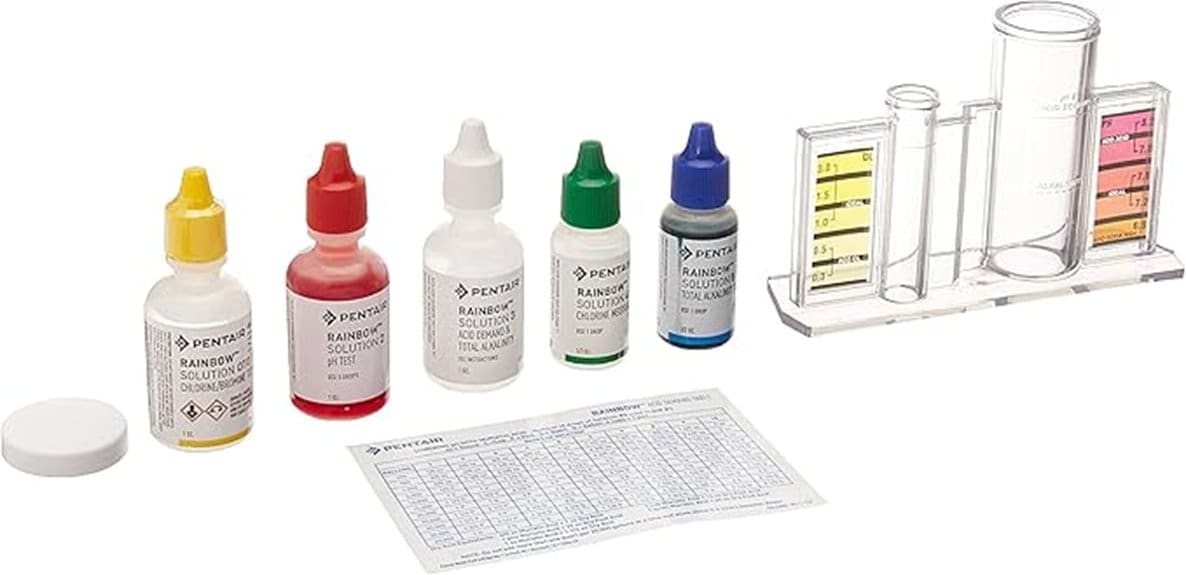
You’ll get a compact, pocketable all‑in‑one kit that measures free chlorine, pH, total alkalinity and acid demand for routine pool or spa care. It includes numbered reagents, a lucite test cell, a small reagent bottle and a color chart; reagents need cool storage. Tests are repeatable for household use though titrations can vary by ±20–30 ppm or ±0.5 pH with user error. It’s cost‑effective for maintenance; read on to see full usage tips and limits.
Some Key Takeaways
- Compact all-in-one water test kit ideal for routine pool or spa maintenance and small water features.
- Tests pH, free chlorine, acid demand, and total alkalinity with organized reagents and lucite cell.
- Provides consistent chlorine and pH results; alkalinity and titration have ±20–30 ppm or ±0.5 pH variability.
- Accuracy depends on reagent shelf life, lighting, drop precision, and user technique.
- Good budget option for routine checks; skip if lab-grade precision is required.
Quick Verdict: Who the Pen Test KIT All in One #78HR R151186 Is Best For
If you need a compact, all-in-one water test solution for routine pool or spa maintenance, the Pen Test KIT All in ONE #78HR R151186 fits the bill. You’ll appreciate its focused capability if you’re a small pool owner or a home gardeners who also keeps a water feature. You’ll test pH, free chlorine, acid demand and total alkalinity without excess gear. You’ll like the organized reagents and lucite cell for repeatable readings. You’ll carry it easily, perform methodical checks, and act on clear results. You’ll save time and reduce guesswork in routine maintenance. It’s especially useful for homeowners who use clarifiers to maintain clear pool water and improve backyard water features.
What’s Included and Key Specs (Reagents, Lucite Cell, Dimensions, Weight)
While compact, the Pen Test KIT All in ONE #78HR R151186 comes organized for immediate use: it includes reagents for free chlorine, pH, acid demand and total alkalinity (No.1–No.5 with a 1/2-oz No.4), a lucite test cell with wide standards for repeatable readings, a 1-ounce reagent bottle, a water test booklet, and a blue display box, all packaged in a unit weighing about 1.05 pounds and measuring roughly 0.75 x 1.16 x 1.25 inches. You’ll find clearly labeled reagent vials; note reagent shelf life is limited, so store cool. The lucite clarity aids visual matching; dimensions and weight make it pocketable. Many homeowners use digital pool testers and accessories to keep water balanced and enjoy their outdoor spaces, making this kit a handy complement for maintaining pool chemistry and water quality.
How to Use the Kit: Step-by-Step Testing for Chlorine, pH, Alkalinity, and Acid Demand
Start by gathering the kit, a clean sample container, and a towel; you’ll work on a stable surface with good light. Collect sample per booklet, fill lucite test cell to mark, then add chlorine reagent drops, cap, invert gently, wait prescribed time and compare color to chart. For pH, rinse cell, add pH reagent, mix, compare. Measure alkalinity with designated reagent sequence and tally drops; record result. For acid demand, follow titration steps adding reagent increments until endpoint color appears. Note that color blindness users should use careful lighting or digital conversion apps to read results accurately. Also make sure to follow recommended chlorine tablet storage and handling practices to keep your pool safe and sparkling.
Real-World Performance: Accuracy, Ease of Use, Durability, and Common Issues
Because you’ll rely on this kit for routine pool decisions, accuracy and repeatability matter more than convenience: the Pen Test KIT gives consistently reliable chlorine and pH readings within the expected colorimetric resolution for household testers, but alkalinity and acid-demand titrations require careful drop counting and steady hands to avoid ±20–30 ppm or ±0.5 pH-equivalent variability. You’ll monitor reagent shelf life; expired reagents skew results. Expect occasional sensor drift–style changes from batch variance, not electronics. User error dominates inaccuracies: poor lighting, imprecise drops, or contamination. Colorblind accessibility is limited; bring a friend or use a phone camera to compare hues. For homeowners maintaining outdoor pool areas, regular testing with simple pool water test kits is an essential part of seasonal pool care.
Buy or Skip? Pricing, Warranty, and Final Recommendation
If you need a basic, reliable pool test kit and you’re willing to trade lab-grade precision for affordability, the Pen Test KIT All in ONE #78HR is a sensible buy: it delivers consistent pH and chlorine readings at typical household resolution, includes all reagents and a lucite test cell, and weighs just over a pound for easy storage. You’ll pay less than digital alternatives; the pricing strategy targets budget-conscious owners who still want complete reagent sets. Warranty coverage is available through manufacturer support on request. Recommendation: buy if you need routine maintenance checks; skip if you demand lab accuracy. Many homeowners use pool test kits alongside regular maintenance tips to keep their outdoor water clear and safe.
Some Questions Answered
Can I Replace Individual Reagents Separately if One Runs Out?
Yes — you can replace reagents individually if one runs out. Check the supplier compatibility for Pentair R151186 reagents, match reagent numbers (No.1–No.5, acid/alkalinity) and volumes, and buy the specific bottle rather than a full kit. You’ll want to confirm concentration and expiration, keep original labeling, and source from authorized suppliers to guarantee accuracy. Store replacements per instructions to maintain test reliability and consistent results.
Are Reagent Expiration Dates Printed on the Bottles?
Yes — you’ll usually find reagent expiration dates printed on the bottles or their labels. Check each bottle for explicit expiration or manufacture dates; if none appear, look for shelf life labeling on the packaging or instructions. Because batch variability affects potency, note lot numbers and test reagents before use. If dates are missing or unclear, contact manufacturer support to confirm usable life and warranty coverage.
Is This Kit Suitable for Saltwater Pools or Spas?
Yes — you can use it for saltwater pools and spas, but test results may need interpretation for higher salinity. You’ll get free chlorine and pH readings suitable for salt systems; bromine readings won’t apply. Follow reagent expiration and storage guidance, and perform regular electrode maintenance on any electronic meters you pair with the kit to avoid salt corrosion. Calibrate frequently and rinse cells after saltwater testing to maintain accuracy.
Can Results Be Converted to Digital Logging or Apps?
You can’t directly export readings; this kit gives analog color-matching results, so you’ll need to digitize them for digital logging and app integration. Photograph strips or the lucite cell under consistent lighting, record values manually into a pool app, or use a color-reading accessory/scanner that maps colors to numbers. Maintain a calibration reference card, timestamp entries, and note reagent batch for accuracy when syncing to cloud-based loggers or apps.
Are Colorblind-Friendly Comparison Options Available?
Yes — you can adapt testing for color vision differences. Use high contrast swatches alongside the kit’s color chart and add tactile markers (like raised dots or textured tape) to reagent bottles and the lucite test cell positions. You’ll want to label swatches with bold outlines and numeric codes, document mappings in a log, and optionally photograph results with a color-correcting app for verification. These steps give reliable, accessible comparisons.