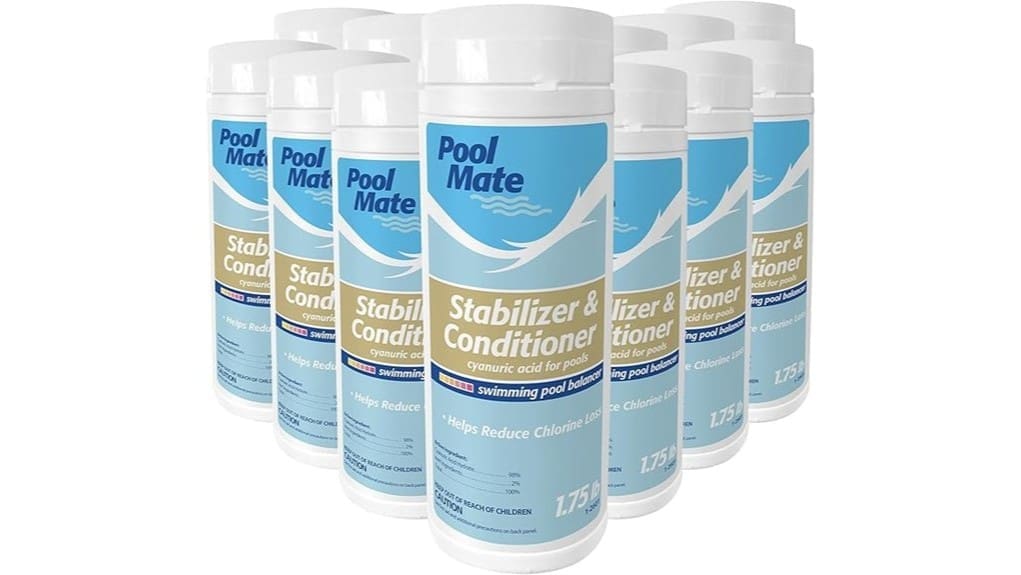
You’ll find Pool Mate Premium gives you predictable cyanuric acid control in a compact 12‑pack of 1.75‑lb sealed containers, each tamper‑evident and recyclable. It’s formulated to hold CYA in the 40–100 ppm range; 6 oz raises CYA 10 ppm per 5,000 gallons. Apply slowly to the skimmer or premix in warm water, run filtration 24 hours, then verify with a reliable test kit. It dissolves fully with circulation and lowers chlorine demand—keep reading for full dosing, safety, and comparison details.
Some Key Takeaways
- Granular cyanuric acid in twelve 1.75-lb sealed containers (21 lbs total) for predictable CYA maintenance in pools.
- Dosage: 6 oz raises CYA 10 ppm per 5,000 gallons; premix or add slowly to skimmer and run filter 24 hours.
- Full dissolution typically within 24 hours with continuous recirculation and a clean filter; premixing in warm water speeds it up.
- Maintains CYA at 40–100 ppm to stabilize chlorine, reduce chlorinator usage, and steady free chlorine (2.0–4.0 ppm).
- Safety: wear gloves and eye protection, avoid inhalation, keep dry, and verify CYA with reliable test kits after 24 hours.
Why Pool Mate Premium Is Worth Considering for Pool Stabilizer
Because maintaining effective chlorine levels hinges on controlled degradation, Pool Mate Premium Pool Stabilizer and Conditioner deserves consideration if you want reliable cyanuric acid management. You’ll measure and dose granular cyanuric acid precisely to maintain 40–100 ppm, improving chlorine longevity and reducing frequent shock cycles. You’ll compare cost comparison metrics against bulk alternatives, noting per-ounce price, packaging waste, and handling convenience. You’ll assess environmental impact: lower chlorine demand reduces chemical discharge, yet cyanuric persistence warrants controlled application and proper dilution. You’ll follow dosing protocols, guarantee full dissolution, and verify residuals with a reliable test kit for optimal, compliant results. Proper alkalinity balance supports overall water health and stability, so monitor total alkalinity alongside cyanuric acid to maintain balanced pool chemistry.
What’s in the Box: Key Specs, Packaging, and Brand Details
When you unpack a 12-pack of Pool Mate Premium Pool Stabilizer and Conditioner, you’ll find twelve 1.75-pound sealed containers of granular cyanuric acid (totaling 336 ounces) clearly labeled with the brand, model number (1-2601-12), UPC (034261124441) and ASIN (B0F7BQLXPY). You’ll also see country-of-origin (Made in USA), net weight (21 pounds), and concise usage icons. The packaging is durable, tamper-evident polyethylene with compact cartons for efficient palletization. Brand history is summarized on the label, emphasizing pool chemistry expertise. Packaging sustainability is addressed via recyclable cartons and minimized void fill to lower transport footprint. This product is suitable for homeowners who want to maintain outdoor pools and manage phosphate levels for clearer water.
How to Use Pool Mate Premium Safely and Get the Right Dosage
Start by testing and recording your pool’s current cyanuric acid (CYA), free chlorine, pH, and volume so you can dose precisely; Pool Mate Premium is granular cyanuric acid and must be added to reach a target CYA of 40–100 ppm, with 6 ounces raising CYA by 10 ppm per 5,000 gallons. For safe handling, wear gloves and eye protection, avoid inhalation, and keep product dry. Perform dosage calculation using pool volume: multiply required ppm increase by (6 oz/10 ppm) scaled to gallons. Add slowly to skimmer or premix in warm water, run filter continuously 24 hours, retest and adjust. Keep your pool balanced to protect chlorine efficacy and prevent algae growth by maintaining the proper stabilizer level cyanuric acid.
Real-World Performance: Stabilization, Chlorine Retention, and Dissolving Time
Having established correct dosing and safe handling, you’ll notice Pool Mate Premium delivers predictable stabilization and measurable chlorine retention in routine pool use. You’ll see stabilization speed depend on dissolution technique and circulation: premixing granules in warm water or adding slowly to the skimmer with the pump running accelerates attainment of target cyanuric acid (40–100 ppm). Expect full dissolution within 24 hours with continuous recirculation and a clean filter. Measured chlorine preservation is evident as reduced chlorinator consumption and steadier free chlorine (2.0–4.0 ppm) when CYA is maintained. Monitor with a reliable test kit to confirm performance. Homeowners who enjoy their outdoor spaces often prefer using chlorine tablets for ongoing sanitization and convenience.
Who Should Buy It and Alternatives to Compare
If you need predictable cyanuric acid control and reduced chlorine loss for a residential or small commercial pool, Pool Mate Premium is a practical choice because it delivers granular CYA that dissolves reliably and lets you maintain the recommended 40–100 ppm range with straightforward dosing. You should buy it if you’re an owner upgrading stabilizer management, managing multiple 5,000–20,000 gallon systems, or want rapid, measurable CYA adjustments without complex equipment. Budget conscious buyers will appreciate 1.75‑lb units and the 12‑pack for per‑ounce economy. Compare to liquid stabilizers and competing granular CYA by dissolution rate, dosing accuracy, and cost per ppm. Many homeowners use pool test strips to monitor CYA and chlorine levels regularly to keep their outdoor water safe and clear, so consider pairing stabilizer purchases with pool test strips for easy maintenance.
Some Questions Answered
Is Pool Mate Safe for Vinyl or Fiberglass Pool Liners?
Yes — you can use it with vinyl and fiberglass liners when dosed correctly. The cyanuric acid provides vinyl compatibility by stabilizing free chlorine, reducing aggressive chlorine spikes that can harm liners. You’ll maintain liner maintenance by keeping CYA 40–100 ppm, chlorine 2.0–4.0 ppm, and pH 7.4–7.6. Add slowly, dissolve fully, and recirculate 24 hours; monitor with a reliable test kit to avoid overconcentration.
Can Cyanuric Acid Harm Landscaping or Concrete if Spilled?
Yes — if cyanuric acid spills and concentrates, it can cause landscape discoloration and may contribute to concrete etching over time. You should neutralize and rinse spills immediately, remove contaminated soil or vegetation, and flush hard surfaces with plenty of water. Wear protective gloves and eyewear, avoid allowing runoff into storm drains, and monitor exposed areas for staining or surface degradation. Contact local waste guidance for disposal of residues.
Is This Product Pet-Safe if Animals Access Treated Water?
No — you shouldn’t consider it pet-safe for animals drinking treated pool water. Cyanuric acid itself has low acute toxicity, but concentrated granules and altered pool chemistry can irritate or stress pets; chlorine stabilization means residual chlorine persists longer, increasing pet exposure. Monitor pet exposure and prevent drinking. For wildlife impact, avoid spills and runoff; contaminated water can harm small animals and ecosystems. Rinse spills and follow label precautions.
Can Pool Mate Be Used With Saltwater Chlorine Generators?
Yes — you can use it with saltwater chlorine generators. Cyanuric acid provides saltwater compatibility by stabilizing free chlorine produced by the generator, reducing degradation from sunlight. You’ll monitor and maintain CYA within 40–100 ppm, adjust dosing per pool volume, and keep chlorine 2.0–4.0 ppm and pH 7.4–7.6. Follow generator maintenance guidelines, clean cells regularly, and guarantee proper circulation to avoid scale or performance issues.
Does Cyanuric Acid Affect Solar Pool Heating Efficiency?
Yes — cyanuric acid can slightly reduce solar efficiency if levels get very high. You’ll see modest heat-transfer loss as stabilizer builds up on surfaces or in solar panels’ plumbing. Heavy granular use can lead to filter clogging if not pre-dissolved and filtered properly, worsening flow and heat exchange. Maintain recommended 40–100 ppm, pre-dissolve or add slowly, keep filters clean, and guarantee proper recirculation to preserve solar efficiency.