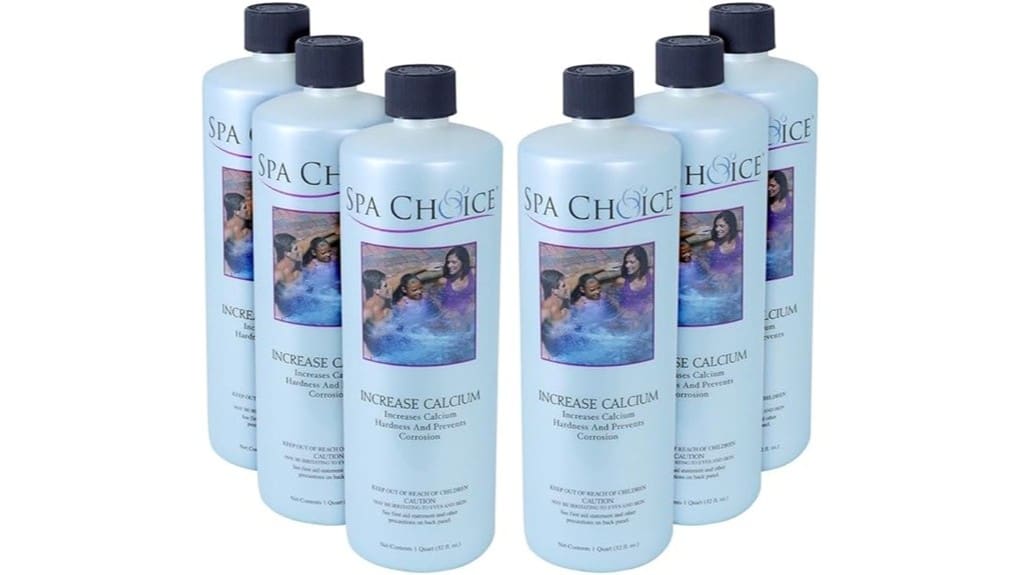
You’ll get a fast, predictable boost to spa calcium hardness with SpaChoice Premium Liquid. Test first, then add measured ounces—1 oz per 500 gallons typically raises hardness ~10 ppm and mixes in about 20 minutes with circulation. It supplies dissolved calcium to stop aggressive water and protect plaster, seals, and equipment. Liquid mixes more consistently than granules and is easier to dose. If you want practical dosing steps, comparisons, and packaging details, keep going.
Some Key Takeaways
- Raises calcium hardness predictably, typically ~10 ppm per ounce per 500 gallons for fast correction.
- Liquid formula mixes quickly, minimizing clumping and equipment risk compared to granular products.
- Measurable hardness changes usually occur within ~20 minutes with circulation and filter running.
- Recommended dosing: test first, calculate required ounces, add with pump on, retest before additional doses.
- Sold as a 6-pack (192 fl oz total) for cost-effective routine treatments and multi-spa maintenance.
How This Liquid Calcium Increaser Works and Who Should Use It
Because low calcium lets water become aggressive, SpaChoice Liquid Calcium Hardness Increaser supplies dissolved calcium ions that raise hardness to the recommended 200–400 ppm range, stabilizing water chemistry and protecting plaster, seals, and equipment from etching and corrosion. You’ll use it when tests show low hardness or during frequent water replacement. The liquid delivers measured calcium without relying on slow ion exchange processes in filters, helping restore mineral saturation quickly. You’ll pour the dose with circulation running, then run the filter 1–2 hours and retest. It’s practical for owners who need precise, fast corrections in spas and hot tubs. This product is ideal for homeowners who maintain outdoor water features and want to keep pool water balanced for durable surfaces and equipment.
Real-World Performance: Raising Hardness, Speed, and Results to Expect
Having restored calcium levels as described, you’ll want to know how quickly and reliably this liquid increaser works in real conditions. You’ll see rapid absorption into spa water; measurable increases occur within 20 minutes, with filter circulation helping distribute product evenly. Expect consistent elevation toward target 200–400 ppm when you follow dosage guidelines. Performance is predictable: 1 ounce per 500 gallons raises hardness ~10 ppm. In practice, small adjustments are needed for measurement error and water chemistry. Results minimize soft-water corrosion and plaster etching risks once levels stabilize. Recheck after initial circulation and again before making further additions. Maintaining proper stabilizer levels helps ensure long-term water balance and protects pool equipment, so monitor total alkalinity and stabilizer levels alongside calcium hardness.
How to Dose and Apply SpaChoice (Step-by-Step for Hot Tubs)
Start by testing your spa’s calcium hardness with a reliable kit or at a local dealer so you know how much to add; SpaChoice’s dosing guideline raises hardness about 10 ppm per ounce per 500 gallons, with a target range of 200–400 ppm. Follow this test procedure: measure current ppm, calculate ounces needed (desired rise ÷ 10 × gallons/500), and prepare the bottle. Turn pump and jets on, pour measured SpaChoice evenly around the spa, run filter 1–2 hours, and retest after ~20 minutes. Observe safety precautions: wear gloves, avoid contact with eyes, and store upright, sealed, away from children. Floating thermometers can help you monitor overall spa conditions, including temperature, while you manage chemical levels like calcium hardness—consider placing one in your spa for continuous temperature monitoring.
Pros, Cons, and How It Compares to Granular Alternatives
While liquid and granular calcium increasers both raise hardness, SpaChoice’s liquid formula gives you faster, more consistent mixing and easier dosing for routine hot tub maintenance. You’ll appreciate liquid convenience: pour measured ounces, run the pump, and avoid clumping. Pros: predictable ppm increase, minimal agitation, reduced risk of undissolved particles damaging equipment. Cons: larger shipping weight per bottle and slightly higher cost per ppm versus concentrated granules. Compared to granules, you won’t manage granule storage humidity or pre-dissolve batches. If you value straightforward application and consistent distribution, the liquid option simplifies regular maintenance and reduces dosing errors. Keeping overall pool alkalinity balanced helps protect surfaces and equipment by stabilizing calcium levels and preventing scale or corrosion, so monitor alkalinity alongside hardness and adjust as needed with alkalinity increasers.
Buying Details, Packaging, and When to Choose This 6‑Pack
When you’re stocking up, the 6‑pack of SpaChoice Premium Liquid Calcium delivers a full 192 fl oz so you can treat multiple routine balancings without frequent repurchasing; small spas will see long service life from one set, while commercial or multiple‑spa setups benefit from the consistent dosing and reduced handling compared with single bottles. You’ll get bulk savings versus individual quarts and a single SKU (472-3-3061-06) simplifies ordering. Check retail availability online and local dealers; consider storage considerations like cool, dry space and sealed caps. The pack makes a practical gift option for new spa owners. Many homeowners who enjoy their outdoor spaces prefer buying in bulk to streamline maintenance and reduce trips to the store, especially for pool opening chemicals.
Some Questions Answered
Is This Product Safe for Saltwater Hot Tubs?
Yes — you can use it in saltwater hot tubs, but watch corrosion concerns and marine compatibility. You’ll test calcium hardness first, calculate dose (1 oz per 500 gal ≈ +10 ppm), pour with equipment on, and run the filter 1–2 hours. Maintain ideal 200–400 ppm to reduce metal corrosion. If you have a salt chlorine generator or sensitive marine-grade components, consult your spa dealer to confirm compatibility with salt systems.
Does It Affect pH or Alkalinity Levels?
No, it won’t directly change pH or total alkalinity in normal use; you’re adding dissolved calcium to adjust hardness. Calcium kinetics can cause minor transient readings as ions equilibrate, but significant shifts in pH or alkalinity only occur if you overdosed or changed buffering capacity. Maintain proper water buffering (alkalinity) and test after dosing; adjust alkalinity/pH separately if needed. Follow dosage guidelines and retest after circulation.
Can I Use It With Ozone or Bromine Systems?
Yes — you can use it with ozone and bromine systems. The product shows ozone compatibility and won’t chemically neutralize ozone. It also won’t materially change bromine interactions, since it simply raises calcium hardness. You should test water after dosing and run circulation for 1–2 hours. Monitor bromine residual and adjust sanitizer if needed, and consult your spa dealer if you use advanced oxidation or combined sanitizer systems.
What Is the Shelf Life After Opening?
There’s no manufacturer-stated shelf life after opening, but you should expect 1–2 years if you store it properly. Keep bottles tightly closed, in a cool, dry place away from direct sunlight and heat (storage conditions). Check expiry indicators like changes in color, sedimentation, off-odors, or separation; if observed, discard. Label opened date on the bottle, use older stock first, and consult the manufacturer or your dealer for prolonged storage guidance.
Is It Safe for Acrylic or Vinyl Spa Surfaces?
Yes — you can use it on acrylic and vinyl spa surfaces; the formula raises calcium hardness without harsh abrasives, so surface compatibility is generally good. You should follow dosing instructions and dilute per directions to avoid localized concentrated contact. Check your spa manufacturer’s recommendations first, since improper chemical use could affect finish and may have warranty implications. Test water after treatment and consult your dealer for borderline conditions or concerns.