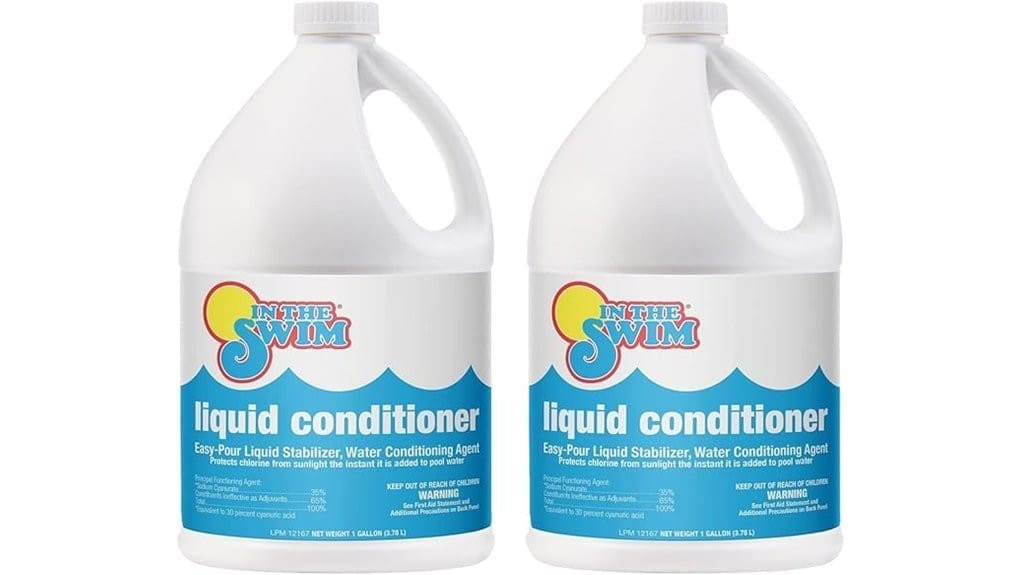
You’ll find In The Swim Liquid Conditioner gives fast, pH-neutral CYA stabilization and immediate UV protection, so your chlorine lasts longer with minimal fuss. It’s liquid, so it dissolves instantly, avoids grit, and won’t clog filters, though it’s heavier to handle than granular stabilizers. One gallon raises CYA about 32 ppm per 10,000 gallons for predictable dosing. It’s great for routine maintainers; keep circulating after application, and more details follow if you want specifics.
Some Key Takeaways
- Liquid conditioner provides fast, predictable CYA stabilization, raising CYA ≈32 ppm per gallon per 10,000 gallons.
- It dissolves immediately and pH-neutral formula minimizes alkalinity swings and residue.
- Surfactant-enhanced liquid disperses faster than granular stabilizers, reducing filter-clogging risk.
- Offers immediate UV protection to slow chlorine breakdown, with consistent real-world dosing performance.
- Downsides: heavier handling, higher per-ppm cost, and less portable than granular alternatives.
Quick Verdict: Is In The Swim Liquid Conditioner Worth Buying?
Although it’s liquid rather than granular, In The Swim Liquid Conditioner gives you fast, reliable CYA stabilization—so if you want quick, no-mess protection that won’t upset pool chemistry or clog filters, it’s worth buying. You’ll appreciate immediate UV protection and consistent CYA boosts—one gallon raises levels ~32 ppm per 10,000 gallons—so dosing is predictable. Stability comparison versus granules favors faster integration and less filter risk. User testimonials note ease of use and fewer dosing errors. If you need straightforward, pool-safe stabilization with minimal cleanup, this product delivers predictable performance without complicating routine maintenance. Homeowners who enjoy their outdoor spaces often pair conditioners with pool clarifiers to maintain clear water and enhance overall pool appearance, making regular maintenance simpler and more enjoyable for homeowners.
How It Works and What’s in the Bottle (Fast-Dissolving Formula, pH-Neutral CYA)
When you add In The Swim Liquid Conditioner to your pool, its fast-dissolving, liquid CYA formula disperses immediately and begins protecting chlorine from UV breakdown without changing your water’s pH. You’ll get a pH neutral cyanuric acid solution that’s designed to stabilize chlorine while avoiding alkalinity swings. The surfactant enhanced mix helps the product spread faster than dry stabilizers, reducing application time and eliminating dust or residue. Ingredients focus on stabilized CYA in liquid carrier with wetting agents; there’s no grit to clog filters. Objectively, it’s a convenient, low-impact way to introduce cyanuric acid into pool water. Many homeowners use solar covers to further reduce heat loss and chemical degradation by limiting sun exposure to the water surface, improving overall pool efficiency and maintenance with solar covers.
Real-World Performance: Raising CYA, UV Protection, and Ease of Use
Because the liquid formula dissolves immediately and carries a surfactant to speed distribution, you’ll see measurable CYA changes quickly and get UV protection to start working right away. In your pool, rapid dissolution means one gallon raises CYA about 32 ppm per 10,000 gallons, so dosing is predictable. UV shielding begins on contact, reducing chlorine loss without altering pH. Application is straightforward: pour and circulate; you won’t deal with dust or filter-clogging residue. Backyard testing matched label claims for small and medium pools, showing consistent stabilization and easy handling for routine maintenance and startup dosing. Many homeowners use flocculants and related products to keep clearer pool water and maintain outdoor enjoyment.
Pros, Cons, and Who Should (or Shouldn’t) Use This 2-Pack
If you want reliable, fast-acting stabilization without dust or residue, this 2-pack delivers predictable CYA increases and immediate UV protection in a convenient, easy-pour format. You’ll appreciate easy application, consistent dosing, and pool maintenance simplicity; the liquid format speeds treatment versus granules. Pros: pH-neutral chemistry, minimal residue, good chemical compatibility, and bulk value. Cons: liquid handling weight, limited portability, and needing measured dosing for large volumes. Who should use it: regular maintainers wanting quick stabilization and sensible seasonal storage. Who shouldn’t: hobbyists avoiding liquids, those with strict transport limits, or users unsure about user safety handling. This product pairs well with pool solar blankets to help retain the heat and chemicals your pool needs.
Buying Guide: Dosing, Storage, Price Considerations, and Where to Buy
Now that you know who this 2-pack suits, let’s look at practical buying details you’ll care about: how to dose it accurately, safe storage and handling, how price compares to granular stabilizers, and the best places to purchase. Dose: 1 gallon raises CYA ~32 ppm per 10,000 gallons; measure your volume and add proportionally, pouring near return jets for fast dispersion. Follow storage tips: keep sealed, upright, away from heat and direct sunlight, out of reach of children. Pricing trends favor liquid for convenience though per-ppm cost can be higher than granular. Buy from In The Swim, major retailers, or Amazon. Store pool chemicals in cool, shaded areas and use approved chemical storage containers to keep them safe and organized.
Some Questions Answered
Is This Liquid Conditioner Safe for All Types of Pool Liners?
Yes — you can use it with most liners; the product’s pH-neutral, pool-safe formula minimizes risk of liner compatibility issues. You’ll avoid material degradation when applied per directions, since it’s fast-dissolving and nonabrasive. Still, you should test a small area or consult your liner manufacturer for rare or specialty materials. If you notice discoloration or softening, stop use and contact the seller or manufacturer for warranty guidance and compatibility confirmation.
Can I Use It With Saltwater Chlorine Generators?
Yes — you can use it with saltwater chlorine generators. The liquid conditioner is saltwater compatible and won’t upset mineral balance when dosed per instructions. It helps reduce cell scaling by stabilizing cyanuric acid without leaving residue. That said, follow your generator warranty terms and manufacturer’s dosing guidance; keep CYA within recommended ranges and monitor mineral balance to avoid long-term impacts on the cell and system performance.
Does It Affect Chlorine Test Kit Readings?
No — it won’t cause chlorine interference or skew test accuracy. You’ll find the pH-neutral, liquid stabilizer doesn’t react with free chlorine or common test reagents, so colorimetric and electronic kits remain reliable after proper mixing. To guarantee best results, wait until the conditioner is fully dispersed and retest; high cyanuric acid can mask weak chlorine, so keep CYA within recommended ranges for accurate free chlorine readings.
Is the Product Safe to Handle Without Gloves?
You can handle it with care, but you shouldn’t assume gloves are unnecessary — skin irritation is possible with concentrated pool chemicals. The pH-neutral, fast-dissolving formula is pool-safe, yet you’ll reduce risk by wearing gloves and eye protection during pouring. Store upright, sealed, in a cool, ventilated area away from children and sunlight for protective storage. If contact occurs, rinse thoroughly and seek medical advice for persistent irritation.
Can Leftover Product Be Poured Down Household Drains?
No — you shouldn’t pour leftover product down household drains. For environmental disposal, follow local hazardous-waste guidelines or contact your municipality; the stabilizer can affect waterways despite being pool-safe. Also consider plumbing impact: concentrated chemicals can corrode seals or upset septic systems. You’ll want to dilute small amounts and take larger quantities to a proper disposal facility or hazardous-waste collection event to minimize environmental and plumbing risks.