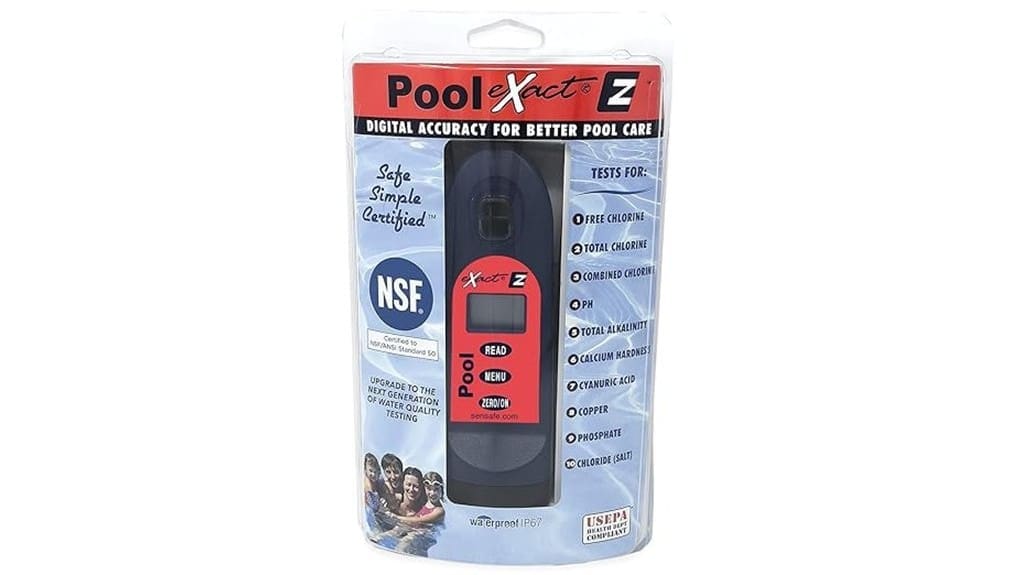
You’ll get a rugged, entry-level photometer that gives repeatable, auditable pool-water readings without color matching, ideal for homeowners and small commercial operators or new pool techs. It uses premeasured reagent foils that snap to a strip, requires timed exposure and rinses, and auto-calibrates for traceable results across chlorine, pH, alkalinity, hardness, cyanuric acid, phosphate, salt, and metals within stated ranges. It ships with QC docs, a two-year warranty, and setup/testing steps—more specifics follow.
Some Key Takeaways
- Reliable digital photometer offering accurate, repeatable pool chemical readings without subjective color matching.
- Covers essential parameters: free/total chlorine, pH, alkalinity, calcium, cyanuric acid, phosphate, salt, and copper.
- Uses premeasured reagent foils and timed strips for consistent sample volume and absorbance-based digital results.
- Suited for homeowners and small-commercial operators prioritizing compliance, traceability, and QA documentation.
- Slightly higher upfront cost than entry-level kits but includes warranty, QC documentation, and rugged field durability.
Which Buyers Is the ITS 486201 Pool eXact EZ Photometer Best For?
If you’re managing a residential or small commercial pool and need reliable, repeatable water readings without color matching, the ITS 486201 is built for you. You’ll find it suits homeowners with moderate pools and new pool operators who require compliance-focused results. Follow procedure: unbox meter, verify six reagent foils per parameter, calibrate per manual, sample and run tests for free chlorine, total chlorine, pH, alkalinity, hardness, cyanuric acid and others within stated ranges. You’ll record digital readings, compare to regulatory or maintenance targets, and act on deviations. Warranty and QC documentation support routine operational checks. Homeowners can use simple maintenance practices to keep pool water clear and interpret photometer results within a regular care routine.
How the eXact Strip System and Photometer Work Together
The eXact Strip system pairs premeasured reagent foils with the digital photometer so you can run precise, repeatable tests without subjective color matching: you snap a reagent foil onto the strip, expose it to the pool sample per the instructions, then insert the strip into the meter which reads absorbance and converts it to a digital concentration within the stated detection ranges. You follow timed exposure and rinsing steps; strip mechanics guarantee consistent reagent volume and optical path. The meter performs automatic sensor calibration against internal references at power-up and periodically during use, so your results remain traceable, auditable, and compliant with stated performance. This streamlined approach makes maintaining ideal outdoor water conditions simple for homeowners who use digital pool testing tools like those sold on our site and other specialty retailers, especially when monitoring pool water.
Measurement Coverage and Accuracy: What This Kit Actually Tests
Review the kit’s analyte list and detection ranges to know exactly what you’ll get: the ITS 486201 measures free, combined, and total chlorine (0.00–12.0 ppm), pH (6.4–8.4), total alkalinity (10–200 ppm), calcium hardness (20–700 ppm), cyanuric acid (1–110 ppm), phosphate (0.2–3.0 ppm), chloride/salt (80–6700 ppm), and copper (0.00–9.0 ppm). You’ll verify coverage against your regulatory or maintenance requirements, note any test limitations (e.g., upper/lower bounds), and plan confirmatory methods if needed. Maintain calibration needs per manufacturer schedule, keep reagents sealed, and document results and QC checks to demonstrate compliance and traceability. These kits are ideal for homeowners who want to keep their outdoor pool water safe with simple test kits pool water safety.
Real-World Setup, Testing Steps, and Time-Per-Test
When you unpack the ITS 486201, lay out the photometer, cleaning brush, and sealed reagent foils on a clean, level surface and confirm the lot numbers and expiration dates against your records before testing. You’ll perform sample preparation by rinsing the cuvette, collecting pool water mid-depth, and filling to the marked line. Insert the foil strip per instructions, wait the prescribed reaction time, then read the digital result. Typical cycle: 1–2 minutes setup, 2–5 minutes reaction depending on parameter, 30 seconds read/reset. The kit’s compact case supports field portability for routine compliance checks. This is particularly useful for homeowners managing pool opening chemicals to ensure safe, sparkling water before regular use.
Durability, QA, Warranty, and Value Compared to Entry-Level Alternatives
Because you’ll likely use this kit in varied pool environments, ITS designs the photometer and accessories for rugged field handling and repeatable performance under Good Manufacturing Practices. You’ll inspect build quality on receipt; reject damaged items per QC instructions and document serial/model. Follow the instruction booklet for routine cleaning and reagent handling; calibrated standards and in-process checks reduce drift. Warranty coverage is two years from purchase; file claims with provided proof and contact customer support for troubleshooting. Compared to entry-level alternatives, this kit trades slightly higher upfront cost for documented QA, reproducible results, spare reagent supply, and clearer compliance traceability. This setup also supports improved outdoor living by integrating with common pool pump installation workflows on homeowner properties.
Some Questions Answered
Does the Meter Require Calibration by the User?
No, you don’t need to perform routine user calibration; the meter ships with factory calibration and is ready to use. You should, however, follow the instruction booklet for verification steps, use supplied reagents, and run occasional check tests to confirm readings. If you suspect drift or damage, contact support for recalibration or replacement. Maintain clean optics, store reagents properly, and document any out-of-spec results per quality procedures.
Can I Test Spa/Saltwater With These Reagents?
Yes — you can test spa water and saltwater, but check for salt interference. Use the designated reagents and follow the instruction booklet for sample volume and timing. Rinse the cuvette and brush between tests, and run controls if results seem off. For high-salt pools or spas, verify chloride and salt-range limits (80–6700 ppm) and watch for potential salt interference with copper and chlorine readings. Keep records for compliance.
Are Replacement Reagent Foils Sold Separately?
Yes — replacement reagent foils are available for purchase so you can maintain testing supplies. Order the specific foil packs matching each test type and keep usage records for compliance. When replacing, follow manufacturer instructions for installation and calibration checks. Dispose of used foil pouches per local regulations and foil disposal guidelines in the manual; don’t mix reagents with regular waste. Retain receipts and lot numbers for warranty and traceability.
Is the Device Compatible With Mobile Apps or Bluetooth?
No — you won’t get mobile compatibility or bluetooth pairing with this unit. Check the user guide to confirm firmware limits, then follow compliance steps: 1) Do not attempt aftermarket modules that could void warranty. 2) Use the digital photometer standalone per instructions. 3) For remote logging or app integration, document requirements and contact ITS support for approved solutions. 4) Keep records proving you followed manufacturer guidance.
What Is the Shelf Life of Unopened Reagent Foils?
Unopened reagent foils typically have a shelf life of 2 years. You should store them in a cool, dry place away from direct sunlight and extreme temperatures; label storage conditions and lot/date on receipt. Implement expiry tracking by recording manufacture and expiry dates in inventory, rotating stock FIFO, and rejecting foils past expiration. If storage conditions are compromised, quarantine and verify reagent integrity before use.