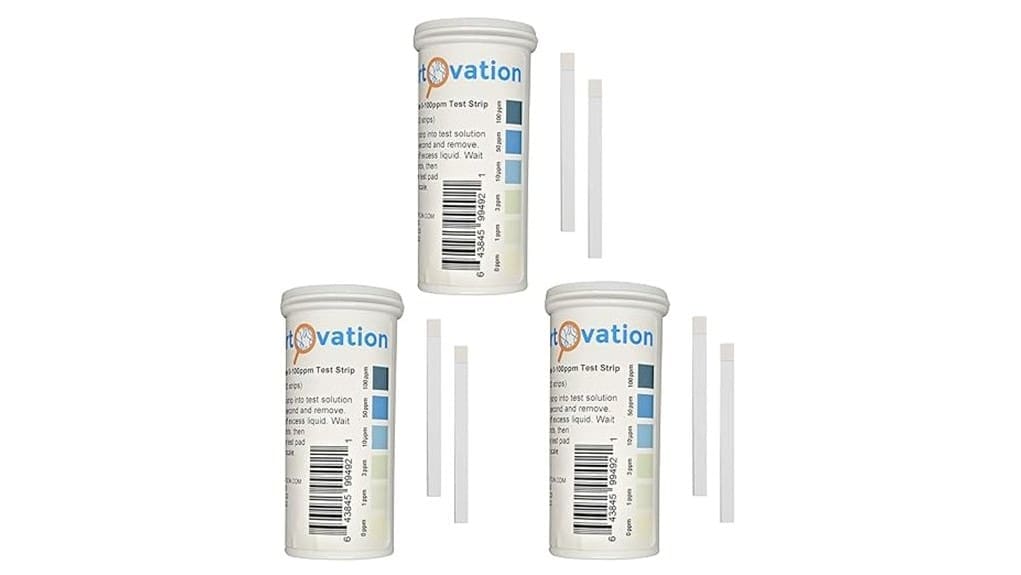
You’ll get fast, on-site H2O2 readings from 0–100 ppm with these dip strips; just dip briefly and match the pad to printed calibration shades at 0, 1, 3, 10, 50, and 100 ppm. They’re cheap, instant, and good for pools, spas, or treated drinking water, but lighting, contaminants, and oxidizers can skew results so confirm critical readings with lab tests. Store bottles sealed and cool; keep controls handy for session checks—more practical tips follow.
Some Key Takeaways
- Fast, low-cost colorimetric strips provide instant H2O2 readings from 0 to 100 ppm with calibration marks at 0,1,3,10,50,100 ppm.
- Best for routine pool, spa, and treated drinking water screening but not a substitute for lab-grade quantitative methods.
- Accuracy depends on immediate visual matching, lighting, water temp, and contaminants; retest with fresh strip if results seem off.
- Cross-reactivity with strong oxidizers or residual chlorine can skew readings; confirm borderline or critical results with lab or calibrated meters.
- Pack of three 100-strip bottles offers convenience and savings; store sealed in a cool, dry, dark place to preserve sensor lifespan.
How the Bartovation H2O2 0–100 Ppm Test Strips Work and What’s in the Box
Grab a strip, dip it briefly in the water, and read the result in seconds—the Bartovation H2O2 0–100 ppm strips use a colorimetric reagent that turns progressively blue as hydrogen peroxide concentration rises, with calibration points at 0, 1, 3, 10, 50, and 100 ppm for quick visual comparison. You’ll observe a chemical reaction on the pad; more intense blue signals higher H2O2. The packaging contents include three bottles of 100 strips each (300 total), instructions, and safety notes. You should follow handling guidance, avoid contaminating strips, and store bottles sealed to preserve accuracy and safety. These testers are ideal for homeowners who want to keep pool water safe and well-balanced while enjoying their outdoor spaces.
Quick Accuracy Check: Calibration Points, Color Scale, and Real-World Test Results
While you’re using the Bartovation H2O2 0–100 ppm strips, quickly verify accuracy by checking the pad color against the printed calibration points (0, 1, 3, 10, 50, 100 ppm) immediately after dipping; the pad should develop progressively deeper blue with higher peroxide and match one of those reference shades within seconds. You should perform a brief color calibration check each session to confirm readings. Note field variability from lighting, water temperature, and contaminants; if results seem off, retest with fresh strip and known control. Record discrepancies, discard questionable strips, and prioritize safety when elevated H2O2 is detected. Homeowners often rely on simple test kits to monitor their outdoor pool water safety and quality.
Use Cases and Step-by-Step How to Test Pools, Spas, and Drinking Water
When testing pools, spas, or drinking water with the Bartovation H2O2 0–100 ppm strips, you’ll follow a simple, safety-focused routine: collect a representative sample, dip the strip for the recommended time, compare the pad to the printed calibration shades (0, 1, 3, 10, 50, 100 ppm) immediately, and act on any elevated readings by retesting and reducing exposure until levels return to safe ranges. Use cases include routine pool maintenance checks after shock treatments, spa turnover monitoring, and tap testing for peroxide-treated municipal or well water. Record results, follow corrective actions, and retest to confirm safe peroxide levels. For homeowners maintaining outdoor water features, incorporating regular chemical testing is an essential part of pool opening preparation and ongoing care.
Pros, Cons, and Reliability Compared to Other Peroxide Test Methods
Although colorimetric test strips trade some precision for speed and convenience, they give you a fast, on-site screen for hydrogen peroxide that’s ideal for routine checks of pools, spas, and drinking water. You’ll appreciate instant results, low cost per test, and no instruments to calibrate; sensor lifespan is effectively the unopened strip life and on-bottle expiry. Downsides: limited resolution versus lab titration or electrochemical meters, and cross reactivity concerns with strong oxidizers or residual chlorine can skew readings. For safety, use strips for regular monitoring and confirm critical or borderline results with a quantitative lab method or calibrated meter. Homeowners who enjoy outdoor spaces will find these strips especially useful for maintaining safe pool and spa water with routine monitoring.
Who Should Buy These Strips and Practical Buying Tips (Quantity, Storage, Cost)
If you need quick, on-site checks of residual hydrogen peroxide in pools, spas, or drinking water, these strips are a practical choice because they deliver fast visual results without instruments. You should buy them if you manage multiple pools, run a spa service, or monitor household drinking water and want simple pass/fail screening. Buy the 3×100 pack to avoid frequent reorder; bulk storage needs cool, dry, sealed conditions away from sunlight to preserve reagents. Plan purchase timing ahead of heavy-use seasons. Consider cost per strip versus lab testing; use strips for routine checks and confirm anomalies with professional analysis. These strips pair well with automatic pool vacuums for maintaining clean, relaxing outdoor living spaces.
Some Questions Answered
Are These Strips Safe for Children to Handle?
Yes — the strips are generally safe to handle, but child safe handling means you shouldn’t let kids use them unsupervised. They’re low-risk paper strips that change color with peroxide, yet chemicals and small pieces can irritate or be swallowed. Supervision recommended whenever children are present: keep bottles capped, store out of reach, instruct kids not to taste or touch their faces after handling, and wash hands thoroughly after use.
Do the Strips Detect Stabilized Peroxide or Only Free H2O2?
They detect free H2O2, not stabilized peroxide. You should assume stabilized peroxide can cause test interference and yield lower or misleading readings because stabilizers alter the reactive chemistry the strip measures. For safety, handle strips with care and avoid testing immediately after adding stabilized peroxide—wait and follow product instructions. If stabilized peroxide is present, consider lab confirmation or a method validated for stabilized peroxide to guarantee accurate, reliable results.
Can I Use Strips in Saltwater or Chlorinated Pools?
Yes — you can use the strips in saltwater or chlorinated pools, but you’ll need to account for interferences. For accurate pool testing, rinse the strip, dip briefly, and compare color quickly; strong chlorine or other oxidizers can skew Marine compatibility readings by producing false positives. If chlorine is present, consider neutralizing it or testing a separate sample. Always follow safety procedures and verify unexpected high readings with a secondary method.
What Is the Strips’ Shelf Life After Opening a Bottle?
You should use strips within 6–12 months after opening if stored properly. Keep bottles tightly sealed, away from heat, sunlight, and humidity — ideal storage conditions are cool, dry, and dark. Watch for expiration indicators: faded or inconsistent color reactions, damaged or discolored strips, or a changed chemical odor. If any indicator appears, discard remaining strips and replace them to guarantee accurate, safe peroxide readings.
Are Replacement Color Charts or Bottles Available Separately?
Yes — you can get replacement charts and chart replacements separately from the manufacturer or authorized dealers. Check Bartovation’s website or contact customer service with your model (PPX02V100-ML) and UPC to request replacement color charts or extra bottles. Keep charts dry and laminated if possible, and store strips per instructions to make certain accurate readings. If you suspect degradation, replace charts and strips immediately for safety.