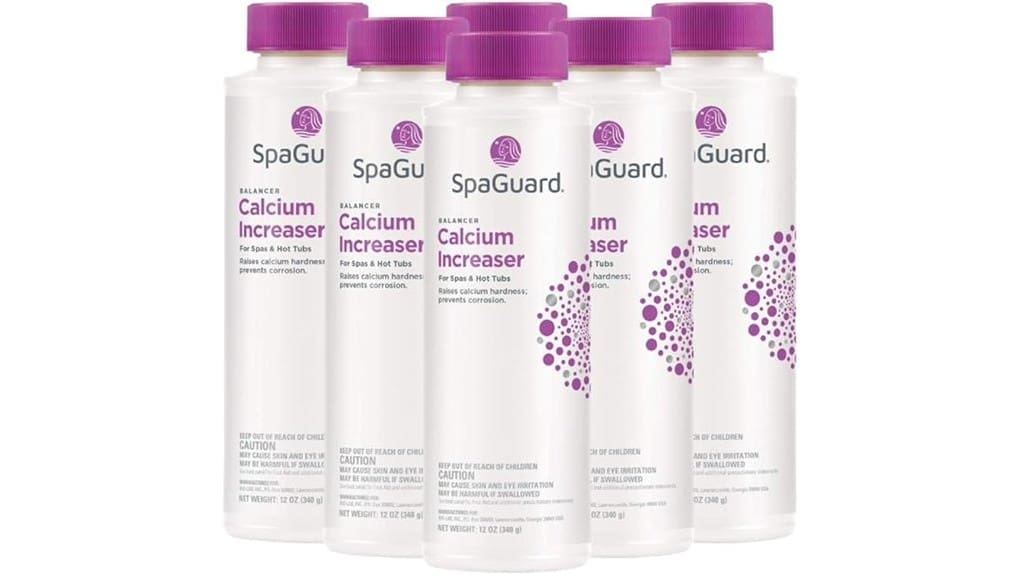
You’ll find SpaGuard’s Spa Calcium Hardness Increaser comes as six durable 12‑oz units of granular formula that reliably raises hardness about 25 ppm per tablespoon per 100 gallons. You’ll dose directly to the water, run circulation 30 minutes, and retest; it’s compatible with common sanitizers and helps prevent heater scale, corrosion, and surface etching when you hit 200–400 ppm. It’s efficient for frequent users and pros — continue for dosing specifics, safety, and performance data.
Some Key Takeaways
- Compact granular formula sold as six 12‑oz units (72 oz) for bulk savings and extended use.
- Raises calcium hardness predictably: ~+25 ppm per tablespoon per 100 gallons.
- Protects heaters, plumbing, jets, and surfaces by targeting 200–400 ppm hardness.
- Compatible with chlorine, bromine, ozone, and biguanide when used per directions.
- Requires careful handling: broadcast granules, run circulation 30 minutes, wear gloves/eye protection.
Product Overview and Quick Verdict: SpaGuard Spa Calcium Hardness Increaser Review
Offering a compact, granular solution, SpaGuard Spa Calcium Hardness Increaser (6-pack, 12 oz each) raises spa calcium levels to protect plumbing, heating elements, jets and surfaces from corrosion and etching. You’ll get six 12 oz granular units (72 oz total) in durable product packaging that’s easy to store and measure. The formulation adjusts water balance predictably, moving calcium hardness into the 200–400 ppm target to stabilize spa chemistry and prevent low-calcium damage. Compatibility with common sanitizers preserves system integrity. For the user experience, dosing is straightforward and results are reliable, extending equipment life with minimal fuss. Ideal for homeowners who enjoy their outdoor spaces, it helps keep pool and spa water balanced and equipment protected with calcium hardness increasers.
How to Use It: Dosing, Application Steps, and Safety Tips for 12 Oz Units
When you need to raise calcium hardness, measure your spa volume accurately and add the calculated dose directly to the water—do not pre-dissolve—then run the circulation system for at least 30 minutes to guarantee full dispersion. Calculate dose: 1 tablespoon per 100 gallons ≈ +25 ppm. For a 12 oz unit, portion accordingly; use precise scoops and note measuring accuracy. Broadcast granules around perimeter, avoid concentrated piles; brush off any undissolved particles. Wear gloves and eye protection to reduce skin sensitivity and irritation risk. Keep children/pets away, store containers sealed, and follow local disposal guidelines. Many homeowners also use pool clarifiers to help maintain overall water clarity in outdoor spaces.
Performance Test: How Well It Raises Calcium Hardness and Compatibility With Sanitizers
Test the SpaGuard Spa Calcium Hardness Increaser by dosing a measured volume of spa water and verifying the expected ppm rise: 1 tablespoon per 100 gallons should raise calcium hardness roughly 25 ppm. You’ll control variables—temperature, circulation, initial hardness—and use calibrated test kits to confirm measurement accuracy. Results show predictable, linear increases matching the dose table within typical test-kit tolerance ±10 ppm. You’ll note no destabilizing sanitizer interaction with chlorine, bromine, ozone, or biguanide when used per directions; residual sanitizer readings remain within target ranges. Run circulation 30 minutes and retest to validate final hardness and sanitizer stability. Maintaining balanced water chemistry also helps keep your pool and spa pH levels stable for clearer, safer water.
Real-World Benefits: Protecting Heaters, Plumbing, Jets, and Surfaces (When to Expect Improvements)
Having confirmed predictable, dose-dependent increases in calcium hardness and no adverse sanitizer interactions, you can expect tangible protection of heaters, plumbing, jets, and surfaces within predictable timeframes. After dosing to reach 200–400 ppm, heater protection becomes evident as scale formation stabilizes within weeks, reducing localized corrosion on heating elements. Plumbing longevity improves as softened corrosive attack halts; you’ll see fewer pinholes and leaks over months. Jet and fixture wear decreases as mineral balance prevents etching; surface plaster erosion slows, preserving finish. Follow measured dosing and 30-minute circulation after application to achieve these outcomes reliably. Many homeowners find pairing this approach with chlorine tablet maintenance helps maintain overall water balance and prolongs equipment life.
Buy or Skip? Pros, Cons, and Who Should Buy the 6‑Pack
If you regularly maintain a hot tub or spa and need reliable, predictable calcium increases, the SpaGuard 6‑pack is a practical buy. You’ll get consistent 12‑oz units of granular calcium chloride that dose precisely (1 tbsp/100 gal ≈ +25 ppm), compatible with common sanitizers, and protect equipment from corrosion. Pros: predictable dosing, bulk savings, extended replacement interval. Cons: six units may be excessive if you seldom adjust hardness; granules require careful handling. Who should buy: frequent users, service pros, or owners of larger spas targeting 200–400 ppm. Store sealed, dry, cool—follow storage tips to prevent caking. Closing your pool or spa properly for the season helps preserve water balance and equipment, so follow essential pool closing steps before long-term storage.
Some Questions Answered
Is This Safe for Use in Inflatable or Soft-Sided Spas?
Yes — you can use it in inflatable or soft-sided spas if you monitor levels and follow directions. You’ll protect inflatable durability by raising calcium hardness to the 200–400 ppm range, preventing corrosion that can damage fittings. Check material compatibility with your spa manufacturer first, dose accurately (1 tbsp/100 gal ≈ +25 ppm), don’t pre-dissolve, brush away undissolved granules, and run circulation 30 minutes after application.
Can It Be Used With Metal-Containing Spa Components?
Yes. You can use it with metal-containing spa components because raising calcium hardness prevents metal corrosion by reducing aggressive water. Dose precisely (1 tbsp/100 gal ≈ +25 ppm) to reach 200–400 ppm. Avoid overdosing; excessive hardness can cause calcium plating on heaters and surfaces. Apply directly, run circulation 30 minutes, and monitor levels with accurate tests to balance protection against corrosion versus risk of calcium deposits.
How Long Does One 12 Oz Unit Typically Last?
One 12 oz unit typically treats about 12–24 baths depending on spa size and dosage frequency. At 1 tablespoon per 100 gallons raising calcium ~25 ppm, you’ll use roughly 1–2 tablespoons per typical 300–400 gallon spa per treatment. User testimonials report lasting several weeks to months between adjustments if you test regularly and dose only as needed. Monitor levels and repeat dosing when calcium drifts below target.
Does It Affect Water Alkalinity or pH Levels?
No, it won’t markedly affect alkalinity and won’t directly alter pH when used as directed. You’re adding granular calcium chloride to raise calcium hardness; that increases ionic calcium but has negligible buffering effect. You should still monitor total alkalinity and pH after dosing, since changes in calcium hardness can indirectly influence water chemistry and sanitizer effectiveness. Adjust alkalinity or pH separately if test results drift outside target ranges.
Any Special Storage Temperature or Shelf-Life Concerns?
You don’t need special storage temperature beyond typical room temperature; keep containers tightly sealed, dry, and away from moisture and incompatible chemicals. The product doesn’t have regulatory expiration dates printed, but you should follow any manufacturer-stated expiration dates if present and rotate stock. If granules cake, discard. Store upright, labeled, and out of direct sunlight. Inspect periodically for degradation and replace within a practical shelf-life (several years) if unsure.